Why Skilled Trades Continue to Outperform Four-Year Degrees
Skilled trades are reshaping the future of work. Discover why careers in beauty, wellness, and the trades are outperforming many four-year degrees in the latest feature from Beauty Spot Magazine.

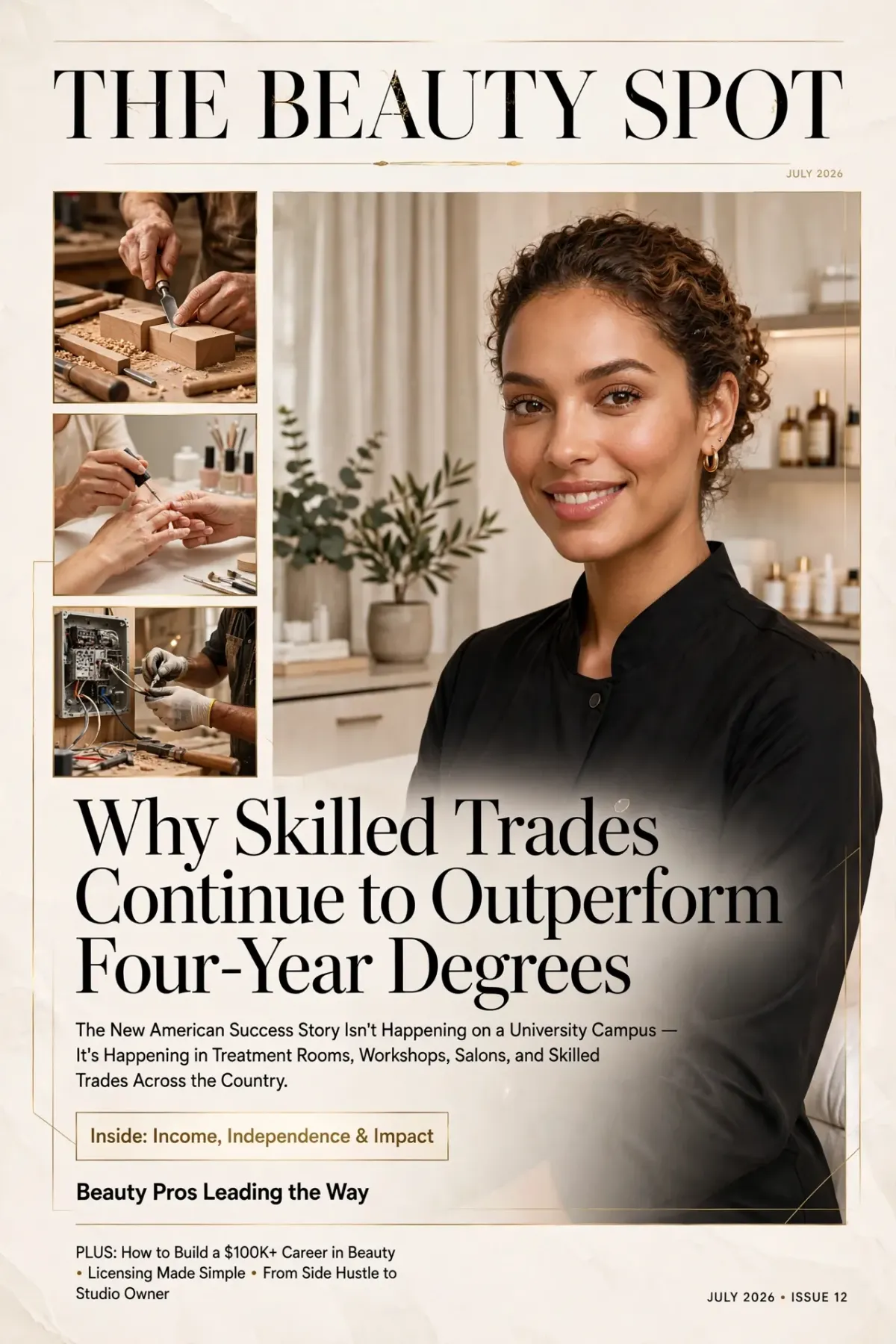
The New American Success Story Isn't Happening on a University Campus—It's Happening in Treatment Rooms, Workshops, Salons, and Skilled Trades Across the Country.
For generations, America sold a single version of success: graduate from high school, earn a four-year degree, find a corporate job, and build a stable life. It was a formula repeated by parents, guidance counselors, politicians, and employers alike. College wasn't simply presented as an option—it became the expectation. Yet as tuition costs soared, student debt reached historic levels, and the labor market evolved faster than universities could adapt, that once-reliable roadmap began to fracture.
Today, a different reality is emerging. Across the United States, skilled trades are experiencing unprecedented demand while employers struggle to fill essential positions. Electricians, welders, HVAC technicians, plumbers, automotive specialists, cosmetologists, estheticians, medical assistants, and advanced beauty professionals are entering careers with lower educational debt, faster workforce entry, and in many cases, stronger long-term earning potential than graduates holding traditional bachelor's degrees.
This isn't a rejection of higher education. It is a reassessment of value.
The conversation is no longer about whether college is worthwhile. The question has become whether it is the best investment for every student.
The answer, increasingly, is no.
The Cost of the Traditional Promise
For decades, higher education operated under one assumption: more education automatically translated into more opportunity. While that remains true in highly specialized professions such as medicine, engineering, and law, the equation has become far less predictable for many other fields.
The average student now graduates with tens of thousands of dollars in debt before earning their first paycheck. Many enter competitive job markets where entry-level positions require years of experience despite demanding expensive credentials. Others discover their degree offers little advantage in industries transformed by automation, artificial intelligence, or shifting economic priorities.
Meanwhile, student loan payments often delay milestones once considered part of adulthood—buying a home, starting a business, investing, or building retirement savings.
The opportunity cost has become impossible to ignore.
Skilled Trades Are Experiencing a Renaissance
While universities continue producing graduates in saturated fields, America's skilled workforce is aging. Millions of experienced tradespeople are retiring, leaving behind critical shortages that affect nearly every sector of the economy.
Construction companies cannot hire enough electricians.
Manufacturers need precision machinists.
Healthcare systems need certified technicians.
Luxury spas are searching for experienced estheticians.
Medical aesthetics practices compete aggressively for licensed professionals with advanced treatment knowledge.
The labor shortage is no longer temporary. It is structural.
For young professionals willing to master specialized skills, that shortage represents opportunity.
Unlike many office careers that compete globally through remote work, skilled trades remain deeply local. A licensed esthetician cannot outsource a facial to another country. A plumber cannot repair a broken pipe over Zoom. Human expertise continues to matter.
Beauty Is One of America's Most Underrated Skilled Trades
Few industries illustrate this shift better than professional beauty.
For years, careers in esthetics, cosmetology, barbering, massage therapy, and nail technology were often dismissed as alternatives for students who "weren't college material."
That stereotype no longer reflects reality.
Modern estheticians combine anatomy, skin physiology, chemistry, sanitation, client psychology, business management, retail strategy, marketing, and technology into one highly specialized profession. Advanced providers routinely work alongside dermatologists, plastic surgeons, and medical aesthetics teams while remaining within their legal scope of practice. Texas, for example, maintains clear licensing requirements and defined professional boundaries that emphasize both technical competence and regulatory compliance for estheticians.
Today's successful beauty professional isn't simply performing services.
They're building brands.
Managing client retention.
Creating recurring revenue.
Selling high-performance skincare.
Leveraging social media.
Developing memberships.
Operating luxury businesses.
In many cases, they're becoming entrepreneurs within just a few years of entering the workforce.
Income Is No Longer Defined by a Diploma
One of the greatest misconceptions surrounding skilled trades is that they offer limited earning potential.
In reality, income increasingly reflects specialization rather than educational pedigree.
An experienced esthetician specializing in corrective skincare, acne management, advanced facial treatments, or luxury client experiences can build six-figure businesses through service revenue, retail sales, memberships, education, consulting, or product development.
Similarly, electricians who own contracting firms, HVAC specialists managing commercial accounts, or welders working in high-demand industries frequently out-earn graduates working in entry-level corporate positions.
The difference lies in ownership.
Many skilled trades naturally evolve into entrepreneurship.
Professionals control pricing.
They choose their clientele.
They expand into education.
They hire employees.
They build equity.
Degrees rarely teach ownership.
Trades often require it.
Technology Isn't Replacing Skilled Professionals—It's Elevating Them
Artificial intelligence has changed the employment conversation almost overnight.
Routine administrative work, repetitive writing, data processing, scheduling, customer service, and basic analysis are increasingly being automated.
Yet professions requiring human judgment, dexterity, trust, creativity, and interpersonal connection remain remarkably resilient.
A client doesn't visit a luxury spa simply to receive skincare.
They invest in expertise.
Personalization.
Confidence.
Human connection.
That experience cannot be downloaded.
Technology will undoubtedly reshape skilled trades, but it is more likely to enhance professionals than replace them. Diagnostic tools, digital consultations, business automation, AI-assisted marketing, and advanced devices increase efficiency while allowing practitioners to focus on the human experience clients truly value.
The Entrepreneurial Advantage
Perhaps the greatest strength of skilled trades is their ability to create business owners rather than employees.
Many graduates spend years climbing organizational ladders designed by someone else.
Tradespeople often begin building their own ladders almost immediately.
A licensed esthetician may eventually own a treatment studio.
That studio may evolve into a luxury spa.
The spa may launch a skincare line.
The skincare line may become an education company.
The education company may become a national brand.
Entire business ecosystems frequently begin with a single vocational license.
That's a pathway traditional education rarely highlights.
Texas Offers a Powerful Example
Texas continues to experience rapid population growth, robust small-business formation, and expanding demand for licensed professionals across healthcare, construction, and personal care industries.
The state's beauty sector reflects this momentum.
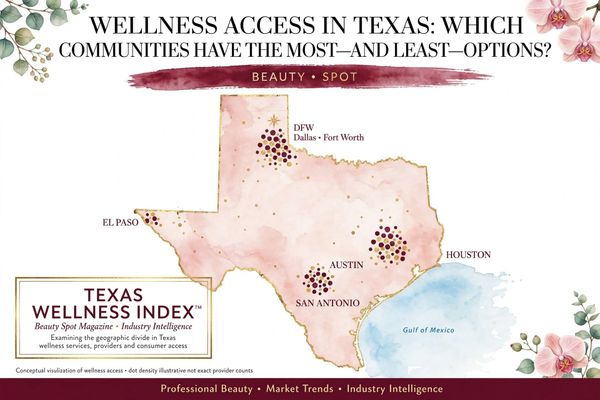
Luxury med spas, corrective skincare clinics, wellness centers, and advanced esthetics practices continue expanding throughout metropolitan markets such as Dallas-Fort Worth, Houston, Austin, and San Antonio. With growth comes increased demand for practitioners who combine technical excellence with regulatory awareness and exceptional client experiences. Texas licensing standards reinforce the importance of practicing within one's legal scope while continuing professional development.
For aspiring beauty professionals, the opportunity extends far beyond employment.
Texas remains one of the country's strongest environments for launching independently owned service businesses.
Success Is Being Redefined
The debate between college and skilled trades has never been about declaring one universally better than the other.
Doctors need medical school.
Engineers need engineering programs.
Scientists need research universities.
But millions of young Americans have been led to believe success requires following the exact same educational path.
The data—and the workforce—tell a different story.
Today's economy rewards adaptability.
Specialization.
Entrepreneurship.
Continuous learning.
Customer relationships.
Technical mastery.
These qualities exist in abundance throughout the skilled trades.
Perhaps the greatest shift isn't economic at all.
It's cultural.
America is finally beginning to recognize that intelligence isn't measured by the letters after your name. It's reflected in your ability to solve problems, create value, master a craft, and build a meaningful career.
Whether that happens in a laboratory, a law office, a construction site, or an esthetics treatment room is becoming far less important than it once was.
The future belongs to professionals who know how to create value with both their minds and their hands.
And for an increasing number of Americans, that future begins not with a four-year degree—but with a skill, a license, and the courage to build something of their own.
Editorial Note: This article reflects broad workforce and economic trends. Individual career outcomes vary based on specialization, geographic market, business strategy, experience, and ongoing professional development. Beauty professionals should always comply with applicable state licensing laws and scope-of-practice requirements.