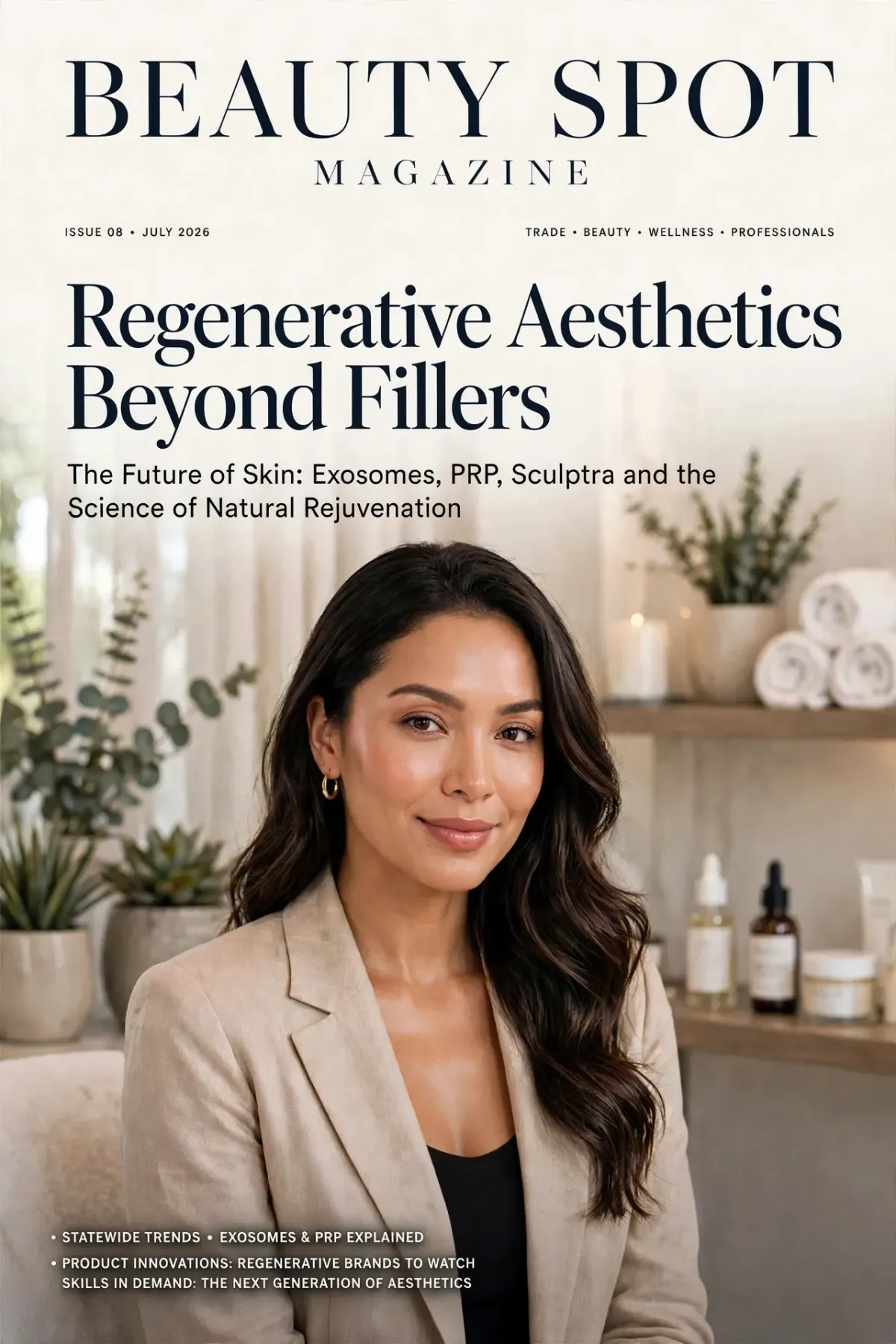
Regenerative Aesthetics Beyond Fillers
Discover how regenerative aesthetics is moving beyond fillers to support collagen, skin quality, facial balance, and long-term rejuvenation—while keeping safety, provider expertise, and Texas scope of practice in focus.

The New Luxury Is Not Looking “Done.” It Is Helping the Skin Perform Better.
For nearly two decades, the modern aesthetics conversation has been dominated by volume. Cheeks were lifted, lips were defined, shadows were softened, and facial architecture became something that could be adjusted in a lunch-hour appointment. Injectable fillers transformed the industry because they offered something clients could immediately understand: visible change, controlled placement, and relatively little downtime.
But beauty culture is entering a more nuanced era.
Today’s most sophisticated clients are no longer asking only, “Where should I add volume?” They are asking why their skin looks tired despite good skincare, why texture continues to change, why elasticity feels different, and how they can preserve facial vitality without appearing overcorrected.
The emerging answer is regenerative aesthetics—a broad and rapidly evolving category built around the idea that aesthetic medicine can do more than replace what has been lost. It may also support the skin’s own renewal processes, encourage tissue remodeling, improve skin quality, and create results that unfold gradually rather than announce themselves overnight.
This is aesthetics beyond fillers.
Not anti-injectable. Not anti-aging. Not a rejection of modern medicine.
It is a shift from correction alone toward skin longevity.
“The future of aesthetic luxury is not simply adding more. It is creating the conditions for the skin to function, recover, and age more beautifully.”
From Facial Volume to Tissue Quality
Fillers remain valuable when they are thoughtfully selected, conservatively placed, and used for the right indication. They can restore structural support, soften folds, improve proportion, and address areas where volume depletion is genuinely contributing to an aged or fatigued appearance.
The problem begins when every concern is treated as a volume problem.
Crepey texture is not always solved by filler. Diffuse laxity is not necessarily a request for larger cheeks. Dullness, enlarged pores, uneven tone, impaired barrier function, acne scarring, and declining elasticity each require a different conversation.
Regenerative aesthetics reframes the face as living tissue rather than static architecture. The focus shifts toward collagen behavior, fibroblast activity, cellular signaling, inflammation, vascular support, barrier integrity, and the gradual remodeling of skin.
That distinction matters.
A volumizing product occupies space. A regenerative strategy is intended to influence how the tissue behaves over time. In practice, the two approaches may complement each other, but they are not interchangeable.
The most elegant treatment plans understand the difference.
What “Regenerative” Actually Means
The word regenerative is now used across medical aesthetics, skincare marketing, device technology, and social media. It can describe everything from platelet-based procedures to biostimulatory injectables, microneedling, polynucleotides, energy-based treatments, and topical products positioned around repair.
Because the category is so broad, the term should never be accepted without further explanation.
What is the product or procedure intended to stimulate? What evidence supports that mechanism? Is the outcome hydration, inflammation modulation, collagen induction, tissue remodeling, wound-healing support, or simply temporary cosmetic improvement? Is the treatment medical, esthetic, investigational, or primarily promotional?
These questions separate education from trend-chasing.
In its most credible form, regenerative aesthetics refers to treatments designed to encourage biological processes associated with repair, renewal, collagen production, extracellular matrix support, or improved tissue quality. The visible result is often less dramatic at first than traditional filler because the treatment is not simply placing instant volume beneath the skin.
The transformation may appear as firmer texture, improved luminosity, softened fine lines, better elasticity, or a more rested quality that is difficult to trace to one feature.
The client does not necessarily look altered.
She looks biologically refreshed.
Collagen Biostimulation: The Quiet Architecture of the Face
Collagen-stimulating treatments have become central to the regenerative conversation because collagen is essential to the skin’s strength, resilience, and structural appearance. As collagen organization and production change over time, the face may begin to show laxity, thinning, textural irregularity, and reduced support.
Biostimulatory injectables are designed to trigger a gradual tissue response rather than act exclusively as conventional space-filling gels. Depending on the product and indication, they may be used to support collagen formation and improve the appearance of broader areas of facial or body laxity.
These treatments require a different kind of client psychology.
The person seeking instant transformation may become impatient. The person who understands cumulative improvement may appreciate the subtlety. Results typically develop over time, and treatment planning may require a series, maintenance, and realistic expectations.
That slower evolution is precisely what makes the category attractive to quiet-luxury clients. There is no sudden visual announcement. No obvious shift from one week to the next. The face simply begins to look more supported.
Yet biostimulation is not casual skincare. Injectable procedures belong within appropriately licensed medical practice, with careful patient selection, informed consent, product knowledge, complication preparedness, and anatomical expertise.
The luxury is not the syringe.
The luxury is judgment.
Platelet-Based Treatments and the Appeal of the Patient’s Own Biology
Platelet-rich plasma and related platelet-based procedures helped introduce mainstream clients to the idea that their own blood-derived components could be used within an aesthetic treatment strategy. These procedures are commonly discussed in relation to growth factors, tissue repair, healing support, and collagen stimulation.
Their appeal is easy to understand. In a beauty culture increasingly drawn to personalized medicine, autologous treatments feel intimate, intelligent, and biologically aligned.
But platelet-based treatments are not interchangeable, and outcomes may vary according to preparation methods, platelet concentration, equipment, patient health, treatment technique, and the condition being addressed. “Natural” does not automatically mean risk-free, predictable, or universally appropriate.
The strongest providers explain what the treatment may reasonably support without turning biology into fantasy. They avoid guaranteed rejuvenation claims, disclose that outcomes vary, and place the procedure inside a complete treatment plan rather than presenting it as a miracle vial.
Microneedling: Controlled Injury, Serious Responsibility
Microneedling occupies a prominent position in regenerative aesthetics because controlled micro-injury can stimulate fibroblast activity, collagen and elastin production, and tissue remodeling. It is frequently discussed for concerns such as acne scarring, fine lines, uneven pigmentation, laxity, and textural change.
Yet the language surrounding microneedling often sounds far more casual than the procedure itself.
Depth matters. Device classification matters. Infection control matters. The treatment area, client history, topical agents, contraindications, and post-procedure care all influence safety. Active lesions, certain inflammatory conditions, uncontrolled health concerns, and a history of abnormal scarring may affect candidacy.
The growing practice of combining microneedling with “boosters” introduces another layer of responsibility. Products marketed for topical application are not automatically appropriate for implantation or transdermal delivery. Sterility, formulation, regulatory status, intended use, and professional scope must all be evaluated.
A beautiful protocol is not defined by how many substances are layered onto compromised skin.
It is defined by whether every step is justified.
Polynucleotides, PDRN, Exosomes, and the New Language of Repair
Few categories illustrate the excitement—and confusion—of regenerative aesthetics more clearly than polynucleotides, PDRN, and exosome-positioned products.
Polynucleotide-based products are often discussed in relation to hydration, tissue quality, elasticity, and repair signaling. PDRN is similarly marketed around tissue support and inflammation modulation. Exosomes are described as cellular messengers capable of carrying proteins, lipids, and signaling materials between cells.
The scientific language is seductive. It sounds futuristic because it is.
But providers must distinguish emerging potential from established certainty. Products vary widely in sourcing, processing, sterility, formulation, regulatory status, and clinical evidence. The fact that two products use the same popular ingredient term does not mean they are equivalent.
This is where editorial beauty culture must mature. A treatment should not be elevated simply because it contains a molecule that photographs well in a vial.
Sophisticated aesthetics requires traceability: What is it? Where was it manufactured? How is it intended to be used? What evidence exists? What claims are permitted? What adverse reactions have been considered? Who is legally authorized to administer it?
The more advanced the terminology becomes, the more disciplined the provider must become.
Energy-Based Regeneration Without the Hype
Radiofrequency, ultrasound, fractional technologies, lasers, LED, and other energy-based devices are also frequently positioned within regenerative treatment plans. Depending on the modality, energy may be used to create controlled thermal or photobiomodulatory effects intended to support collagen remodeling, improve texture, address pigment, or enhance firmness.
These technologies can be powerful, but “non-surgical” does not mean non-medical, universally safe, or appropriate for every operator.
Settings, skin tone, tissue depth, device quality, contraindications, and provider training influence outcomes. Over-treatment may compromise the barrier, trigger prolonged inflammation, worsen pigmentation, or create other complications. Under-treatment may produce little beyond an expensive appointment.
Regenerative aesthetics is not a contest to create the most inflammation.
The goal is a controlled biological response followed by intelligent recovery.
The Texas Perspective: Education Does Not Expand a License
For Texas estheticians, regenerative aesthetics creates extraordinary educational and business opportunities—but also serious scope-of-practice concerns.
An esthetics license does not authorize every procedure taught in a private certification course. Training and legal permission are not the same. Services that penetrate deeply, alter living tissue, involve prescription products, use injections, or cross into medical treatment may require medical licensure, delegation, supervision, or a different professional setting.
The Beauty Spot Texas legal framework emphasizes that providers must distinguish superficial esthetic services from procedures that move beyond the epidermis or into medical territory. It also warns against advanced exfoliation, device use, and “medical-grade” positioning that exceed a provider’s lawful authority.
This is not a limitation on ambition.
It is a call for better positioning.
The advanced esthetician can play an essential role in consultation support, barrier preparation, compliant facial care, pigmentation awareness, post-procedure comfort within scope, home-care planning, client education, and long-term skin maintenance. She may become the professional who helps the client’s skin remain resilient between medical procedures.
That partnership model is stronger than pretending every beauty professional should perform every treatment.
“Your certificate proves you completed a class. Your license determines what you may legally perform.”
The New Treatment Plan Is an Ecosystem
The future is unlikely to belong to one hero procedure.
A regenerative plan may combine medical evaluation, conservative injectables, collagen stimulation, energy-based treatment, pigment management, barrier repair, nutrition-conscious wellness, sun protection, and disciplined home care.
The order matters.
A client with an impaired barrier may need stabilization before stimulation. A client prone to post-inflammatory hyperpigmentation may require a more cautious strategy. A client with facial heaviness may not benefit from indiscriminate volume. A client experiencing rapid or unusual skin changes may require medical assessment rather than an aesthetic package.
The best treatment plan is not the one containing the most modalities.
It is the one with the clearest rationale.
Consultation becomes the centerpiece: medical history, medications, previous procedures, healing patterns, pigmentation risk, lifestyle, budget, downtime tolerance, and emotional expectations. Before-and-after photography should document change honestly. Consent should describe both benefits and limitations. Maintenance should be discussed before the first procedure, not introduced after the client has already invested.
What Luxury Clients Are Really Buying
The regenerative client is not simply buying collagen.
She is buying restraint.
She is buying a provider who knows when not to inject, when to postpone treatment, when to refer, and when the skin needs recovery more than stimulation. She is buying a plan that respects the architecture of her face without treating aging as a defect.
This is why regenerative aesthetics fits so naturally within the language of modern luxury. Quiet luxury beauty is not built on excess. It is built on discernment, quality, personalization, and results that appear integrated rather than imposed.
The most compelling outcome is not, “What did you have done?”
It is, “You look well.”
Beyond the Filler Era
Fillers are not disappearing. They are becoming one instrument inside a larger orchestra.
The next era of aesthetics will be defined by providers who understand structure and skin quality, immediate correction and long-term remodeling, technology and human biology, ambition and lawful scope. It will favor treatment plans that protect identity rather than manufacture sameness.
Regenerative aesthetics is still evolving. Some modalities have established clinical roles, while others require stronger evidence, clearer regulation, or more standardized protocols. Responsible professionals should preserve that distinction rather than flattening every innovation into the same promise.
Because the future of beauty will not be won by the loudest claim.
It will be shaped by professionals who can hold science, artistry, ethics, and restraint in the same beautifully trained hand.
And in that future, the most luxurious result may be the one that never looks like a procedure at all.