The Rise of Clean Beauty Brands Born in Texas
Discover how Texas-born clean beauty brands are combining thoughtful formulation, cultural identity, luxury wellness, and entrepreneurial ambition to reshape the modern beauty industry.

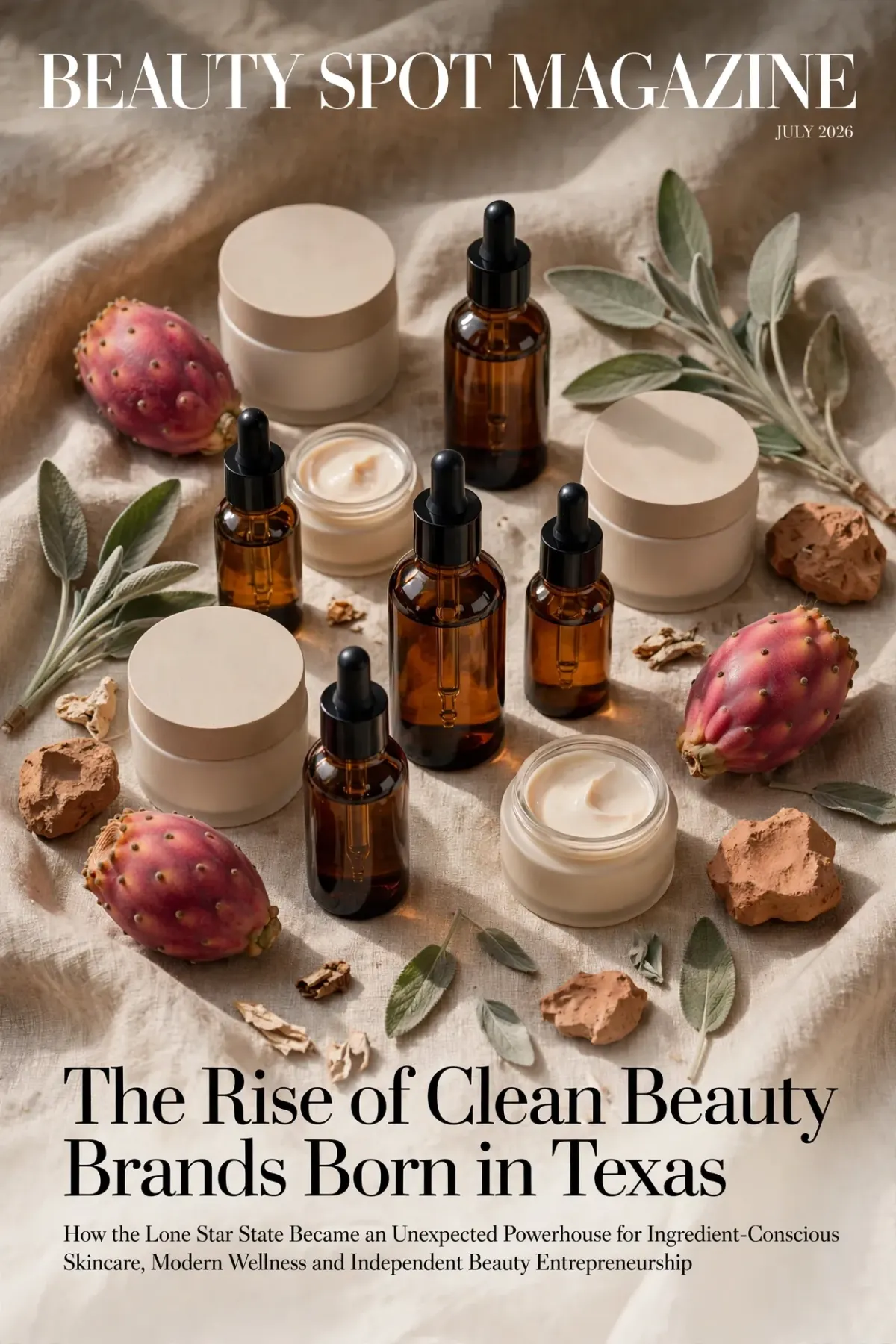
How the Lone Star State Became an Unexpected Powerhouse for Ingredient-Conscious Skincare, Modern Wellness and Independent Beauty Entrepreneurship
For years, clean beauty was imagined through a distinctly coastal lens. Its visual language belonged to sun-washed California bathrooms, minimalist New York boutiques and Pacific Northwest apothecaries lined with amber glass. The movement appeared to arrive dressed in linen, carrying a reusable tote and speaking fluently about botanical extracts, ingredient transparency and environmental responsibility.
Texas was rarely positioned at the center of that conversation.
Yet quietly—and then unmistakably—the state began producing a different kind of clean beauty brand: less precious, more entrepreneurial; deeply connected to wellness, but unwilling to sacrifice performance; regionally grounded, but ambitious enough to compete nationally. From Austin’s modern wellness ecosystem to Dallas–Fort Worth’s beauty-business infrastructure and San Antonio’s growing aesthetics culture, Texas has become fertile territory for founders building products around conscious formulation, independent identity and a more sophisticated understanding of what consumers now expect from beauty.
This is not simply a story about removing ingredients from a formula.
It is a story about Texas women, chemists, estheticians, spa operators and entrepreneurs redefining what a beauty company can look like when it is born outside the traditional industry capitals.
The new Texas beauty brand is not asking permission to enter the national conversation. It is building its own laboratory, treatment room, community and point of view.
Clean Beauty, Rewritten in a Texas Accent
“Clean beauty” remains one of the industry’s most emotionally powerful—and technically complicated—phrases. It can describe ingredient-conscious formulation, cruelty-free practices, greater supply-chain transparency, environmental commitments, sensitive-skin positioning or the exclusion of substances a brand has chosen not to use. What it does not represent is one universally regulated formulation standard.
That distinction matters.
In the earliest phase of the clean movement, brands often built their identities around fear-based exclusion lists: no parabens, no sulfates, no silicones, no synthetics, no chemicals. But modern consumers—and especially licensed professionals—are becoming more discerning. They increasingly understand that “natural” does not automatically mean gentle, “synthetic” does not automatically mean unsafe and every cosmetic ingredient is, at its foundation, part of chemistry.
The conversation is becoming more intelligent. The strongest clean beauty brands are shifting away from purity theater and toward formulation accountability: Why is this ingredient included? At what concentration? What function does it perform? How is the product preserved? Is the packaging compatible with the formula? Does the brand make cosmetic claims or drift into unsupported medical promises?
That evolution is especially important in professional beauty spaces, where products must do more than photograph beautifully. Estheticians and spa owners need formulas that remain stable, layer predictably, support the skin barrier and integrate responsibly into treatment plans.
Texas providers operate in a market where consumers often expect visible results, sophisticated service environments and high levels of trust. Beauty Spot’s Texas professional framework repeatedly emphasizes that premium positioning depends not only on treatment skill, but also on safety, knowledge, documentation and compliance awareness.
Clean beauty becomes more credible when it moves beyond lifestyle language and enters that professional standard.
Why Texas Became Fertile Ground
Texas offers an unusual combination of conditions for independent beauty growth. It has rapidly expanding metropolitan markets, a strong culture of entrepreneurship, comparatively accessible business infrastructure, a large and diverse consumer base, thriving hospitality and wellness sectors, and cities with highly distinctive identities.
Austin gave clean beauty founders access to a population already conversant in holistic living, wellness technology, plant-based lifestyles and independent retail. Dallas and Fort Worth brought luxury commerce, medical aesthetics, manufacturing relationships and high-performance branding. Houston contributed international influence, demographic complexity and a sophisticated appetite for beauty across cultures and skin tones. San Antonio offered a rich blend of heritage, wellness, tourism and an increasingly visible professional aesthetics community.
Texas also has scale. A founder can test a product inside a local spa, build loyalty through regional pop-ups, develop wholesale relationships with boutiques and still reach millions of potential consumers without leaving the state.
There is history beneath that momentum. Beauty has long functioned as a pathway to entrepreneurship, particularly for women. Professional beauty education records how product creation, salon ownership and early franchise systems opened commercial opportunities to women well before many other industries did. Today’s Texas founder is part of that same lineage—only now the treatment room may lead to a Shopify store, a formulation studio, a national retailer or a venture-backed expansion strategy.
The Brands That Changed the Perception of Texas Beauty
Several Texas-connected companies have helped widen the industry’s understanding of what can emerge from the state.
Austin-born W3LL PEOPLE became an influential name in the early clean cosmetics movement by helping make ingredient-conscious makeup feel modern rather than medicinal. Its significance was not limited to what the brand excluded. It helped challenge the assumption that cleaner-positioned cosmetics had to look earthy, perform weakly or appeal only to a niche wellness consumer. Complexion products, color cosmetics and professional-looking packaging placed clean makeup closer to the mainstream beauty counter.
FarmHouse Fresh, associated with the Dallas–Fort Worth region, built a distinctly Texan version of sensorial skincare—lush textures, playful product storytelling, spa appeal and a strong connection to ingredient narratives. Its world is not sterile minimalism. It is generous, tactile and hospitality-driven, demonstrating that conscious beauty can still feel indulgent.
Austin’s milk + honey expanded the conversation from individual products to an entire clean-leaning wellness environment. Its influence reflects a critical Texas advantage: the ability to connect service, retail, ritual and lifestyle under one brand experience. A cleanser is no longer simply a cleanser when the client first encounters it inside a beautifully designed spa, through the hands of a trusted professional and within a larger narrative of rest, care and personal maintenance.
Sanara Skincare brought another essential perspective: culturally resonant body care and founder storytelling shaped by Latin American botanical traditions. Brands such as Sanara demonstrate why the future of clean beauty cannot be reduced to neutral packaging and a narrow version of wellness. Ingredient-conscious beauty becomes more meaningful when it honors heritage, ritual, geography and the communities from which its inspiration comes.
Dallas-based BeautyBio represents a different edge of the Texas market—the convergence of beauty devices, skincare, clinical aspiration and luxury retail. While not every performance-driven brand defines itself through the same clean-beauty language, the rise of such companies reveals the broader ecosystem in which Texas clean beauty is developing: one where consumers expect both ingredient awareness and technological sophistication.
Together, these businesses show that Texas beauty does not have one aesthetic. It can be botanical, clinical, glamorous, heritage-driven, spa-centered or digitally native. Its common thread is not sameness. It is independence.
The Ingredient Story Is Growing Up
The next generation of Texas-born beauty companies will face a more educated consumer than the founders of a decade ago.
Shoppers are reading ingredient lists, but they are also questioning vague claims. They want to know whether “non-toxic” is scientifically meaningful, whether a preservative-free formula is actually safe, whether a botanical extract is present at an effective level and whether sustainable packaging protects the product throughout its intended shelf life.
This is where professional education becomes essential.
A beautiful ingredient story may attract the first purchase, but formulation integrity earns the second. Botanical oils can offer emollience and sensory pleasure, yet some may be unsuitable for particular skin conditions. Essential oils can create a luxurious aromatic experience, but they can also present sensitization concerns for some users. Active ingredients can elevate performance, but only when compatibility, stability, packaging and intended use are thoughtfully considered.
The most credible founders will not position chemistry as the enemy. They will use chemistry as the architecture that makes conscious formulation possible.
For estheticians, this shift creates an important retail opportunity. Professionals can become translators between brand language and skin reality. They can explain that a product’s value is not determined by the length of its exclusion list, but by how appropriately it is formulated for the client in front of them.
That authority must remain disciplined. Texas beauty professionals are expected to operate within the limits of their license and avoid allowing marketing language to turn cosmetic products into implied medical treatments. Beauty Spot’s Texas legal framework warns against careless use of medicalized claims and emphasizes that advanced positioning must remain aligned with lawful professional scope.
In other words, “clean,” “clinical,” “professional” and “medical-grade” are not interchangeable words.
Sophisticated brands will understand the difference.
Clean Beauty as Cultural Identity
One reason Texas-born brands feel increasingly relevant is that clean beauty itself is moving away from a single visual identity.
The original clean-beauty aesthetic was often pale, minimal and culturally anonymous. Today’s consumer is asking for more texture: formulas rooted in regional ingredients, packaging that expresses personality, founders whose stories reflect real communities and products designed for a broader range of complexions, hair textures, climates and beauty rituals.
Texas is uniquely positioned to contribute to that expansion.
The state is shaped by Mexican, Indigenous, Southern, Black, Western, German, Central European, Asian and global influences. Its beauty culture moves between ranchland and high-rise luxury, botanical tradition and advanced aesthetics, small-town makers and billion-dollar metropolitan economies.
A Texas clean beauty brand can draw from desert botanicals, Gulf humidity, Hill Country wellness, borderland traditions, Southern hospitality and the polished service culture of luxury spas. The opportunity is not to turn these references into decorative branding. It is to build products and narratives with cultural intelligence.
Consumers can feel when heritage is being honored—and when it is merely being mined.
The Professional Beauty Opportunity
For estheticians and spa owners, the rise of regional clean brands offers more than new products to place on a shelf. It creates the possibility of deeper client relationships and stronger retail differentiation.
National prestige brands offer recognition. Texas-born brands can offer proximity, founder access, local storytelling, regional exclusivity and a stronger sense of discovery.
A curated retail wall featuring independent Texas beauty companies can become part of the spa’s identity. The professional is no longer simply reselling products available everywhere. She is acting as an editor—selecting formulas based on skin compatibility, brand ethics, sensory experience and the emotional world she wants her clients to enter.
That role requires discernment. Not every small-batch product belongs in a professional setting. Before bringing a brand into a spa, owners should evaluate ingredient documentation, preservation, batch consistency, insurance, claims language, wholesale support, training, packaging stability and the company’s ability to fulfill orders as it grows.
Luxury is not created by exclusivity alone.
It is created by consistency.
The industry’s professional education tradition has long recognized that product knowledge, business understanding, continuing education and strong communication are essential to career growth. The same is true for modern retail. The provider who understands the formula, the founder story, the client profile and the home-care strategy can turn a product purchase into a trusted recommendation rather than a transaction.
The Business Behind the Beauty
Texas founders also reflect a broader change in beauty entrepreneurship. Many are not beginning with the dream of building a global conglomerate. They are beginning with a specific frustration.
A founder cannot find body care that speaks to her heritage. An esthetician wants formulas that complement her treatment philosophy. A spa owner wants products that match the sensory standards of her service environment. A consumer with reactive skin wants fewer marketing promises and more transparency. A makeup artist wants performance without abandoning her ingredient priorities.
The most magnetic brands often begin with that kind of intimate problem.
But turning a personal solution into a durable company requires more than a compelling origin story. It requires margins, manufacturing, regulatory awareness, inventory discipline, trademark strategy, customer acquisition, wholesale systems and the emotional stamina to survive slow growth.
Texas culture tends to celebrate boldness, but the beauty businesses most likely to endure will pair bold branding with operational restraint. They will resist launching too many products, making exaggerated claims or scaling before their supply chain is ready.
A brand is not successful because it goes viral.
It is successful because it remains trustworthy after attention arrives.
What Comes Next
The next chapter of Texas clean beauty will likely be more sophisticated, more diverse and more difficult to categorize.
Expect to see greater emphasis on skin-barrier support, microbiome-aware positioning, scalp wellness, body treatments, multifunctional cosmetics, refill systems and climate-conscious formulation. Expect more collaboration between estheticians, cosmetic chemists, physicians, wellness practitioners and culturally grounded founders. Expect clean beauty language to become less absolute as consumers demand greater scientific accuracy.
The strongest brands will stop trying to prove that they are the purest.
They will prove that they are thoughtful.
They will disclose more, educate better and build formulas that respect both the consumer’s values and the complexity of cosmetic science. They will create packaging worthy of luxury retail without allowing design to outrun efficacy. They will celebrate Texas identity without turning it into costume.
Most importantly, they will understand that the clean beauty movement is no longer only about what a product leaves out.
It is about what a brand stands for when the market becomes crowded, the claims become louder and consumers begin looking past the label.
A New Beauty Geography
Texas is not replacing California, New York or Europe as a beauty capital. It is doing something more interesting: expanding the map.
The state’s emerging influence suggests that the future of beauty may not belong to one city or one aesthetic. It may belong to regional ecosystems where founders can connect local culture, professional knowledge, modern formulation and global ambition.
That is the real rise of clean beauty brands born in Texas.
Not a parade of beige bottles.
Not another marketing category built on fear.
A new generation of companies translating independence, hospitality, science, heritage and entrepreneurial nerve into products people are proud to place on their skin.
And in true Texas fashion, they are not entering quietly.