The Best New Beauty Products Made in Texas
Texas beauty growth, aesthetics trends, workforce intelligence, market momentum, and statewide industry performance.

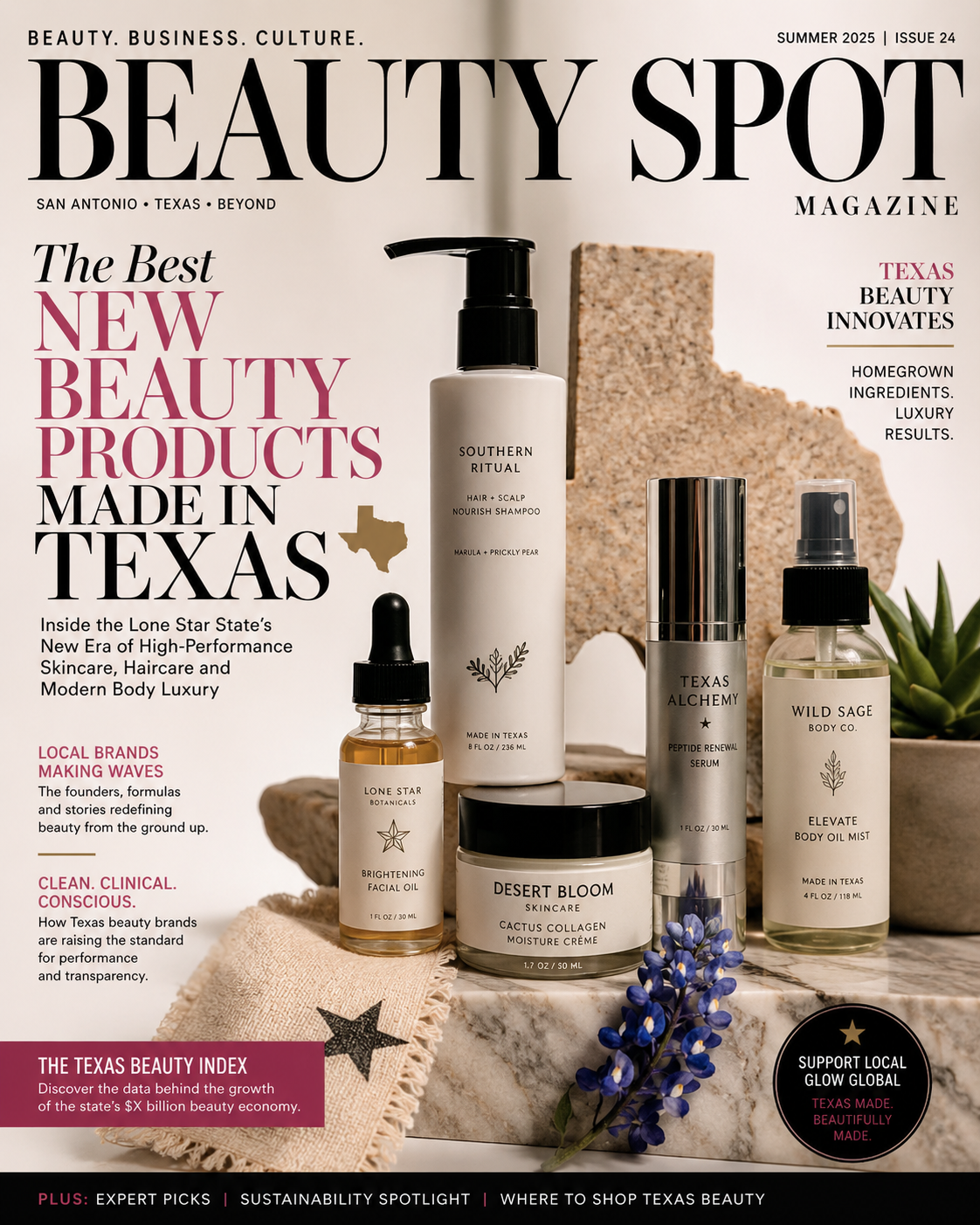
Inside the Lone Star State’s New Era of High-Performance Skincare, Haircare and Modern Body Luxury
For years, Texas beauty was easy to underestimate.
The state’s visual language—sunlit ranches, wildflowers, desert minerals, rodeo polish and unapologetic glamour—often overshadowed the serious product innovation happening behind the scenes. Yet across Dallas, Houston, Austin, San Antonio and the smaller manufacturing communities between them, a more sophisticated beauty economy has been taking shape.
This is not simply a wave of charming local apothecaries selling cactus soap and lavender balm at weekend markets. Texas is now home to clinical-minded skincare founders, professional haircare laboratories, ingredient-conscious body brands, luxury spa suppliers and independent makers building products with national retail potential.
The most compelling Texas-made beauty products understand the state they come from. They are developed for intense heat, relentless air-conditioning, hard water, high ultraviolet exposure, shifting humidity and consumers who expect visible performance without sacrificing pleasure.
They also reflect a distinctly Texan approach to entrepreneurship: ambitious, self-financed, operationally sharp and less interested in asking permission from the traditional beauty establishment.
Texas beauty is no longer a regional novelty. It is becoming a category of its own.
FarmHouse Fresh and the New Language of Texas Body Care
Few brands have translated Texas geography into beauty as convincingly as FarmHouse Fresh. Based in McKinney, the company built its identity around sensorial body care, spa-worthy textures and an ingredient story that feels both pastoral and polished.
Its strongest products live in the space between treatment and indulgence: whipped body creams, botanical oils, exfoliating scrubs, masks and hand-care formulas designed to turn an ordinary routine into something tactile and transportive.
What makes the brand particularly relevant now is the return of body care as a serious beauty category. Consumers are no longer satisfied with applying an anonymous lotion after the shower. They are treating the body with the same intentionality once reserved for facial skincare—layering exfoliants, hydrators, oils and barrier-supportive creams.
FarmHouse Fresh anticipated this movement early.
The brand’s appeal is not built on clinical austerity. It is built on abundance: rich textures, garden-inspired fragrance, gleaming oils and packaging that feels at home in a luxury treatment room. For spa owners, these products also offer something commercially intelligent. They create an immediate sensory connection, making them naturally suited to treatment upgrades, retail displays, seasonal rituals and gift-driven purchasing.
The lesson is clear: Texas-made beauty does not need to imitate the cold minimalism of coastal clinical brands. It can be warm, generous and highly sensorial while still feeling sophisticated.
BeautyBio and the Dallas Approach to At-Home Aesthetics
Dallas has always understood presentation, polish and the psychology of visible transformation. BeautyBio channels that sensibility into a category that continues to expand: beauty technology designed for home use.
The brand became widely associated with microneedling-inspired tools and treatment systems positioned as a bridge between traditional skincare and professional aesthetics. Its success reflects a larger change in consumer behavior. Clients increasingly want products that feel active, technical and results-oriented, even when they are being used at a bathroom vanity rather than inside a medical spa.
That desire has created enormous opportunity, but it also requires careful education.
At-home tools should never be presented as substitutes for licensed professional procedures. Cosmetic devices vary widely in design, intensity and intended use, and consumers need clear instructions, sanitation guidance and realistic expectations. The prestige of the category depends on responsible positioning.
BeautyBio’s relevance lies in its understanding that the modern luxury client does not separate beauty into neat categories. She may receive professional treatments, use an LED device at home, maintain a carefully curated routine and invest in products designed to support the appearance of smoother, brighter or more refined-looking skin.
The best Texas beauty companies recognize this ecosystem. They are not merely selling jars. They are creating rituals, systems and identities around performance.
Mary Kay’s Quiet Manufacturing Power
It would be impossible to discuss beauty made in Texas without acknowledging Mary Kay.
The company’s cultural familiarity can sometimes obscure its significance as a Texas beauty institution. Headquartered in the Dallas area, Mary Kay helped establish a model of female entrepreneurship long before “founder-led beauty” became an industry phrase.
Its modern relevance is not rooted in nostalgia. It is rooted in infrastructure.
Beauty brands are often celebrated for their packaging, influencer strategy or hero ingredient, but long-term success depends on far less glamorous capabilities: research, testing, manufacturing, quality control, distribution, education and the ability to produce consistently at scale.
Texas has become increasingly attractive to beauty companies precisely because it can support those operational demands. The state offers manufacturing capacity, logistics access, major metropolitan talent pools and a business culture comfortable with growth.
Mary Kay represents the established end of that spectrum—a reminder that Texas beauty is not only artisanal. It can also be global, technically sophisticated and operationally mature.
For independent founders, that legacy matters. It proves that a beauty company built in Texas does not need to relocate to Los Angeles or New York to become internationally relevant.
Houston Haircare Has Always Been More Technical Than Trendy
Houston’s contribution to the beauty industry is inseparable from professional haircare.
Farouk Systems, the Houston-based company behind CHI and related professional brands, helped give Texas a serious foothold in salon technology, thermal styling and chemical innovation. The company’s history reflects an important truth about the state’s beauty culture: Texas glamour has always required engineering.
Heat styling, humidity management, shine, color preservation and smoothness are not abstract concerns here. They are daily realities.
The strongest hair products emerging from Texas tend to understand that the client is navigating environmental stress as much as aesthetic preference. A formula may need to support softness without collapse, polish without greasiness and manageability without coating the hair in an overly heavy film.
This is especially important in a state where climate conditions can change dramatically from Amarillo to Galveston. West Texas dryness, Gulf Coast humidity and mineral-heavy municipal water systems create very different hair and scalp experiences.
Products that succeed in this market often travel well because they have already been tested against extremes.
Texas haircare also carries an important professional advantage. The state has a deep salon culture and a large network of cosmetologists, independent suite owners, educators and beauty entrepreneurs. That creates a natural feedback loop between manufacturer and working professional.
The next generation of Texas haircare will likely move beyond simple smoothing claims and focus more heavily on scalp health, bond support, textured-hair performance, color longevity and climate-adaptive styling.
Sanara and the Rise of Culturally Intelligent Wellness Beauty
Austin’s beauty identity is different from Dallas or Houston. It is softer, more ingredient-conscious and closely connected to wellness, ritual and independent design.
Sanara represents this side of the Texas market. The brand draws from Latin American botanicals and cultural beauty traditions, creating body-care products that feel intimate, grounded and editorially modern.
This kind of brand matters because the future of luxury beauty is not only about increasingly complex formulations. It is also about context.
Consumers want to know why an ingredient was chosen, what tradition informs the ritual and whether the story is being told with respect. Cultural intelligence has become part of product intelligence.
Sanara’s positioning speaks to a client who wants beauty to feel restorative rather than corrective. The products are not framed around “fixing” the body. They invite the user to slow down, massage, moisturize, breathe and reconnect with skin as a living sensory surface.
That approach reflects a larger industry movement away from fear-based beauty marketing. The most modern brands are replacing the language of flaws with the language of support: barrier support, hydration, resilience, radiance, comfort and longevity.
Texas is especially well positioned for this transition. Its population is culturally diverse, its wellness industry is expanding, and its consumers are increasingly selective about whose traditions are being commercialized—and how.
What Makes a Texas Beauty Product Worth Buying?
A Texas address alone does not make a product exceptional.
The strongest products coming out of the state share several characteristics. They are built for real environmental conditions. They have a coherent ingredient story. They understand texture and sensory experience. They look elevated enough for premium retail. Most importantly, they deliver a clear reason to exist.
For professionals, product evaluation should go beyond branding.
An esthetician or spa owner should consider whether a formula fits the treatment philosophy of the business, whether the instructions are appropriate for the intended user, whether the ingredient deck supports the marketing language and whether the product can be sold without creating unrealistic expectations.
The phrase “clinical-grade,” for example, is often used more loosely than consumers realize. It is a marketing term, not a universal guarantee of efficacy. Likewise, “natural” does not automatically mean safer, gentler or more effective.
Texas professionals have an opportunity to lead with better product literacy.
That means looking closely at preservatives, fragrance systems, exfoliating ingredients, potential sensitizers, active concentrations when disclosed, packaging stability and compatibility with professional services. It also means distinguishing between a beautifully branded cosmetic and a product appropriate for use before or after an advanced treatment.
Within a Texas esthetics practice, product recommendations must remain within professional scope. Estheticians may educate clients about cosmetic skincare and home care, but they should avoid diagnosing medical conditions or making guaranteed therapeutic claims. Texas beauty law rewards providers who treat compliance as part of luxury service—not as an inconvenience.
The Luxury Opportunity for Texas Spas
For spa owners, stocking Texas-made beauty can become more than a local-interest gesture. It can be a positioning strategy.
A curated “Made in Texas” retail edit creates a sense of place. It gives visiting clients something distinctive to take home and gives local clients a deeper emotional reason to purchase. It can also help independent spas differentiate themselves from national chains carrying the same familiar brands.
The key is curation.
A luxury retail wall should not feel like a souvenir shop. Texas identity can be communicated through material, texture, provenance and performance rather than predictable western graphics. Think limestone neutrals, smoked glass, botanical greens, sun-warmed amber and sculptural displays that reference the landscape without turning it into costume.
Treatment menus can follow the same principle.
A Hill Country body ritual might pair botanical exfoliation with aromatic oil and warm compresses. A Gulf-inspired hydration treatment could focus on replenishment, cooling textures and barrier comfort. A West Texas recovery facial might emphasize moisture retention and relief for environmentally stressed skin.
The storytelling should remain elegant and credible. Regional inspiration is most powerful when it is connected to the actual function of the product.
The Difference Between Texas-Made and Texas-Branded
As the category grows, consumers will need more transparency.
A company can be founded in Texas while manufacturing elsewhere. A formula may be developed by a Texas-based founder but produced by a contract laboratory in another state. Packaging may say “designed in Austin” or “born in Dallas” without confirming where the product itself was made.
None of those models is inherently inferior. But they are not identical.
For a product to be described editorially as Texas-made, the publication should verify where it is formulated, manufactured, filled or assembled. Brands should also be asked whether production occurs entirely in Texas or whether only selected products meet that description.
This distinction protects readers and strengthens the credibility of the broader Texas beauty movement.
Evidence integrity should come before decorative storytelling. The publication’s narrative framework requires separating observed facts, calculated findings, interpretation and unresolved questions rather than blending them into one polished claim. That same discipline should apply to beauty coverage: founder claims, manufacturing claims and product-performance claims each deserve their own level of verification.
The Products to Watch Next
The most exciting Texas beauty products of the coming era may not be the loudest launches.
Watch for scalp serums designed around heat, buildup and protective styling. Look for body products that address barrier care with the sophistication once reserved for facial skincare. Expect more Latin American, Indigenous, Southern and borderland botanical stories—hopefully told with greater respect, sourcing transparency and cultural depth.
There is also room for Texas to become a leader in post-treatment cosmetic care, men’s grooming, high-performance sun protection, hard-water haircare and professional backbar products developed specifically for regional climates.
The state’s most powerful advantage may be its combination of beauty culture and business scale. Texas understands aspiration, but it also understands operations. It has the clients, the providers, the laboratories, the distribution networks and the entrepreneurial appetite required to build brands that move beyond local admiration.
The next iconic Texas beauty company may already be formulating in a small lab outside Houston, testing packaging in Dallas, building community in Austin or developing its first professional protocol in San Antonio.
And when it arrives, it will not need to disguise where it comes from.
It will carry Texas in the formula: resilient, expansive, sensorial, technically ambitious and impossible to overlook.
The future of Texas beauty will not be defined by western nostalgia. It will be defined by products strong enough to become part of the modern beauty canon.
Inside the Lone Star State’s New Era of High-Performance Skincare, Haircare and Modern Body Luxury
For years, Texas beauty was easy to underestimate.
The state’s visual language—sunlit ranches, wildflowers, desert minerals, rodeo polish and unapologetic glamour—often overshadowed the serious product innovation happening behind the scenes. Yet across Dallas, Houston, Austin, San Antonio and the smaller manufacturing communities between them, a more sophisticated beauty economy has been taking shape.
This is not simply a wave of charming local apothecaries selling cactus soap and lavender balm at weekend markets. Texas is now home to clinical-minded skincare founders, professional haircare laboratories, ingredient-conscious body brands, luxury spa suppliers and independent makers building products with national retail potential.
The most compelling Texas-made beauty products understand the state they come from. They are developed for intense heat, relentless air-conditioning, hard water, high ultraviolet exposure, shifting humidity and consumers who expect visible performance without sacrificing pleasure.
They also reflect a distinctly Texan approach to entrepreneurship: ambitious, self-financed, operationally sharp and less interested in asking permission from the traditional beauty establishment.
Texas beauty is no longer a regional novelty. It is becoming a category of its own.
FarmHouse Fresh and the New Language of Texas Body Care
Few brands have translated Texas geography into beauty as convincingly as FarmHouse Fresh. Based in McKinney, the company built its identity around sensorial body care, spa-worthy textures and an ingredient story that feels both pastoral and polished.
Its strongest products live in the space between treatment and indulgence: whipped body creams, botanical oils, exfoliating scrubs, masks and hand-care formulas designed to turn an ordinary routine into something tactile and transportive.
What makes the brand particularly relevant now is the return of body care as a serious beauty category. Consumers are no longer satisfied with applying an anonymous lotion after the shower. They are treating the body with the same intentionality once reserved for facial skincare—layering exfoliants, hydrators, oils and barrier-supportive creams.
FarmHouse Fresh anticipated this movement early.
The brand’s appeal is not built on clinical austerity. It is built on abundance: rich textures, garden-inspired fragrance, gleaming oils and packaging that feels at home in a luxury treatment room. For spa owners, these products also offer something commercially intelligent. They create an immediate sensory connection, making them naturally suited to treatment upgrades, retail displays, seasonal rituals and gift-driven purchasing.
The lesson is clear: Texas-made beauty does not need to imitate the cold minimalism of coastal clinical brands. It can be warm, generous and highly sensorial while still feeling sophisticated.
BeautyBio and the Dallas Approach to At-Home Aesthetics
Dallas has always understood presentation, polish and the psychology of visible transformation. BeautyBio channels that sensibility into a category that continues to expand: beauty technology designed for home use.
The brand became widely associated with microneedling-inspired tools and treatment systems positioned as a bridge between traditional skincare and professional aesthetics. Its success reflects a larger change in consumer behavior. Clients increasingly want products that feel active, technical and results-oriented, even when they are being used at a bathroom vanity rather than inside a medical spa.
That desire has created enormous opportunity, but it also requires careful education.
At-home tools should never be presented as substitutes for licensed professional procedures. Cosmetic devices vary widely in design, intensity and intended use, and consumers need clear instructions, sanitation guidance and realistic expectations. The prestige of the category depends on responsible positioning.
BeautyBio’s relevance lies in its understanding that the modern luxury client does not separate beauty into neat categories. She may receive professional treatments, use an LED device at home, maintain a carefully curated routine and invest in products designed to support the appearance of smoother, brighter or more refined-looking skin.
The best Texas beauty companies recognize this ecosystem. They are not merely selling jars. They are creating rituals, systems and identities around performance.
Mary Kay’s Quiet Manufacturing Power
It would be impossible to discuss beauty made in Texas without acknowledging Mary Kay.
The company’s cultural familiarity can sometimes obscure its significance as a Texas beauty institution. Headquartered in the Dallas area, Mary Kay helped establish a model of female entrepreneurship long before “founder-led beauty” became an industry phrase.
Its modern relevance is not rooted in nostalgia. It is rooted in infrastructure.
Beauty brands are often celebrated for their packaging, influencer strategy or hero ingredient, but long-term success depends on far less glamorous capabilities: research, testing, manufacturing, quality control, distribution, education and the ability to produce consistently at scale.
Texas has become increasingly attractive to beauty companies precisely because it can support those operational demands. The state offers manufacturing capacity, logistics access, major metropolitan talent pools and a business culture comfortable with growth.
Mary Kay represents the established end of that spectrum—a reminder that Texas beauty is not only artisanal. It can also be global, technically sophisticated and operationally mature.
For independent founders, that legacy matters. It proves that a beauty company built in Texas does not need to relocate to Los Angeles or New York to become internationally relevant.
Houston Haircare Has Always Been More Technical Than Trendy
Houston’s contribution to the beauty industry is inseparable from professional haircare.
Farouk Systems, the Houston-based company behind CHI and related professional brands, helped give Texas a serious foothold in salon technology, thermal styling and chemical innovation. The company’s history reflects an important truth about the state’s beauty culture: Texas glamour has always required engineering.
Heat styling, humidity management, shine, color preservation and smoothness are not abstract concerns here. They are daily realities.
The strongest hair products emerging from Texas tend to understand that the client is navigating environmental stress as much as aesthetic preference. A formula may need to support softness without collapse, polish without greasiness and manageability without coating the hair in an overly heavy film.
This is especially important in a state where climate conditions can change dramatically from Amarillo to Galveston. West Texas dryness, Gulf Coast humidity and mineral-heavy municipal water systems create very different hair and scalp experiences.
Products that succeed in this market often travel well because they have already been tested against extremes.
Texas haircare also carries an important professional advantage. The state has a deep salon culture and a large network of cosmetologists, independent suite owners, educators and beauty entrepreneurs. That creates a natural feedback loop between manufacturer and working professional.
The next generation of Texas haircare will likely move beyond simple smoothing claims and focus more heavily on scalp health, bond support, textured-hair performance, color longevity and climate-adaptive styling.
Sanara and the Rise of Culturally Intelligent Wellness Beauty
Austin’s beauty identity is different from Dallas or Houston. It is softer, more ingredient-conscious and closely connected to wellness, ritual and independent design.
Sanara represents this side of the Texas market. The brand draws from Latin American botanicals and cultural beauty traditions, creating body-care products that feel intimate, grounded and editorially modern.
This kind of brand matters because the future of luxury beauty is not only about increasingly complex formulations. It is also about context.
Consumers want to know why an ingredient was chosen, what tradition informs the ritual and whether the story is being told with respect. Cultural intelligence has become part of product intelligence.
Sanara’s positioning speaks to a client who wants beauty to feel restorative rather than corrective. The products are not framed around “fixing” the body. They invite the user to slow down, massage, moisturize, breathe and reconnect with skin as a living sensory surface.
That approach reflects a larger industry movement away from fear-based beauty marketing. The most modern brands are replacing the language of flaws with the language of support: barrier support, hydration, resilience, radiance, comfort and longevity.
Texas is especially well positioned for this transition. Its population is culturally diverse, its wellness industry is expanding, and its consumers are increasingly selective about whose traditions are being commercialized—and how.
What Makes a Texas Beauty Product Worth Buying?
A Texas address alone does not make a product exceptional.
The strongest products coming out of the state share several characteristics. They are built for real environmental conditions. They have a coherent ingredient story. They understand texture and sensory experience. They look elevated enough for premium retail. Most importantly, they deliver a clear reason to exist.
For professionals, product evaluation should go beyond branding.
An esthetician or spa owner should consider whether a formula fits the treatment philosophy of the business, whether the instructions are appropriate for the intended user, whether the ingredient deck supports the marketing language and whether the product can be sold without creating unrealistic expectations.
The phrase “clinical-grade,” for example, is often used more loosely than consumers realize. It is a marketing term, not a universal guarantee of efficacy. Likewise, “natural” does not automatically mean safer, gentler or more effective.
Texas professionals have an opportunity to lead with better product literacy.
That means looking closely at preservatives, fragrance systems, exfoliating ingredients, potential sensitizers, active concentrations when disclosed, packaging stability and compatibility with professional services. It also means distinguishing between a beautifully branded cosmetic and a product appropriate for use before or after an advanced treatment.
Within a Texas esthetics practice, product recommendations must remain within professional scope. Estheticians may educate clients about cosmetic skincare and home care, but they should avoid diagnosing medical conditions or making guaranteed therapeutic claims. Texas beauty law rewards providers who treat compliance as part of luxury service—not as an inconvenience.
The Luxury Opportunity for Texas Spas
For spa owners, stocking Texas-made beauty can become more than a local-interest gesture. It can be a positioning strategy.
A curated “Made in Texas” retail edit creates a sense of place. It gives visiting clients something distinctive to take home and gives local clients a deeper emotional reason to purchase. It can also help independent spas differentiate themselves from national chains carrying the same familiar brands.
The key is curation.
A luxury retail wall should not feel like a souvenir shop. Texas identity can be communicated through material, texture, provenance and performance rather than predictable western graphics. Think limestone neutrals, smoked glass, botanical greens, sun-warmed amber and sculptural displays that reference the landscape without turning it into costume.
Treatment menus can follow the same principle.
A Hill Country body ritual might pair botanical exfoliation with aromatic oil and warm compresses. A Gulf-inspired hydration treatment could focus on replenishment, cooling textures and barrier comfort. A West Texas recovery facial might emphasize moisture retention and relief for environmentally stressed skin.
The storytelling should remain elegant and credible. Regional inspiration is most powerful when it is connected to the actual function of the product.
The Difference Between Texas-Made and Texas-Branded
As the category grows, consumers will need more transparency.
A company can be founded in Texas while manufacturing elsewhere. A formula may be developed by a Texas-based founder but produced by a contract laboratory in another state. Packaging may say “designed in Austin” or “born in Dallas” without confirming where the product itself was made.
None of those models is inherently inferior. But they are not identical.
For a product to be described editorially as Texas-made, the publication should verify where it is formulated, manufactured, filled or assembled. Brands should also be asked whether production occurs entirely in Texas or whether only selected products meet that description.
This distinction protects readers and strengthens the credibility of the broader Texas beauty movement.
Evidence integrity should come before decorative storytelling. The publication’s narrative framework requires separating observed facts, calculated findings, interpretation and unresolved questions rather than blending them into one polished claim. That same discipline should apply to beauty coverage: founder claims, manufacturing claims and product-performance claims each deserve their own level of verification.
The Products to Watch Next
The most exciting Texas beauty products of the coming era may not be the loudest launches.
Watch for scalp serums designed around heat, buildup and protective styling. Look for body products that address barrier care with the sophistication once reserved for facial skincare. Expect more Latin American, Indigenous, Southern and borderland botanical stories—hopefully told with greater respect, sourcing transparency and cultural depth.
There is also room for Texas to become a leader in post-treatment cosmetic care, men’s grooming, high-performance sun protection, hard-water haircare and professional backbar products developed specifically for regional climates.
The state’s most powerful advantage may be its combination of beauty culture and business scale. Texas understands aspiration, but it also understands operations. It has the clients, the providers, the laboratories, the distribution networks and the entrepreneurial appetite required to build brands that move beyond local admiration.
The next iconic Texas beauty company may already be formulating in a small lab outside Houston, testing packaging in Dallas, building community in Austin or developing its first professional protocol in San Antonio.
And when it arrives, it will not need to disguise where it comes from.
It will carry Texas in the formula: resilient, expansive, sensorial, technically ambitious and impossible to overlook.
The future of Texas beauty will not be defined by western nostalgia. It will be defined by products strong enough to become part of the modern beauty canon.