Texas Beauty Workforce Report: By the Numbers
The Texas Beauty Workforce Index reveals how education, licensing, entrepreneurship, and economic change are shaping beauty careers and business growth statewide.

The Beauty Economy Texas Can No Longer Afford to Underestimate
Texas beauty is often photographed through its finished details: the precision haircut, the sculpted brow, the glossy manicure, the luminous complexion, the immaculate fade. What is rarely captured is the workforce behind the image—the licensed professionals, students, instructors, independent operators, suite owners, school administrators, salon teams, mobile providers and emerging entrepreneurs whose labor supports one of the state’s most culturally visible service economies.
This workforce does far more than deliver appointments. It creates neighborhood businesses, first-generation ownership opportunities, flexible income pathways and highly personal forms of client care. It also operates inside a regulatory structure that determines who may work, what services may be offered, how professionals are trained and how establishments are expected to function.
The numbers shaping that system deserve more attention.
This is not simply a report about beauty. It is a report about labor, education, entrepreneurship, compliance and the future of service-based business in Texas.
Beauty may be sold through transformation, but the industry itself is built through workforce infrastructure.
750 Hours: The Beginning of an Esthetics Career
For a Texas esthetician, the professional journey begins with 750 hours of approved education, followed by the applicable licensing examinations and state requirements.
That number represents far more than time spent inside a classroom. It is the first formal investment a future skin professional makes in technical knowledge, sanitation, treatment theory, client consultation, product use and workplace readiness.
Yet 750 hours should never be mistaken for complete career preparation.
Licensure establishes legal entry into the profession. It does not automatically establish advanced treatment judgment, financial literacy, client-retention skill, luxury service positioning or business resilience. A graduate may understand the sequence of a facial and still be unprepared to calculate service profitability, manage rebooking, evaluate a lease, distinguish employee status from independent contracting or build a clientele without discounting.
This is one of the central tensions inside the Texas beauty workforce: professionals are trained to become technically eligible for work, but not always economically prepared to sustain it.
The strongest schools understand this distinction. They do not merely prepare students to pass an examination. They prepare them to enter a marketplace.
4 Hours Every Two Years: The Minimum Is Not the Strategy
Texas beauty professionals are also expected to complete continuing education requirements associated with license renewal. The Beauty Spot legal framework identifies four hours every two years, including sanitation and human-trafficking awareness components.
Four hours may satisfy a renewal obligation. It cannot carry the full weight of modern professional development.
The beauty economy is changing too quickly.
Ingredient literacy is becoming more sophisticated. Clients arrive with social-media terminology, treatment expectations and product regimens assembled from dermatology content, influencer recommendations and luxury retail marketing. Estheticians are being asked about skin cycling, peptides, barrier repair, exosomes, biostimulatory concepts and post-procedure support. Nail professionals are navigating increasingly complex service menus and sanitation expectations. Hair professionals are working across texture specialization, color correction, scalp health and product chemistry. Beauty entrepreneurs are managing digital booking, cancellation policies, memberships, retail inventory and client acquisition costs.
A workforce that treats continuing education as a compliance formality will struggle to compete with one that treats education as a business advantage.
The real opportunity is not to ask how little education is required. It is to ask how much strategic education is needed to remain credible, profitable and safe.
1 License Is Not Permission to Perform Every Service
One of the most important numbers in the Texas beauty economy is also one of the most misunderstood: one license.
A professional license authorizes the holder to perform services permitted within that credential and within the limits of Texas law. It does not authorize every technique taught in a private class, demonstrated online or marketed by a device company.
Texas law requires an appropriate license or permit before a person may perform regulated barbering or cosmetology services. It also restricts the use of professional titles such as “barber” and “cosmetologist” when the person does not hold the required credential.
This matters because the modern beauty market rewards specialization. Professionals are encouraged to become known for corrective skin, advanced exfoliation, lashes, nails, texture, color, scalp care or luxury facial experiences. That specialization can increase revenue and professional visibility, but it can also create pressure to cross legal boundaries.
A certificate is not a license expansion.
A manufacturer demonstration is not a statutory authorization.
A trending service is not automatically an in-scope service.
The most sophisticated Texas professionals understand that compliance is not the opposite of innovation. It is the structure that allows innovation to become sustainable.
25 Students to 1 Instructor: The Classroom Capacity Question
Texas law requires a licensed school to maintain at least one instructor for every 25 students on the premises.
On paper, 25-to-1 is an administrative ratio. In practice, it is a workforce-quality signal.
Beauty education is tactile, visual and highly dependent on observation. Students must learn hand positioning, sanitation sequence, chemical handling, tool control, consultation language, timing and client protection. These are not abstract concepts that can be mastered through lecture alone.
The difference between adequate instruction and excellent instruction is often found in how closely educators can observe student performance.
Can the instructor identify when a student is applying too much pressure? Can she catch a sanitation lapse before it becomes a habit? Can he recognize that a student is technically capable but struggling with client communication? Can the school provide enough individualized correction to prepare graduates for real service environments?
The 25-to-1 ratio creates a legal floor. It should not become an educational ceiling.
Texas beauty schools competing for serious students should increasingly publish more than tuition and program length. They should communicate instructor access, practical-service volume, examination outcomes, completion rates and graduate employment support.
10 Percent: When Student Work Becomes Commercially Visible
Texas law provides that a school may not receive compensation for work performed by a student until the student has completed at least 10 percent of the required training hours for the relevant license.
This number reveals something important about the economics of beauty education: students become part of the service environment relatively early in their training.
That does not mean they are fully formed professionals. It means the school must carefully manage supervision, client expectations, service quality and informed consent.
Student salon services can offer valuable practice, accessible pricing and exposure to real client behavior. They can also become problematic when production pressure overtakes education. The student clinic should remain a learning environment—not a low-cost labor model.
The strongest schools protect that distinction. They design student services around competency, supervision and feedback. They do not measure progress only by the number of appointments completed, but by the quality of the student’s decision-making, sanitation habits, communication and professional growth.
9 Seats: Who Helps Shape the Regulatory Conversation
Texas law establishes a nine-member Barbering and Cosmetology Advisory Board. The board includes four individual practitioner license holders, two establishment license holders, two school license holders and one public member. At least one practitioner seat must be held by a Class A barber and at least one by a cosmetology operator.
Nine seats may appear to be a governance detail, but representation matters.
The Texas beauty workforce is not one occupation. It includes barbers, cosmetologists, estheticians, manicurists, eyelash specialists, instructors, school owners, establishment owners and professionals working in specialized or hybrid environments.
Each segment experiences the market differently.
A school owner sees enrollment, completion and regulatory reporting.
A salon owner sees payroll, rent, retention and compliance.
An independent suite professional sees booking volatility, supply costs and the burden of managing every business function alone.
A practitioner sees the emotional and physical demands of service work.
A public member may see safety, transparency and consumer protection.
The strength of any regulatory system depends partly on whether those perspectives are heard before rules are written, revised or enforced.
1 Instructor, 25 Students—and Thousands of Career Outcomes
Texas schools are required to maintain attendance records, monthly progress reporting and completion documentation. They must also provide course-completion, job-placement and employment-rate information to the department upon request.
These reporting requirements point toward one of the largest unanswered questions in beauty workforce development:
What happens after graduation?
Enrollment numbers alone do not establish workforce success.
A school may enroll hundreds of students, but how many complete the program? How many sit for the examination? How many become licensed? How many enter the field? How many remain after one year? How many eventually own a business, become educators, leave the profession or move into adjacent roles?
Texas cannot fully understand its beauty workforce without tracking the pathway from education to economic participation.
The industry needs clearer measures of graduate outcomes, not simply school activity.
More Than One Workplace Model
Texas law recognizes multiple forms of beauty establishments, including traditional establishments, mini-establishments and mobile establishments. A mini-establishment may include an individual room or suite within a larger connected premises, while a mobile establishment is a movable facility where regulated services are performed away from a fixed location.
This matters because the Texas beauty workforce is increasingly decentralized.
The traditional salon remains important, but it is no longer the only dominant model. Suite culture has expanded professional independence. Mobile services have created convenience and geographic flexibility. Boutique studios have allowed specialists to build highly branded client experiences. Full-service salons, barbershops, med-spa-adjacent environments and independent treatment rooms now compete within the same consumer marketplace.
This flexibility creates opportunity, but it also transfers risk.
An employee may rely on an owner for inventory, scheduling systems, utilities, marketing and compliance infrastructure. An independent operator must carry those responsibilities personally. The freedom to set prices and control the client experience is paired with the burden of rent, taxes, insurance, licensing, documentation, supplies, cancellations and inconsistent demand.
The rise of independence should therefore be measured carefully. A growing number of solo operators may signal entrepreneurship, but it may also reflect the transfer of business risk from establishments to individual workers.
The Difference Between a License Count and a Workforce Count
A credible Texas beauty workforce report must distinguish between several kinds of numbers.
A license count tells us how many credentials exist.
An employment count tells us how many people are working in a measured occupation.
An establishment count tells us how many licensed places are operating.
A school count tells us how much training infrastructure exists.
A business count tells us how many enterprises are active.
None of these figures should be treated as interchangeable.
One person may hold more than one credential. A licensed professional may not currently be practicing. A practitioner may work in more than one location. An establishment may house several independent businesses. A business may employ licensed and nonlicensed staff. A beauty professional may earn income through services, retail, education, content creation and brand partnerships at the same time.
The workforce is an ecosystem, not a single column in a spreadsheet.
This distinction is especially important when Texas communities are compared. A county with a large number of licenses may not have the same level of active employment, consumer access or business stability as a county with fewer licenses but stronger demand and higher retention.
The Wage Number Is Only the Beginning
Traditional occupational wage data can offer useful benchmarks, but beauty income is notoriously difficult to capture.
Some professionals are hourly employees. Some earn commission. Some rent booths. Some operate suites. Some combine service income with tips, retail commissions, education, bridal work, freelance production and digital commerce. Some underreport earnings. Others carry substantial business expenses that are invisible in top-line revenue.
A practitioner producing six figures in gross sales may not take home six figures.
Rent, backbar, retail inventory, software, card fees, insurance, education, licensing, laundry, marketing, equipment and taxes all shape the final economic picture.
For this reason, the Texas beauty workforce should be analyzed through both wage data and business-model data.
The questions should include:
How much does the professional earn?
How much does the professional spend to produce that income?
How predictable is the income?
How dependent is it on tips?
How many unpaid hours are required for consultation, cleaning, content, purchasing and administration?
How many clients must be retained each month to remain viable?
Without those questions, the wage number can create the illusion of stability where none exists.
Women, Immigrant Communities and First-Generation Ownership
The professional beauty industry has long created entrepreneurship pathways for women and people excluded from traditional ownership structures. Industry education materials trace this history to figures such as Martha Matilda Harper, who trained women of limited means and eventually built a large salon franchise system.
That history continues across Texas.
Beauty businesses are often launched with comparatively modest physical footprints. A single room, a chair, a manicure station or a compact treatment suite can become the foundation of a personal brand. For women balancing caregiving, for immigrant entrepreneurs building community-based businesses and for first-generation owners without access to conventional capital, beauty can provide a visible entry point into enterprise.
But accessibility at the entry point does not eliminate structural pressure.
Small beauty businesses still face commercial rent, insurance costs, unstable demand, limited access to benefits and the constant need to convert technical talent into repeat revenue. Many owners are excellent practitioners before they are experienced operators.
The next phase of Texas beauty workforce development must therefore include business education as a core workforce issue—not an optional entrepreneurial add-on.
The Compliance Economy
Texas law makes clear that beauty work takes place inside a regulated environment. Practitioners must hold the appropriate credential, establishments must be licensed where required and schools must meet operational, health and safety obligations.
This creates what might be called the compliance economy.
Every legal beauty business depends on systems that are not visible in the finished client photograph: sanitation logs, license renewals, approved equipment use, employee or contractor documentation, establishment requirements, continuing education, insurance and recordkeeping.
Professionals who understand these systems are not less creative. They are more protected.
The Texas beauty market increasingly rewards polished branding, elevated interiors and advanced service language. But quiet luxury without operational discipline is simply expensive vulnerability.
A beautiful suite is not a compliant suite because it photographs well.
A sophisticated treatment menu is not legally sound because it uses clinical vocabulary.
A certificate wall is not proof that every service is permitted.
The future belongs to providers who can combine atmosphere, results, business intelligence and legal awareness.
What the Completed Texas Report Must Measure
A complete “Texas Beauty Workforce: By the Numbers” report should ultimately publish verified totals and geographic comparisons across the following workforce layers:
Active individual licenses by credential type.
Licensed establishments, mini-establishments, mobile establishments and schools.
License growth or decline over time.
Employment and wage estimates by occupation.
Self-employment and small-business indicators.
School enrollment, completion, examination and job-placement outcomes.
County, metro and ZIP-level professional density.
Urban and rural access gaps.
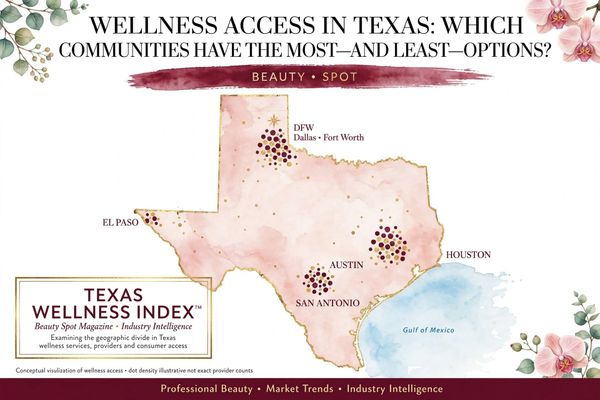
Workforce concentration in Dallas–Fort Worth, Houston, San Antonio, Austin, El Paso, the Rio Grande Valley and other regional markets.
Business survival, retention and ownership patterns.
The relationship between population growth, household income, tourism, healthcare activity and beauty-service demand.
These are not vanity metrics. They are the infrastructure of workforce intelligence.
They help educators determine where training capacity is needed. They help entrepreneurs identify saturated and underserved markets. They help policymakers understand economic participation. They help brands locate professional communities. They help beauty professionals see their work as part of a larger Texas economy.
What the Numbers Already Tell Us
Even before the statewide license and labor totals are fully assembled, the verified figures reveal a clear pattern.
750 hours create entry, but not mastery.
Four hours every two years maintain renewal, but not necessarily relevance.
One license creates authority within a defined scope, not unlimited permission.
One instructor for every 25 students establishes classroom capacity, but not educational excellence.
Ten percent of training hours marks the point at which compensated student services may begin, placing supervision and ethics at the center of school operations.
Nine advisory-board seats help shape a regulatory system serving a far more complex and diverse workforce.
Each number is a threshold.
None is the whole story.
The Future of the Texas Beauty Workforce
Texas beauty is expanding alongside the state’s population, cultural influence and appetite for personal services. Yet growth alone will not guarantee quality careers.
The next era must be built around stronger workforce visibility, better graduate tracking, advanced business education, legal literacy, clearer career pathways and a more realistic understanding of independent work.
Beauty professionals are not simply service providers. They are technical practitioners, client-experience designers, product educators, sanitation managers, content creators, community connectors and, increasingly, small-business operators.
Their economic contribution should be measured with the same seriousness applied to other skilled service industries.
The finished look may last a few weeks.
The workforce behind it shapes livelihoods for years.
Texas does not merely have a beauty industry. It has a beauty workforce—trained, regulated, entrepreneurial and still too often missing from the larger economic conversation.
The numbers are not decoration.
They are the beginning of recognition.