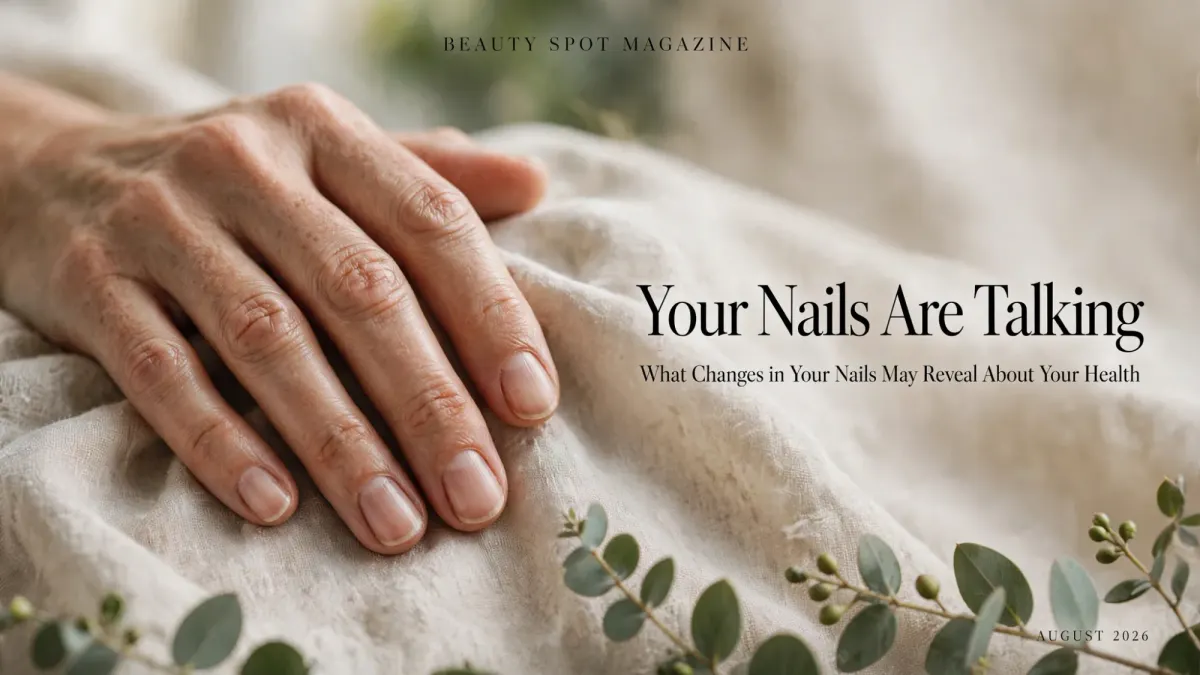
Your Nails Are Talking: What Changes in Your Nails May Reveal About Your Health
What are your nails trying to tell you? Discover what changes in nail color, texture, shape, strength, ridges, and lifting may reveal—and when a professional health evaluation may be worth considering. Read the full Beauty Spot Magazine feature.

By Beauty Spot Magazine
A manicure can conceal a chip, soften a ridge, perfect an uneven edge and transform ten fingertips into tiny works of art. What it cannot do is erase the biology beneath the polish. Nails are part of the integumentary system—the same protective system that includes the skin and hair—and their appearance can sometimes reflect what is happening locally around the nail, how the nail has been treated, or changes occurring elsewhere in the body. Professional cosmetology education recognizes nails as part of this larger system and emphasizes that beauty professionals need an understanding of anatomy and physiology to deliver nail services safely. That does not mean every ridge is a diagnosis, every pale nail signals disease, or your nail technician should become your unofficial physician. It means something subtler and far more useful: when your nails change noticeably, persistently, or unexpectedly, they deserve attention.
The Nail Is More Than the Part We Polish
The visible nail plate is composed largely of keratinized cells, but the living structures responsible for producing that plate sit beneath and around it. Growth begins in the nail matrix, while the nail bed, surrounding folds, cuticle area and blood supply all influence the appearance of the finished nail. Because fingernails grow slowly, what you see today can represent conditions or events from weeks or even months earlier. A period of illness, physical trauma, repeated chemical exposure or aggressive enhancement removal may not become fully visible until the affected portion of nail begins growing forward.
This is why context matters. A single damaged thumbnail after an acrylic removal tells a very different story from similar changes suddenly appearing across eight or ten nails. A yellow toenail compressed for years inside narrow shoes is different from rapidly evolving discoloration accompanied by thickening, pain or separation. Nail interpretation should never begin with panic. It should begin with a better question: What changed—and is it continuing?
A nail change is a clue, not a conclusion.
When Nails Become Brittle, Thin or Easily Split
Brittle nails are among the most common concerns in the beauty chair, and the explanation is often less dramatic than social media makes it sound. Frequent wetting and drying, repeated exposure to solvents, acetone, cleaning products, aggressive filing and mechanical trauma can all leave the nail plate dry, peeling or prone to splitting. Enhancement removal performed by peeling or force rather than appropriate professional removal can also compromise the surface.
But persistent brittleness can sometimes accompany nutritional deficiencies, thyroid disorders, aging-related changes or other health conditions. The key word is persistent. A nail professional can recognize that the nail has changed, ask whether the client has noticed similar changes elsewhere and recommend medical evaluation when appropriate. What the professional should not do is look at a split nail and announce, “You have a thyroid problem,” or sell a supplement as though a diagnosis has already been established.
That distinction matters in a luxury service environment. Expertise is not demonstrated by making the boldest claim. It is demonstrated by knowing where beauty expertise ends and healthcare begins.
Ridges: Normal Texture or Something Worth Watching?
Vertical ridges running from the cuticle toward the free edge become more common with age and may simply reflect normal changes in nail growth. They can also become more visible when nails are dry or thinned. In many cases, they are an aesthetic concern rather than a warning sign.
Horizontal grooves are different. Known clinically as Beau’s lines, pronounced transverse depressions can occur when nail growth is temporarily interrupted. Significant illness, high fever, major physiological stress, injury to the nail matrix and certain medical treatments may all interfere with normal growth. Because the nail continues growing afterward, the groove gradually moves toward the tip.
One isolated horizontal line on a damaged nail may have a straightforward mechanical explanation. Similar grooves appearing across several nails deserve more attention, particularly when the individual recalls being seriously ill or has experienced other unexplained health changes.
The Color Conversation
Healthy nails naturally vary in tone across skin colors and individuals, which makes generalized internet charts dangerously simplistic. Nail beds can appear pinker, warmer, cooler or more pigmented depending on natural complexion, circulation, lighting and translucency of the nail plate. Product staining also matters. Dark lacquers, certain pigments, self-tanners, dyes and smoking can alter nail color without indicating internal disease.
Yet some persistent color changes warrant professional evaluation. Nails that become unusually pale may sometimes be associated with anemia or other systemic conditions. A bluish appearance can be related to inadequate oxygenation or circulation and, particularly when accompanied by shortness of breath, chest discomfort, confusion or other acute symptoms, should not be treated as a cosmetic issue. Yellowing can result from polish staining, but thickened, crumbly, distorted yellow nails—especially on the toes—may raise concern for fungal infection and should be evaluated rather than repeatedly covered with enhancements.
Green discoloration beneath an artificial nail deserves particular respect in the salon. Moisture trapped between an enhancement and the natural nail can create conditions favorable to bacterial growth, including organisms capable of producing a green pigment. The professional response is not to camouflage the area with another opaque set. It is to stop, protect the integrity of the surrounding tissue and follow appropriate sanitation and referral protocols.
White Spots Are Usually Less Mysterious Than TikTok Suggests
One of beauty’s longest-running myths is that every white spot in a nail means calcium deficiency. Small white marks are often associated with minor trauma to the developing nail plate—sometimes from something so insignificant that the client does not remember it happening. Manicuring pressure around the matrix can contribute as well.
Widespread whitening, dramatic changes in nail coloration or abnormalities affecting numerous nails are different and should not be casually interpreted from an online checklist. Nail appearance can be influenced by many conditions, and identical-looking changes can have entirely different causes.
The editorial rule here is simple: pattern matters more than one isolated imperfection.
When the Nail Begins Lifting
Separation of the nail plate from the nail bed, called onycholysis, can occur after trauma, overfiling, repeated chemical exposure or irritation from nail products. It can also occur with certain skin disorders, infections, thyroid disease and medication reactions. Once a space forms beneath the plate, moisture and debris can accumulate, creating additional complications.
This is another point where aesthetic instinct can work against good professional judgment. The temptation may be to shorten the nail, rebalance the enhancement and disguise the separation. But when lifting is unexplained, extensive, recurring, painful or accompanied by discoloration, odor or inflamed surrounding tissue, camouflage is not the sophisticated choice. Referral is.
Pitting, Thickening and Changes in Shape
Tiny pinpoint depressions across the nail surface—known as pitting—can sometimes be associated with inflammatory skin conditions, including psoriasis. Thickened nails may result from chronic pressure, aging, trauma or fungal disease. Nails can also become increasingly curved or distorted over time.
One particularly recognizable structural change is clubbing, in which the fingertips enlarge and the nails curve more prominently around them. Clubbing can be associated with underlying lung, cardiovascular and other systemic conditions. It is not something a nail professional diagnoses. It is a visual change that, when newly developing, belongs in a conversation with a healthcare professional.
The same restraint should guide conversations about spoon-shaped nails, pronounced discoloration, unexplained dark streaks or lesions that appear to involve the tissue beneath the nail. Some of these findings can have harmless explanations; others require medical evaluation. A new or changing dark band—particularly one involving a single nail, broadening over time or extending into nearby skin—should not be dismissed as a beauty inconvenience.
The Nail Professional’s Most Underrated Skill: Observation
Professional nail care in Texas legally encompasses services such as cutting, trimming, polishing, coloring, cleansing, manicuring and pedicuring nails, attaching artificial nails, and certain services involving the hands and feet. That professional role can place nail technicians in a uniquely observant position. They may see a client’s hands every two or three weeks for years. They know whether a thumbnail has always been ridged, whether a toenail has been thick for months or whether a discoloration appeared between appointments.
That continuity is powerful—but it does not convert observation into medical authority.
Beauty Spot’s Texas compliance framework makes the larger principle clear: professional credibility grows when practitioners understand the boundaries of their license instead of treating training or experience as permission to move into medical territory. The most elevated response may be beautifully simple: “I’m noticing something different from your previous appointments. I don’t diagnose nail conditions, but because this is new, I’d like you to have a healthcare professional look at it before we cover or treat the area.”
That sentence protects the client, the professional and the integrity of the industry.
When a Nail Appointment Should Become a Health Conversation
Not every imperfect nail requires a physician. But sudden changes involving several nails; significant pain, swelling, warmth or drainage; recurrent separation; unexplained bleeding; rapidly developing discoloration; a new or changing dark streak; substantial thickening or crumbling; or nail changes occurring alongside other physical symptoms deserve professional medical assessment.
And sometimes urgency matters. Blue or gray nails occurring with breathing difficulty, chest pain, severe weakness or altered awareness belong in medical care—not beneath another layer of polish.
There is also a sanitation issue that cannot be separated from this conversation. When tissue appears infected, open, inflamed or otherwise abnormal, continuing an elective nail service may introduce additional risk. Professional education already treats cleaning, disinfection and proper pre- and post-service procedures as core components of nail practice. In an industry obsessed with flawless finished photographs, knowing when not to perform a service may be one of the highest expressions of professionalism.
Beauty Is Often Where We Notice Ourselves First
There is something intimate about hands. They reveal age, habit, profession, artistry and ritual. We inspect our nails while holding coffee, answering messages, applying serum and sitting beneath the manicure lamp. That visibility makes them one of the places where we may first notice that something feels different.
The goal is not to turn every manicure into a medical screening or every ridge into a reason for anxiety. Most everyday nail imperfections have ordinary explanations. But beauty and wellness have never existed in completely separate worlds. Skin, hair and nails are living records of exposure, growth and change, and attentive professionals can help clients notice those changes without pretending to know more than the evidence allows.
Beauty Spot Magazine’s narrative governance is built around that same discipline: distinguish what is observed from what is merely possible, never turn an association into a diagnosis, and preserve uncertainty when the evidence does not support certainty.
Your nails may be talking.
The sophisticated response is not to diagnose the conversation yourself.
It is to notice when the message has changed—and know when someone qualified should listen.


