Why Textured-Hair Education Belongs in Every Texas Cosmetology Program
Textured-hair education should be foundational in Texas cosmetology programs—not treated as a specialty. Teaching students to analyze, cut, style, protect, and consult across curl patterns builds stronger technical judgment, broader client readiness, and a more inclusive professional standard.
And Why Mannequin Practice Alone Is Not Enough
There is a moment in cosmetology education when knowing the steps is no longer enough.
A student may understand sectioning. They may be able to identify a curl pattern, repeat a blow-dry sequence, execute a twist set on a mannequin and explain the difference between thermal styling and natural styling. They may even perform beautifully when the hair is predictable, evenly distributed and sitting perfectly still on a training head.
Then a real client sits in the chair.
Suddenly, the education becomes different.
The hair has history. One section may be tighter than another. The crown may be denser. The ends may have been lightened. There may be shrinkage the student did not anticipate, tenderness in one area of the scalp, previous heat damage in another, product buildup near the roots or a client who has spent years being told that her texture is “difficult.”
This is where cosmetology moves from repetition into professional judgment.
And it is exactly why textured-hair education in Texas should include more than textbook knowledge and mannequin practice. Students need structured opportunities to place their hands in real hair while an experienced instructor stands close enough to teach them what cannot be fully communicated from a page.
Mannequins Matter. They Just Cannot Be the Finish Line.
Mannequin work has a legitimate place in beauty education.
It gives beginning students room to make mistakes. They can learn hand positioning, sectioning, tool control, basic cutting patterns and styling sequences without the pressure of working on another person. One cosmetology education model in the Beauty Spot source library describes foundational training this way: students first develop theory and technical skills on mannequins in a controlled classroom environment, then progress toward hands-on experience with guests and live models under the support of learning leaders.
That progression is important.
The mannequin should be the laboratory—not the entire clinical education.
Real hair moves differently.
Real clients communicate discomfort.
Real curls shrink.
Real coils can vary dramatically across a single head.
Real density changes how a section feels in the hand.
Real people bring chemical history, styling habits, breakage patterns, scalp sensitivities, lifestyle preferences and expectations into the consultation.
Those variables are not inconveniences. They are the profession.
Textured Hair Makes Hands-On Education Especially Important
Textured hair does not behave as one uniform category.
Even the phrase textured hair contains enormous variation: waves, curls, spirals, coils, highly textured patterns, mixed textures, chemically altered textures, heat-stretched hair, transitioning hair and hair returning to its natural pattern.
A student needs theory to understand those differences.
But the hands have to learn them too.
There is a tactile intelligence involved in professional hair work that develops through repetition: how much tension is appropriate, when resistance signals that a section needs more detangling, how saturated the hair actually is, how much product is enough, how the curl responds when released and how the entire shape changes as the hair begins to dry.
Those judgments become considerably harder to teach when the student's only reference point is manufactured hair attached to a stationary head.
Professional cosmetology materials already recognize textured-hair techniques as part of the technical landscape. Milady's practical curriculum includes blow-drying highly textured hair, working with curly and coily methods, double-strand twists, coils and beginning locs, grooming locs, wrapping coarse coily hair, silk pressing, preparing textured hair for braiding and performing a classic fade on curly hair.
The procedures exist.
The educational question is how deeply students get to experience them.
The Instructor Changes Everything
There is something extraordinarily valuable about an experienced educator watching a student's hands.
An instructor can see when the section is too large before the student sees it.
They can hear when a tool is pulling unnecessarily.
They can notice that the student is using the same tension on the perimeter that they used at the crown.
They can stop a blow-dry technique before too much heat accumulates in one area.
They can ask why the student selected a certain product, why they chose that brush, why they are starting in that section or what they think will happen when the hair returns to its natural state.
That interaction cannot be replicated by simply assigning another mannequin exercise.
It is also why instructor-led classes should be deliberately structured—not treated as students informally finding textured-hair models whenever one happens to appear on the clinic floor.
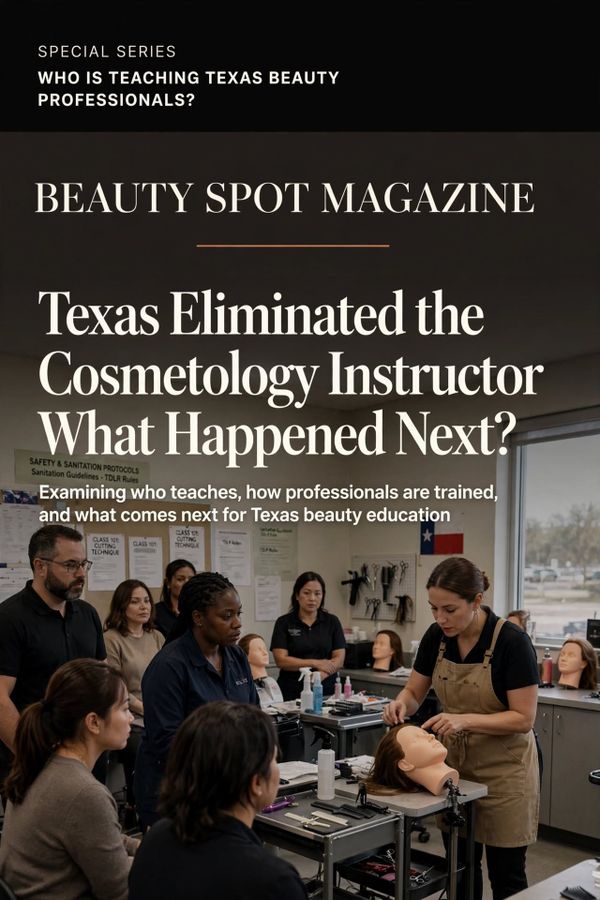
The Texas cosmetology program materials in Beauty Spot's library describe a clinic-classroom model built around guided individual attention and group learning, with instructors conducting specialty classes and practical workshops designed to build professional confidence.
That is the educational architecture textured-hair training deserves.
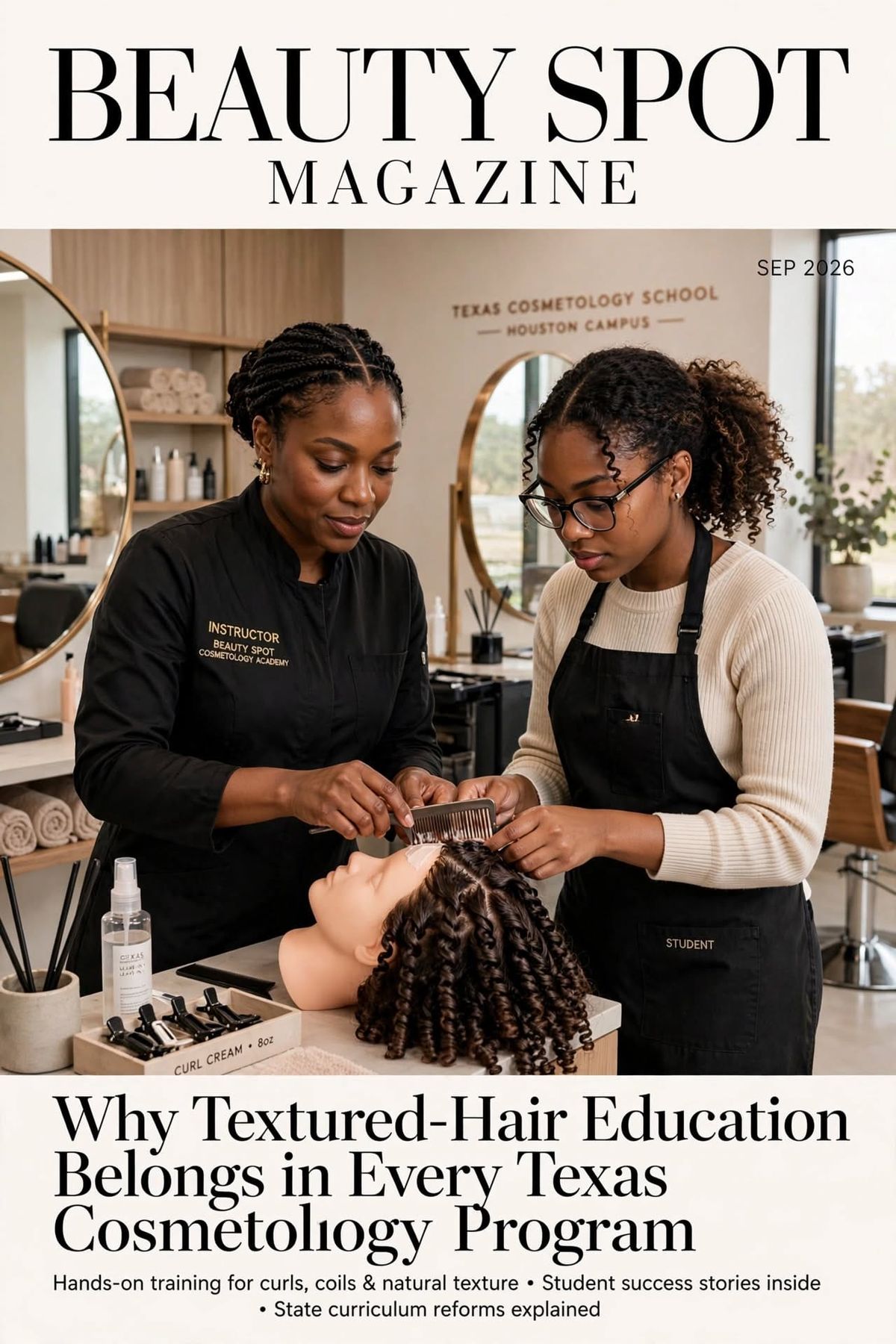
Imagine an instructor-led curl and coil lab in which the educator begins with consultation and analysis, demonstrates technique on a live model, explains product choice and tension in real time, then supervises students as they work directly on guests representing different textures.
The class could stop and compare outcomes.
Why did one side stretch differently?
Why did this curl formation need a different section size?
What happens when too much product is layered onto finer curls?
How does shrinkage alter the haircut?
When should a stylist reconsider a thermal technique?
What does the client's previous chemical history change?
That is no longer memorization.
That is professional reasoning.
Students Need to Feel the Difference
Beauty education is unusually physical.
A future stylist can read about hair density, but density becomes more meaningful when they have worked through twenty minutes of sectioning on a dense head of coils.
They can memorize porosity, but product absorption becomes clearer when they watch two different heads of hair respond differently to moisture.
They can study shrinkage, but cutting textured hair becomes a different lesson when a student watches length change as the finished hair dries.
They can learn consultation scripts, but communication changes when an actual client says, “I want volume, but I don't want you to disturb my curl pattern.”
Those experiences create memory.
And eventually, memory becomes judgment.
This does not mean abandoning textbooks, theory, demonstrations, mannequins or standardized procedures. It means recognizing the learning sequence.
Theory explains.
Mannequins introduce.
Instructors correct.
Real people teach variation.
Repetition creates confidence.
Every piece matters.
A Student Should Not Meet Their First Real Coil Pattern After Graduation
This may be the most important standard.
Graduation should not be the moment when a cosmetologist begins discovering the diversity of the clientele they were licensed to serve.
The first tightly coiled head a stylist shampoos should not have to be a paying client after school.
The first time they experience significant shrinkage should not happen during a booked haircut with a clock running.
The first time they learn that one client's head contains several different curl patterns should not happen when the client is watching them figure it out.
Education should be the place where those discoveries happen—with supervision.
That is what school is for.
A good educator can intervene.
A paying client in a busy salon cannot be expected to become the instructor.
This Is Also About Confidence
Students know when they are uncomfortable.
So do clients.
When someone sits in a salon chair and the stylist immediately begins touching the hair with uncertainty, asking another stylist what to do or quietly avoiding certain services, the experience communicates something before a word is spoken.
Confidence does not come from being told, “You can work with every texture.”
It comes from having done the work.
Again.
And again.
Under supervision.
With correction.
On different people.
That distinction matters for graduates entering a competitive Texas beauty market. A student who has experienced multiple textures in school does not have to pretend to know everything. They simply enter the industry with a larger foundation from which advanced education can grow.
Specialists will still exist—and they should.
There will always be extraordinary curl specialists, loc artists, braiders, colorists, texture experts and educators who pursue years of advanced training.
The goal of cosmetology school is not to manufacture instant specialists.
The goal is to build competent beginners.
What Stronger Textured-Hair Education Could Look Like
The future does not require throwing out mannequin education.
It requires building beyond it.
Students can begin on mannequins to establish control. Then the instructor demonstrates on a live model. Students observe consultation, analysis, preparation, technique and finishing. Next comes supervised student practice on live models, followed by critique: what worked, what changed, what the student felt and what they would do differently next time.
Over time, those models should represent more than one version of textured hair.
Different densities.
Different curl formations.
Different lengths.
Natural and previously altered hair.
Different styling goals.
Different client expectations.
That is how technical range develops.
And critically, schools should not leave students entirely responsible for sourcing these experiences themselves. If textured-hair competence is considered part of professional education, then exposure to that education should be designed into the program rather than left to chance.
The Standard Should Be Experience, Not Exposure
Seeing textured hair is not the same as learning textured hair.
Watching an instructor is not the same as performing the service.
Performing it once is not the same as developing confidence.
And completing a mannequin exercise is not the same as managing the variables of a person sitting in your chair.
Texas beauty education has an opportunity to make that distinction meaningful.
Because this conversation is ultimately larger than curl patterns.
It asks what we believe professional education is supposed to accomplish.
If school exists only to prepare a student to complete required hours and demonstrate procedures, mannequins can carry much of that burden.
But if school exists to begin preparing a professional for the realities of the salon, then supervised human experience matters.
The hands need practice.
The eye needs variation.
The student needs correction.
And the instructor needs the opportunity to say, Feel that. Look at what happened there. Now adjust.
Those are tiny moments.
But those are often the moments in which a cosmetologist is actually made.
Textured-hair education belongs in every Texas cosmetology program. But putting it in the curriculum is only the beginning. Students need the opportunity to touch the hair, understand the person wearing it and learn—with an instructor beside them—how knowledge becomes technique.
That is the difference between completing a lesson and becoming ready for the chair.