Why Exfoliation Makes Skin Glow
Exfoliation reveals smoother, brighter-looking skin by removing dull surface buildup and improving light reflection. Discover why true glow depends on precision, hydration, and barrier health in Beauty Spot Magazine.

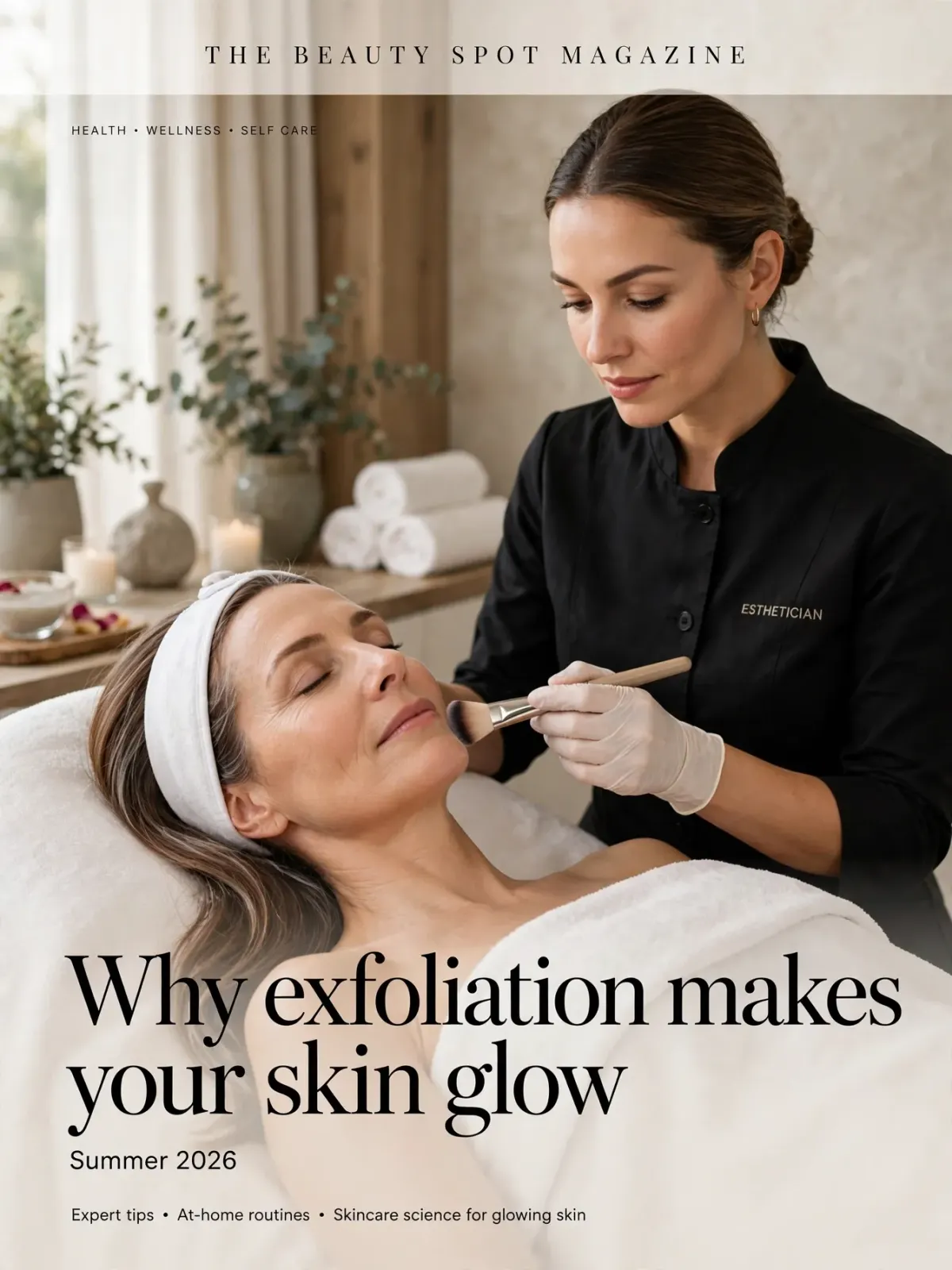
There is a particular kind of radiance that makeup cannot convincingly imitate. It appears before foundation, before highlighter, before the final mist of a treatment-room finishing spray. The skin looks smoother, clearer, more reflective and somehow more awake. Light moves across the complexion differently. Texture seems quieter. Tone looks fresher. This is the visual language of well-exfoliated skin—and it explains why exfoliation remains one of the most powerful, misunderstood and frequently overused steps in modern skincare.
Glow is often marketed as though it comes from a single brightening serum or one transformative facial. In reality, visible luminosity begins at the surface. The outermost layer of the epidermis, known as the stratum corneum, is composed largely of flattened, keratinized cells that naturally loosen and shed over time. This process is essential. It allows the skin to release older surface cells while newer cells gradually move upward through the epidermis.
But natural shedding is not always perfectly uniform.
Environmental exposure, dehydration, age, oil, product buildup and changes in the skin’s renewal rhythm can leave some of those surface cells clinging longer than desired. When they accumulate unevenly, the complexion may appear rough, muted or congested. Fine lines can look more pronounced. Makeup catches on dry patches. Skincare seems to sit on top of the face rather than melting elegantly into it.
Exfoliation helps refine that surface.
By loosening or removing a controlled amount of accumulated corneocytes—the mature cells sitting at the outermost level of the skin—exfoliation creates a smoother optical surface. That distinction matters because much of what we perceive as “glow” is influenced by how evenly light reflects from the complexion. A rough surface scatters light in multiple directions. A smoother surface reflects it more uniformly.
This is why freshly exfoliated skin often appears brighter almost immediately. The skin has not changed color in a dramatic biological sense. Its surface has become more even, allowing light to travel across it with less visual interruption.
Glow is not simply brightness. It is the appearance of light moving evenly across healthy, hydrated skin.
The Optical Science Behind Radiance
Imagine light landing on a piece of frosted glass. The surface is textured, so the light diffuses. Now imagine that same light moving across polished glass. The reflection appears cleaner, sharper and more luminous.
Skin behaves in a similar way.
When dead surface cells collect unevenly, they create microscopic irregularities. These irregularities may not always be obvious to the naked eye, but together they can make the complexion appear dull. Exfoliation reduces some of that surface irregularity, creating the polished effect clients often describe as smooth, glass-like or lit from within.
The transformation can be especially noticeable around areas where buildup tends to become visible: the sides of the nose, the chin, the forehead, the upper lip and regions where makeup frequently separates. Once the surface is refined, complexion products apply more evenly and naturally reflect more light.
This is one reason professional makeup artists and estheticians understand that beautiful makeup begins with skin preparation. Foundation cannot create a sophisticated finish over uncontrolled texture. When exfoliation is appropriate and the barrier is comfortable, makeup becomes less corrective and more editorial.
Why Skincare Feels Better After Exfoliation
Exfoliation also changes the way products feel on the skin.
A layer of compacted, flaky or uneven surface cells can make serums and moisturizers feel as though they are dragging, pilling or remaining on top of the complexion. After careful exfoliation, hydrating products often spread more smoothly and create a more supple finish.
This does not mean exfoliation makes every ingredient penetrate deeply, nor should it be used recklessly as a so-called penetration shortcut. The skin barrier exists for a reason. Its job is to regulate water loss and protect the body from environmental irritants.
The more accurate explanation is that exfoliation can improve the uniformity of the surface, allowing appropriately formulated products to make more consistent contact with the stratum corneum. Humectants can attract water, emollients can soften the surface and occlusive ingredients can help reduce moisture loss. When these elements work together, the skin appears plumper, smoother and more reflective.
In many cases, the glow attributed entirely to exfoliation is actually the combined effect of surface refinement followed by intelligent hydration.
That sequence matters.
Exfoliation without replenishment can create temporary smoothness followed by tightness, irritation and increased water loss. Exfoliation paired with barrier-supportive hydration creates a softer, more sustainable luminosity.
Physical, Enzymatic and Acid-Based Exfoliation
Not all exfoliation works in the same way.
Physical exfoliation uses friction or a textured medium to lift surface debris. This may include professionally controlled polishing products, soft facial tools or carefully formulated scrubs. Its advantage is immediacy. The skin can feel smoother after one use. Its risk is equally immediate: too much pressure, sharp particles or excessive frequency can create irritation.
Enzymatic exfoliation uses enzymes that help loosen surface proteins and accumulated keratinized material. Enzyme products are often selected when a provider wants a gentler, less friction-based approach, although “gentle” still depends on formulation, exposure time and the condition of the skin.
Chemical exfoliants use acids such as alpha hydroxy acids, beta hydroxy acids or polyhydroxy acids to loosen the bonds between surface cells. Alpha hydroxy acids are often chosen for visible texture, dryness and uneven-looking tone. Salicylic acid, a beta hydroxy acid, is oil-soluble and commonly used in routines designed for oily or congested skin. Polyhydroxy acids are often positioned as a more gradual option because of their larger molecular size, although suitability still depends on the individual.
The best exfoliant is not necessarily the strongest formula. It is the one that addresses the skin’s present condition without creating unnecessary inflammation.
When Glow Turns Into Irritation
The beauty industry has spent years teaching consumers how to exfoliate. It has spent far less time teaching them when to stop.
Overexfoliated skin can initially look deceptively smooth or shiny. But this is not the refined luminosity of balanced skin. It may be the tight, reflective appearance of a stressed surface. Warning signs can include burning when applying basic products, persistent redness, unusual sensitivity, flaking, tightness, increased breakouts or a complexion that looks polished yet feels uncomfortable.
True glow should not hurt.
Healthy exfoliation respects the barrier. It does not chase peeling, stinging or aggressive visible shedding as proof that a product is working. A sophisticated provider looks beyond the immediate shine and evaluates comfort, resilience, hydration and recovery.
This is especially important for clients using retinoids, acne medications, strong home-care acids or undergoing advanced professional treatments. Treatment timing matters. In the supplied microneedling training material, post-treatment guidance specifically advises avoiding retinol and exfoliation for 72 hours, underscoring the need to protect the skin during the early recovery window rather than layering stimulation on top of stimulation.
The Texas Professional Perspective
For Texas estheticians, exfoliation is not only a treatment decision. It is also a scope, documentation and client-safety decision.
The Beauty Spot Texas legal framework identifies cleansing, exfoliation and stimulation among the services associated with esthetic practice, while warning that aggressive chemical peels, exfoliation extending beyond superficial layers and procedures that cross into medical territory may create serious scope-of-practice concerns.
That distinction becomes commercially important in high-expectation markets such as San Antonio, Austin, Dallas and Houston, where clients may request dramatic results and providers may feel pressure to offer increasingly aggressive services.
Luxury is not measured by how intensely the skin is treated.
Luxury is measured by precision.
A premium provider understands the skin’s condition, selects an appropriate method, observes contraindications, documents the treatment and protects the client’s long-term barrier health. The Texas framework emphasizes that a professional license permits only what applicable law allows—not every technique a person may have encountered in training.
For the modern esthetician, compliance is not the opposite of creativity or results. It is part of high-trust positioning.
Exfoliation Is a Strategy, Not a Personality Type
Clients are often taught to identify themselves as someone who “needs exfoliation.” The more intelligent question is: what does the skin need today?
A client may need exfoliation one week and barrier repair the next. Seasonal humidity, travel, hormonal changes, stress, professional procedures and home-care habits can alter tolerance. In Texas, high heat and strong ultraviolet exposure add another layer of consideration. Freshly exfoliated skin should be protected carefully from sun exposure, and broad-spectrum sunscreen remains essential to maintaining an even-looking complexion.
The most effective exfoliation plans are adaptive. They consider skin type, current sensitivity, visible buildup, medication use, recent treatments and the total number of active products already in the routine.
More is not more sophisticated.
Better calibrated is more sophisticated.
The New Definition of Glow
The modern beauty client is becoming more discerning. She no longer wants a face that looks aggressively peeled, unnaturally tight or temporarily glossy. She wants skin that appears rested, refined and expensive. She wants clarity without fragility. Smoothness without inflammation. Results without losing the integrity of her barrier.
Exfoliation can help create that finish because it clears away some of what visually interrupts the complexion. It refines texture. It supports more elegant product application. It allows hydration and light reflection to become more visible.
But its greatest value emerges when it is treated as one part of a complete skin strategy—not as a weekly act of punishment.
The future of glow is not endless resurfacing.
It is intelligent renewal.
It is knowing when to polish, when to hydrate, when to protect and when to leave the skin alone. It is the discipline to understand that radiance is not created by removing as much as possible. It is created by removing only what the skin is ready to release.
That is the difference between temporary shine and true luminosity.
And in the new barrier-conscious era of beauty, that difference is everything.