TEXAS BEAUTY PROFESSIONALS PER CAPITA: WHICH COMMUNITIES HAVE THE STRONGEST WORKFORCE?
Texas’ biggest cities may have the most beauty professionals—but do they have the strongest workforce per capita? Beauty Spot examines workforce density, training pipelines and the communities that could emerge as the state’s most concentrated beauty economies.

By Beauty Spot Magazine
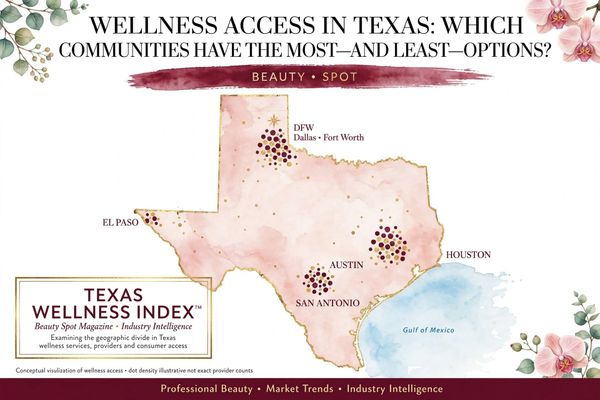
Texas has no shortage of beauty talent. From precision barbers and color specialists to estheticians, nail professionals, lash artists and independent suite owners, the state’s beauty economy is visible almost everywhere. But raw numbers tell only part of the story. Houston, Dallas, San Antonio and Austin may naturally produce large professional counts because they are large cities. The more revealing question is different: which Texas communities have built the strongest beauty workforce relative to the number of people who live there?
That is where beauty professionals per capita becomes more interesting than another list of the state’s biggest markets.
Per-capita analysis changes the conversation from scale to workforce intensity. Instead of asking where the most licensed professionals are located, it asks how deeply beauty work is embedded in a local economy. A community with 1,000 professionals serving 100,000 residents represents a very different labor environment from a city with 2,000 professionals serving one million. The second market is larger in absolute terms. The first may be considerably more concentrated.
And for beauty entrepreneurs, educators, distributors, developers and investors, concentration can reveal something far more useful than size alone.
The strongest beauty market is not always the place with the most professionals. Sometimes it is the place where beauty has become part of the economic identity of the community.
Texas law itself shows just how broad that workforce can be. The state’s barbering and cosmetology framework includes hair services, facial treatments, certain forms of hair removal, nail services, hand and foot services, hair weaving and other regulated beauty practices. Texas also licenses different establishment structures, including specialty establishments and mini-establishments, giving the professional beauty economy multiple ways to organize itself commercially.
That matters when measuring workforce strength. A serious Texas beauty-workforce analysis should not treat the industry as though everyone works behind the same type of salon chair. Modern beauty economies include traditional salons, barbershops, nail studios, esthetics practices, specialty businesses, suites, independent contractors, schools and multi-service establishments. Some communities may be especially strong in barbering. Others may have unusually dense esthetics, nail or specialty-service ecosystems. A statewide per-capita measure becomes more powerful when it can show both the total workforce and the professional mix underneath it.
The Communities Worth Watching
The current Beauty Spot source library does not yet contain a verified statewide table combining active professional licenses with comparable community population counts, so declaring a definitive No. 1 Texas community would go beyond the evidence. But the data already available does reveal where deeper investigation becomes especially compelling.
San Antonio is one of those places.
A Beauty Spot analysis of 56 beauty-school license records in the San Antonio area found programs distributed across 18 ZIP codes, with especially notable concentrations in 78221, 78238 and 78201. Those three ZIP codes accounted for 18 of the 56 school-license records examined. The broader dataset included cosmetology institutions, barber colleges, esthetics programs, specialized academies, high-school career programs and community-college pathways.
That does not prove that San Antonio has Texas’ highest number of beauty professionals per capita. Education records are not the same thing as active workforce counts.
What they do reveal is infrastructure.
Training capacity is one of the strongest early signals of a durable workforce ecosystem because schools create a recurring pipeline of license candidates, instructors, future renters, employees, independent professionals and owners. In San Antonio, that pipeline is also geographically distributed rather than limited to one luxury retail corridor.
The barbering signal is particularly striking. Eighteen of the 56 San Antonio education records analyzed included “barber” or “barbers” in the institution name—nearly one-third of the dataset. That kind of educational presence suggests an industry with enough professional identity and career demand to support multiple training businesses at once.
Beauty Spot would consider that a workforce-development strength signal, not yet a per-capita victory.
And the distinction matters.
Why Smaller Communities Could Surprise Texas
A per-capita ranking has the potential to disrupt assumptions about where Texas beauty power actually lives.
Large metropolitan areas will almost certainly remain important because their scale supports luxury spas, destination salons, advanced skincare businesses, large education networks, med-spa adjacent economies and enormous consumer bases. But density can expose another layer of the market: suburbs, regional hubs and smaller cities where beauty entrepreneurship is unusually concentrated.
A suburban community with strong household income, rapid residential development and a culture of recurring grooming and aesthetic spending could support a surprisingly large number of professionals relative to population. A regional city serving surrounding rural counties may function as the beauty-service destination for far more consumers than its resident population suggests. A border community may have its own cross-market dynamics. A university city may support younger, trend-responsive demand. And a community dense with suites and independent operators may look economically different from one dominated by traditional multi-chair salons.
This is why per-capita rankings should never be interpreted as a simple “best city” list.
They are indicators of market structure.
High workforce density can mean opportunity. It can also mean competition.
A community with a dense professional population may offer mature consumer demand, strong referral ecosystems, continuing-education opportunities and sophisticated clients. It may simultaneously demand sharper branding, stronger retention and more specialization from new entrants.
By contrast, a community with lower professional density may represent whitespace—or it may simply have weaker spending power, lower consumer demand or professionals commuting into neighboring markets.
Density tells us where to look.
It does not tell us everything we need to know.
What a Texas Beauty Workforce Index Should Measure
For Beauty Spot, the next generation of Texas beauty intelligence should move beyond a single statewide professional count.
The most useful comparison would begin with active professional licenses tied to standardized geography and divide those counts by comparable population estimates. Results could then be expressed as licensed beauty professionals per 1,000 or 10,000 residents.
But the richer story begins after that calculation.
Communities should also be examined by professional category, establishment density, training capacity, population growth and—where the evidence supports it—longitudinal change. A place gaining licensed professionals faster than population may represent an emerging beauty hub. A community losing establishments despite stable professional counts may suggest business-model migration toward suites or independent arrangements. A city with substantial school infrastructure but relatively low professional density could represent a developing workforce pipeline.
Beauty Spot’s governing data framework requires exactly this kind of discipline: geographic rankings should define their comparison group, measurement period, methodology and limitations rather than presenting position as meaning by itself.
That is especially important in beauty because licensing data and employment data are not identical. A license may be active even when a professional is not working full time. Mailing geography may differ from workplace geography. Some beauty-adjacent services fall outside the same licensing structure altogether. Texas law, for example, specifies activities that are excluded from barbering and cosmetology regulation, including threading and certain makeup-only services under defined circumstances.
A credible workforce ranking must make those boundaries visible.
Where the Business Intelligence Gets Interesting
For the industry, the value of this analysis extends well beyond bragging rights.
Educators could identify markets where professional demand is expanding faster than training capacity. Product companies could recognize geographic clusters of concentrated professional customers. Salon-suite developers could evaluate workforce density alongside household growth. Employers could see where recruiting pressure may intensify. Beauty professionals considering relocation could compare markets based on competition and professional infrastructure rather than population alone.
And communities themselves could begin to see beauty differently.
Beauty is often culturally treated as consumption—the facial, the haircut, the manicure, the lash appointment.
Economically, it is also workforce development.
It is licensing. Education. Commercial rent. Independent contracting. Product purchasing. Equipment. Continuing education. Entrepreneurship. Repeat consumer spending. And, for thousands of Texans, a pathway into business ownership.
Texas law reinforces that professional infrastructure. Licensed establishments must meet regulatory requirements, and independent contractors leasing space within licensed establishments are subject to licensing provisions as well. The beauty economy may feel highly individual at the treatment-room level, but structurally it is part of an organized professional system.
The Bigger Texas Story
The eventual answer to “Which Texas communities have the strongest beauty workforce?” may challenge the hierarchy people expect.
The winner may not be Dallas.
It may not be Houston.
It may not be Austin or San Antonio.
Once population is placed beneath professional counts, smaller communities may rise sharply. Suburbs may reveal extraordinary concentrations. Regional hubs may demonstrate that they are serving beauty economies much larger than their resident population suggests.
That is precisely why the metric matters.
Raw totals show where the industry is large.
Per-capita intelligence shows where the industry is concentrated.
And concentration tells a deeper story about culture, entrepreneurship, workforce development and local demand.
For Texas beauty professionals, that story is increasingly important. The next era of industry intelligence will not simply ask how many licenses exist. It will ask where professionals cluster, where training pipelines are strongest, where establishments are forming, which communities are gaining momentum—and where the next generation of beauty businesses has room to grow.
Because the future of Texas beauty will not be defined by one giant market.
It will be defined by hundreds of local ecosystems, each developing its own relationship between talent, population, education, entrepreneurship and demand.
That is where the real workforce map begins.