WELLNESS ACCESS IN TEXAS: WHICH COMMUNITIES HAVE THE MOST—AND LEAST—OPTIONS?
Texas may be booming with beauty, fitness, aesthetics and wellness businesses, but access changes dramatically by community. Beauty Spot examines where wellness ecosystems are strongest, where options thin out—and why geography may become the industry’s next major opportunity.

In Texas, wellness can look remarkably different depending on which side of a county line—or even which side of a city—you call home.
In one neighborhood, a consumer can move through an entire ecosystem of boutique fitness studios, dermatology offices, med spas, functional wellness practices, massage therapists, luxury facial studios, nutrition professionals, recovery concepts and membership-based health businesses without driving more than a few miles. Somewhere else, wellness may mean a considerably longer trip, fewer providers, limited appointment availability and a much narrower menu of services.
That contrast is becoming one of the most important stories in the modern Texas wellness economy.
Because the next era of wellness is not simply about what treatments exist.
It is about who can realistically reach them.
Wellness Abundance Is Becoming Geographic
Texas is unusually suited to this conversation because it contains several wellness markets at once.
The state includes enormous metropolitan economies, affluent suburban corridors, rapidly growing exurbs, regional medical centers, small cities, border communities and vast rural areas where population density can change dramatically within a relatively short drive.
That geography creates different versions of wellness access.
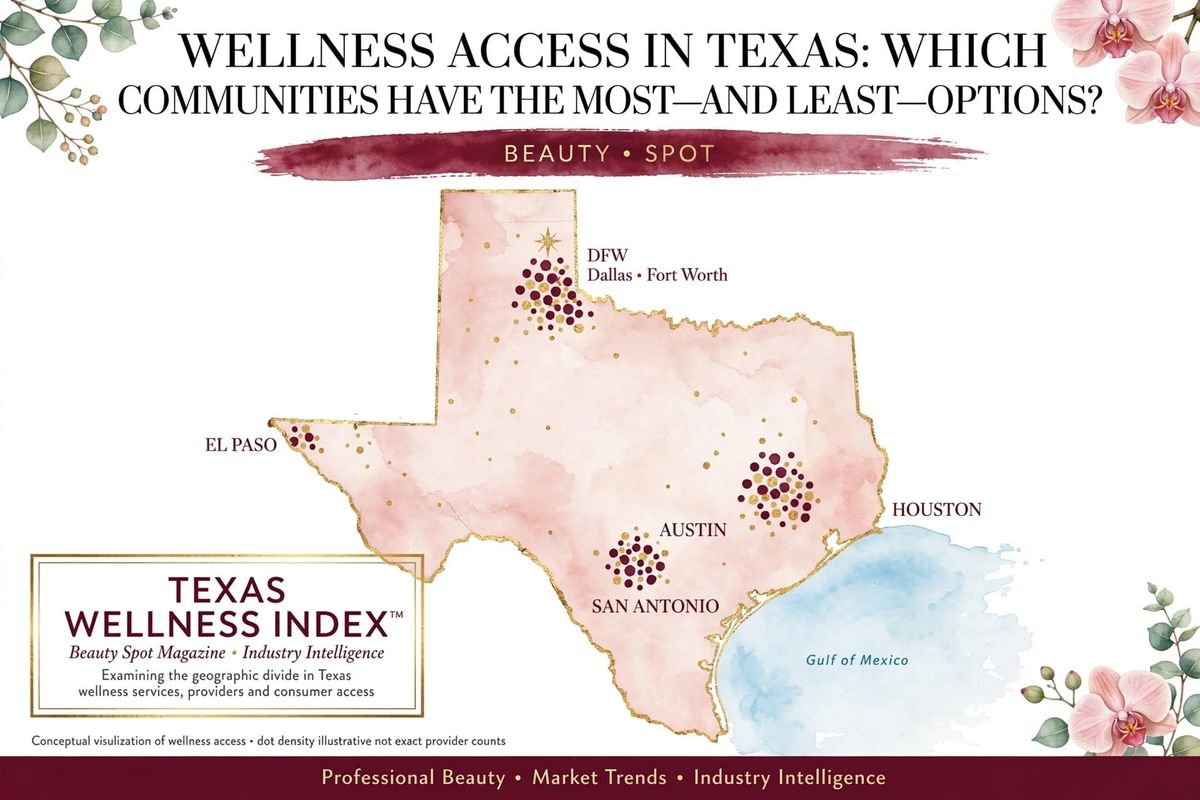
In major metropolitan areas such as Dallas–Fort Worth, Houston, Austin and San Antonio, consumers can generally encounter a much broader commercial wellness landscape. The ecosystem can include aesthetics, fitness, massage, recovery, preventive wellness, nutrition services, specialty skincare, medical wellness and increasingly sophisticated membership concepts.
But even within those metropolitan regions, abundance is not evenly distributed.
Certain suburban and high-income corridors may support dense concentrations of premium providers while neighborhoods only several miles away offer a significantly smaller commercial wellness footprint. Access can change with income, development patterns, transportation, commercial real estate, insurance participation, provider concentration and the kinds of businesses a local consumer base can economically sustain.
That means a city appearing “wellness rich” at the metropolitan level does not necessarily mean every resident experiences that abundance.
The geographic storytelling framework behind Beauty Spot’s analysis is intentionally cautious here: rankings alone cannot explain communities. Place has to be understood through position, scale, pressure, opportunity and lived relevance—not reduced to a simplistic winner-and-loser list.
Where Texas Appears to Have the Deepest Wellness Ecosystems
Without a validated statewide provider-density index attached to this article, Beauty Spot cannot responsibly declare a definitive No. 1 Texas community for wellness access.
What we can identify is the market structure.
Texas’ large metropolitan and affluent suburban areas have many of the conditions that support broad wellness choice: population scale, higher concentrations of discretionary spending, medical infrastructure, fitness culture, commercial development and consumers accustomed to paying privately for services that may sit outside traditional insurance-based healthcare.
Think of markets such as North Dallas and its surrounding suburbs, Austin’s higher-income growth corridors, Houston’s affluent residential and medical districts, and San Antonio communities where aesthetics, fitness and private-pay wellness have expanded alongside residential growth.
These places often operate as wellness clusters rather than collections of unrelated businesses.
A client may see a trainer, visit an aesthetics practice, schedule massage or recovery work, purchase professional skincare and participate in a medically supervised wellness program—all within the same consumer lifestyle.
That interconnectedness matters.
A wellness-rich community is not simply one with a high number of businesses. The stronger ecosystem is one in which consumers have meaningful choice across multiple categories.
That distinction is especially important for beauty professionals.
For an esthetician or spa entrepreneur, being located in a market with twenty competing facial providers may feel saturated. But if that same market also contains thriving gyms, salons, physicians, wellness clinics, bridal businesses, luxury retail, hotels and health-conscious consumers, the underlying referral ecosystem may actually be stronger.
What looks like competition can also be infrastructure.
The Other Texas Wellness Reality
Drive farther away from the state’s strongest population centers and the equation can change quickly.
Many smaller and rural Texas communities operate with fewer specialized providers and greater travel requirements. A consumer may have access to primary healthcare but fewer choices in dermatology, advanced aesthetics, specialty fitness, therapeutic wellness, nutrition counseling or other services associated with today’s broader wellness economy.
This should not be interpreted as meaning those communities are uninterested in wellness.
Demand and supply are not the same thing.
A town can have residents deeply interested in skincare, weight management, healthy aging, fitness or preventive wellness while still lacking enough provider density to create broad consumer choice.
And distance becomes part of the experience.
A forty-five-minute or hour-long drive changes the economics of a facial, wellness consultation or recurring fitness appointment. It adds fuel, scheduling complexity, childcare considerations and lost time. A service may technically exist within the region while remaining functionally difficult to access on a recurring basis.
This is why counting businesses alone will never tell the full Texas story.
Availability is not automatically accessibility.
Access Is More Than a Pin on a Map
A meaningful Texas wellness-access model would need to examine several layers simultaneously.
Provider availability matters, but so do travel distance, appointment capacity, affordability, service diversity, transportation and whether consumers can obtain services appropriate to their actual needs.
Cultural relevance matters too.
A community may contain wellness businesses but still leave consumers searching for providers experienced with diverse skin tones, textured hair, multilingual communication, culturally informed care or specific health and beauty concerns.
There is also the question of professional scope.
A large number of beauty businesses does not necessarily mean a community has access to medical services, just as proximity to a medical practice does not replace the expertise of licensed beauty professionals operating within their lawful scope.
Texas beauty professionals work inside defined regulatory boundaries, making collaboration increasingly important when consumer demand crosses between beauty, wellness and healthcare. Beauty Spot’s Texas legal framework emphasizes that professional growth must remain anchored to scope, sanitation, licensing and compliance rather than simply following whatever treatment is trending.
The strongest wellness communities of the future may therefore be the ones that develop not simply more businesses, but better-connected professional ecosystems.
San Antonio Shows Why Neighborhood-Level Analysis Matters
San Antonio offers a useful example.
At the city level, the market contains healthcare systems, fitness businesses, medical aesthetics, independent estheticians, massage providers, salons and a growing private wellness culture.
But San Antonio is not one consumer market.
Stone Oak does not behave exactly like the Medical Center. The Pearl and surrounding urban core do not behave exactly like far West San Antonio. Alamo Heights, north-central neighborhoods and rapidly developing outer corridors each carry different combinations of household economics, commercial density, age distribution and wellness behavior.
That distinction becomes critical for entrepreneurs.
A provider deciding where to open a practice should not simply ask, “Does San Antonio have demand?”
The stronger question is:
Where inside San Antonio is demand growing faster than convenient access?
That is where geography begins to become business intelligence.
The Most Interesting Communities May Be the Ones in the Middle
The biggest commercial opportunity may not exist in the Texas communities with the highest provider concentration—or those with virtually no wellness economy.
It may exist in the middle.
These are growing suburban, exurban and regional markets where population and consumer expectations are expanding faster than the local wellness infrastructure.
A community approaching sufficient scale to support specialized wellness services can create attractive whitespace for independent estheticians, fitness professionals, massage practitioners, wellness concepts and medically supervised practices.
The opportunity, however, should never be read from population growth alone.
Businesses still need to understand income patterns, competition, licensing requirements, consumer behavior, travel patterns and whether a market can support repeat—not merely occasional—purchasing.
Beauty and wellness businesses live on recurrence.
A market that can generate one celebratory facial is different from a market that can support monthly skincare, fitness memberships, maintenance aesthetics and long-term wellness relationships.
The Next Luxury Metric: Convenience
Luxury wellness has traditionally been defined by environment, exclusivity, technology and service.
Increasingly, it is also being defined by friction.
How hard is it to book?
How far must the client drive?
Can several parts of her wellness routine exist within the same lifestyle radius?
Can she schedule services around work, family and everyday life?
The modern luxury client is not merely purchasing treatment quality.
She is purchasing ease.
That makes geographic convenience one of the least discussed competitive advantages in beauty and wellness.
For a sophisticated provider, the opportunity may not be adding another trendy treatment to an already crowded menu.
It may be becoming the trusted option in a community where clients previously had to leave their neighborhood to find one.
What Texas Should Watch Next
The wellness-access story is far from finished.
Population growth continues to reshape Texas metros and their outer rings. Private wellness is becoming increasingly connected to fitness, healthy aging, aesthetics, recovery and preventive lifestyle behavior. Consumers are also becoming more sophisticated about where beauty ends, where medicine begins and when coordinated professional expertise matters.
Beauty Spot will be watching the places where these forces intersect: fast-growing suburbs gaining new providers, communities where demand appears to exceed supply, rural and regional markets experimenting with new delivery models, and metropolitan neighborhoods where impressive citywide wellness abundance may conceal highly uneven local access.
The International Data Backbone governing this analysis treats access differences, geographic hotspots and market whitespace as legitimate story opportunities—but it also requires that evidence, methodology and geography be validated before a formal ranking is published.
That distinction matters.
A future Beauty Spot Texas Wellness Access Index could eventually answer the headline question quantitatively: which communities truly have the greatest range of wellness options per resident, which require the greatest travel burden, where specialty categories are missing and which emerging markets are closing the gap.
Until that methodology is complete, the most defensible conclusion is also the most important one:
Texas does not have one wellness economy. It has hundreds of local wellness economies operating at dramatically different levels of maturity.
And for consumers, providers and beauty entrepreneurs alike, where you live may increasingly determine not simply which wellness services you choose—but how many choices you have in the first place.