Licensed to Practice. Qualified to Teach?
A professional license may qualify someone to perform beauty services—but does it make them ready to teach? Beauty Spot examines Texas law, educator credibility, private certifications, scope of practice, and why tomorrow’s beauty educators need more than technique to lead responsibly.

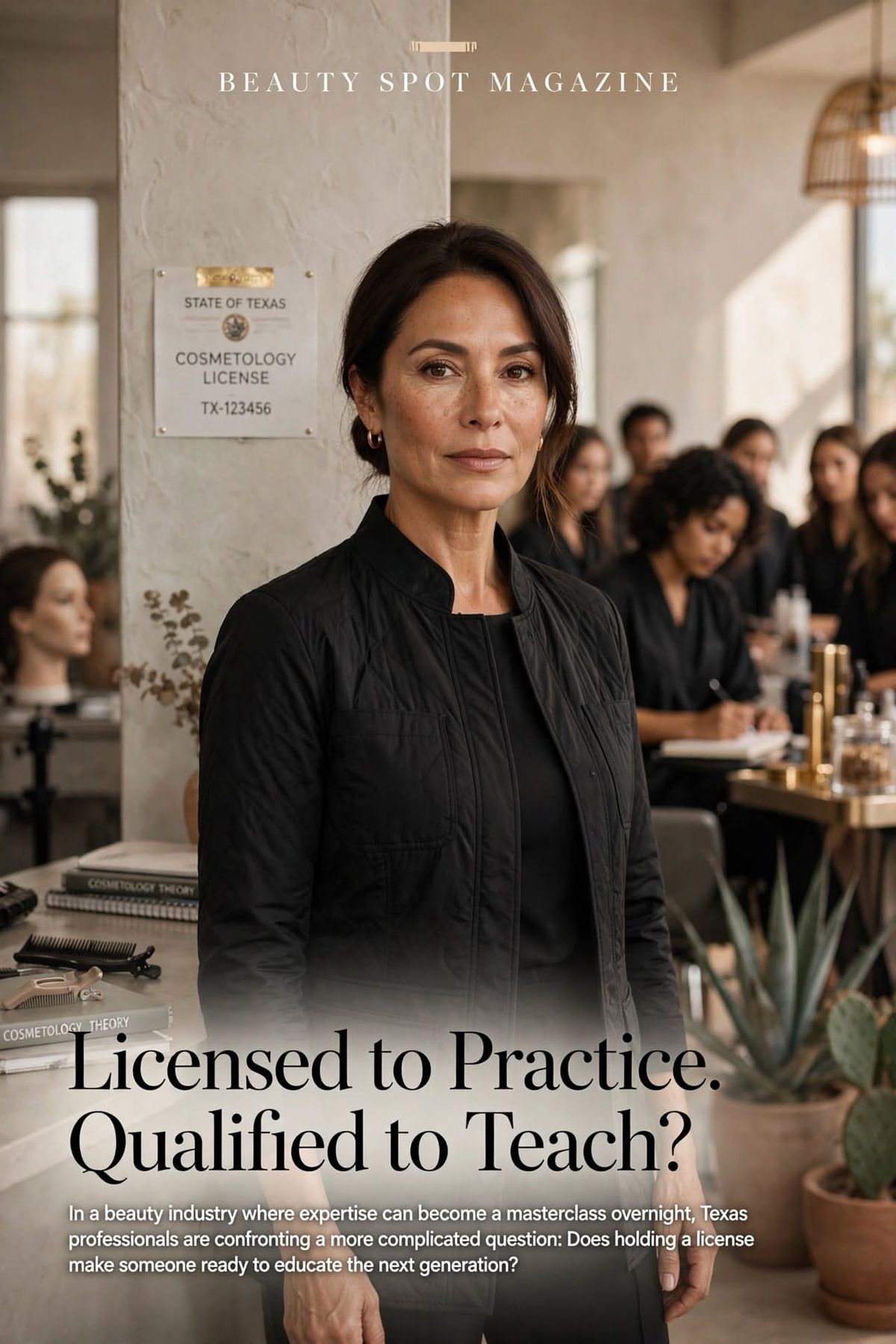
In a beauty industry where expertise can become a masterclass overnight, Texas professionals are confronting a more complicated question: Does holding a license make someone ready to educate the next generation?
There is a particular kind of authority that comes with a beauty license. It represents hours completed, examinations passed, professional standards met, and permission from the state to perform a defined category of services. For a newly licensed esthetician, cosmetologist, nail professional, or other beauty practitioner, that credential can feel monumental because it is. A license marks the transition from student to professional. It allows someone to enter the treatment room, salon floor, studio, or spa and begin building the experience that eventually becomes a career.
But somewhere along the trajectory of modern beauty culture, another transition became almost automatic.
Practitioner became educator.
A successful service became a class. A technique became a certification. A booked treatment room became a training academy. A social following became evidence of expertise.
And suddenly, the industry's most important educational question became one almost no one wanted to ask:
Licensed to practice—but qualified to teach?
It is not an attack on independent educators. Quite the opposite. Beauty Spot believes education is one of the industry's most powerful engines for professional mobility, innovation, and economic growth. Experienced practitioners should teach. Specialists should share what they know. Talented professionals should create educational businesses.
But professional education carries a responsibility different from performing a service.
Because the moment someone begins teaching another professional, the consequences of what they know—and what they do not know—multiply.
The License Is a Starting Point, Not the Entire Résumé
Texas law provides an important legal baseline. A licensed barbering or cosmetology school may provide instruction in services for which the school has been approved, and the person providing that instruction must hold the appropriate license permitting that individual to perform the acts being taught.
That requirement matters.
It prevents a person with no applicable professional credential from simply walking into a licensed school and teaching regulated beauty services.
But regulatory eligibility and educational excellence are two different standards.
A professional license establishes permission to practice within a legally defined scope. It does not automatically demonstrate that the license holder understands adult-learning theory, curriculum development, student assessment, contraindication analysis, classroom management, documentation, instructional sequencing, or how to recognize when a student has memorized a procedure without actually understanding it.
A brilliant esthetician may not yet be a brilliant educator.
A technically gifted nail artist may struggle to explain why a technique works.
A cosmetologist with twenty years behind the chair may possess extraordinary intuitive skill but still need training to translate that intuition into a repeatable learning system.
And a practitioner who learned an advanced treatment in a weekend course may be several educational layers removed from being prepared to teach that treatment responsibly to someone else.
That distinction deserves more respect.
Knowing how to perform a procedure is not the same as knowing how to produce a competent professional.
Beauty Education Has Entered the Creator Economy
The transformation is cultural as much as regulatory.
Education was once concentrated inside cosmetology schools, manufacturer academies, professional associations, apprenticeships, and structured advanced-training organizations. Social media changed that ecosystem almost overnight.
Today, a professional can develop a technique on Monday, film it on Wednesday, design a digital flyer on Thursday, and sell twenty seats to a weekend training by Friday.
Some of those educators are exceptional.
They bring years of experience, documented outcomes, sophisticated safety systems, carefully constructed manuals, strong mentoring, and genuine commitment to student competency. Many independent educators are filling important gaps that traditional beauty education has been slow to address.
But the same low barrier to launching education has also created an uncomfortable reality: marketing authority can now develop faster than professional authority.
Beautiful branding can make a two-day course look like an institution.
Follower counts can look like credentials.
Before-and-after photography can create the appearance of clinical certainty.
And certificates printed on heavyweight paper can imply a qualification that neither the educator nor the student fully understands.
A certificate of completion can document that someone attended training.
It does not automatically create a new state license.
It does not expand an existing scope of practice.
And it does not transform a procedure outside a professional's legal authority into one they may now legally perform.
That distinction is especially important in advanced aesthetics, where language such as medical-grade, corrective, regenerative, clinical, and advanced can blur the boundary between cosmetic education and medical practice.
Beauty Spot's Texas compliance framework emphasizes a principle every educator should understand before creating a training program: a professional license authorizes only what the law allows—not everything a practitioner may have been taught somewhere else.
Teaching cannot expand that boundary.
When Technique Travels Faster Than Regulation
The fastest-growing areas of beauty education are also frequently the areas requiring the greatest caution.
Advanced exfoliation. Devices. Needling concepts. Corrective treatments. Energy-based technologies. Cosmetic enhancement. Regenerative terminology. Procedures marketed alongside medical aesthetics.
These subjects attract students precisely because they appear to offer differentiation and premium earning potential.
But advanced education cannot begin with the question, Can I teach this technique?
It must begin further upstream:
Who may legally perform it?
Under what professional license?
In what environment?
At what depth or intensity?
With what oversight?
Using which devices or products?
And does completing this training actually authorize the student to provide the service?
The answers may not be identical from one procedure—or one professional license—to another.
This is why the phrase certified in deserves careful handling.
The beauty industry often uses certification colloquially to describe private training. But consumers and students may interpret the word very differently. They may hear certified and assume government authorization, professional licensure, or a formally recognized expansion of scope.
Responsible educators explain the distinction.
Great educators make it impossible to misunderstand.
A Classroom Is Also a Safety Environment
In Texas licensed schools, curriculum itself is not casual. Schools must submit course length and curriculum content for department approval, and the program must be structured to reasonably ensure students develop the job skills and knowledge necessary for employment. Texas law also establishes an instructor-to-student ratio of at least one instructor for every 25 students on a licensed school's premises.
Those requirements reveal something deeper about education.
Teaching is not simply demonstrating a beautiful result.
It is building competency.
That requires an educator to know not only what success looks like but what failure looks like before it becomes dangerous.
An experienced educator should be able to identify incorrect pressure, poor sanitation, contraindications, compromised barriers, improper product selection, device misuse, technique drift, weak consultation skills, and gaps in student judgment.
More importantly, the educator should know when not to let the student proceed.
The most sophisticated educators are not defined by how many techniques they can demonstrate.
They are defined by how clearly they understand the limits of those techniques.
The Continuing-Education Distinction Matters Too
Another point frequently misunderstood in the professional marketplace is the difference between general professional training and state-recognized continuing education.
Texas maintains requirements for approved continuing-education providers and courses. Current TDLR course-approval materials require qualifying CE content to comply with applicable Texas law and agency criteria, including prescribed education topics for license renewal.
That means a class may be useful, advanced, beautifully produced, and genuinely valuable without necessarily qualifying as state-approved continuing education.
Educators should make that distinction transparent in their marketing.
Students deserve to know exactly what they are purchasing:
professional development,
manufacturer education,
private certification,
skill enrichment,
or approved continuing-education credit.
Those categories can all have value.
They simply are not interchangeable.
Experience Should Count—But It Should Be Interrogated
Years in the industry matter.
Repetition creates pattern recognition that textbooks cannot fully reproduce. A professional who has treated thousands of clients has likely encountered variables a newly licensed practitioner has never seen.
But time alone is an imperfect measure of expertise.
Ten years of thoughtful practice is different from repeating the same year ten times.
The educator of the future will need more than seniority. The strongest instructors will combine technical experience with ongoing education, legal awareness, evidence evaluation, communication skill, business ethics, cultural competency, and the humility to revise what they teach when standards change.
That last quality may be the most important.
Beauty evolves quickly.
Products change.
Devices change.
Regulations change.
Scientific understanding changes.
What was taught five years ago may need qualification today.
True authority is not the ability to speak with absolute certainty.
It is the ability to distinguish what is established, what is evolving, what remains disputed, and what lies outside one's professional authority.
The New Luxury in Beauty Education Is Credibility
The premium beauty client has become more sophisticated.
So has the premium beauty student.
Professionals investing hundreds—or thousands—of dollars in education are beginning to look beyond the Instagram reel.
They want to know who developed the curriculum.
How long the educator has practiced.
Whether protocols align with professional scope.
Whether safety and contraindications are taught with the same enthusiasm as technique.
Whether students are assessed.
Whether there is post-course mentoring.
Whether the instructor can explain not merely how but why.
And increasingly, they want to know exactly what the certificate at the end of class means.
This is good for the industry.
It moves beauty education away from personality-driven authority and toward professional trust.
For educators, that is not a limitation.
It is a competitive advantage.
Imagine being able to say that your program is intentionally designed around legal scope, learning objectives, sanitation, contraindications, competency assessment, case selection, documentation, aftercare, business ethics, and professional limitations.
That is not less glamorous than a beautifully branded masterclass.
That is luxury education.
Because luxury has never truly been about excess.
It is about precision.
From Practitioner to Educator
The beauty industry does not need fewer educators.
It needs more prepared ones.
Practitioners with genuine experience should build academies. Product developers should teach chemistry. Estheticians should mentor new estheticians. Nail professionals should preserve techniques that took decades to master. Cosmetologists should build programs that prepare future professionals for careers beyond the state examination.
But the title educator should represent something.
It should mean that the person standing at the front of the classroom has accepted responsibility not only for demonstrating a technique but for shaping another professional's judgment.
Because students carry their teachers into every treatment room they enter afterward.
They carry their sanitation habits.
Their consultation language.
Their shortcuts.
Their confidence.
Their blind spots.
Their understanding of scope.
Their respect—or lack of respect—for professional boundaries.
One educator can influence hundreds of treatments they will never personally witness.
That is extraordinary power.
And it deserves an equally extraordinary standard.
The Question That Should Come Before the Class
The future of beauty education will not be decided by whether professionals continue creating independent training.
They will.
The question is whether the industry will mature enough to distinguish access to education from authority to educate.
A license proves something important.
Experience proves something else.
Teaching requires another layer entirely.
Texas gives professionals a legal framework for practice and licensed-school instruction, but the industry's highest standards will always require more than minimum eligibility. They will require educators who understand the law, respect the limits of their licenses, build curriculum intentionally, teach safety as rigorously as technique, and care more about student competency than certificate volume.
The professional who wants to teach should therefore ask a question far more demanding than:
Am I allowed to teach this?
The better question is:
Am I prepared to be responsible for what happens after my student leaves the room?
Because licensed to practice may open the door.
Qualified to teach is the standard that determines what happens once you walk through it.