Understanding Your Skin Type
Understanding your skin type changes everything. It helps you choose products with intention, recognize dehydration or sensitivity, and avoid overcorrecting the complexion. Skin type is your baseline; skin condition is the conversation happening on top of it. Read the skin before chasing the trends.

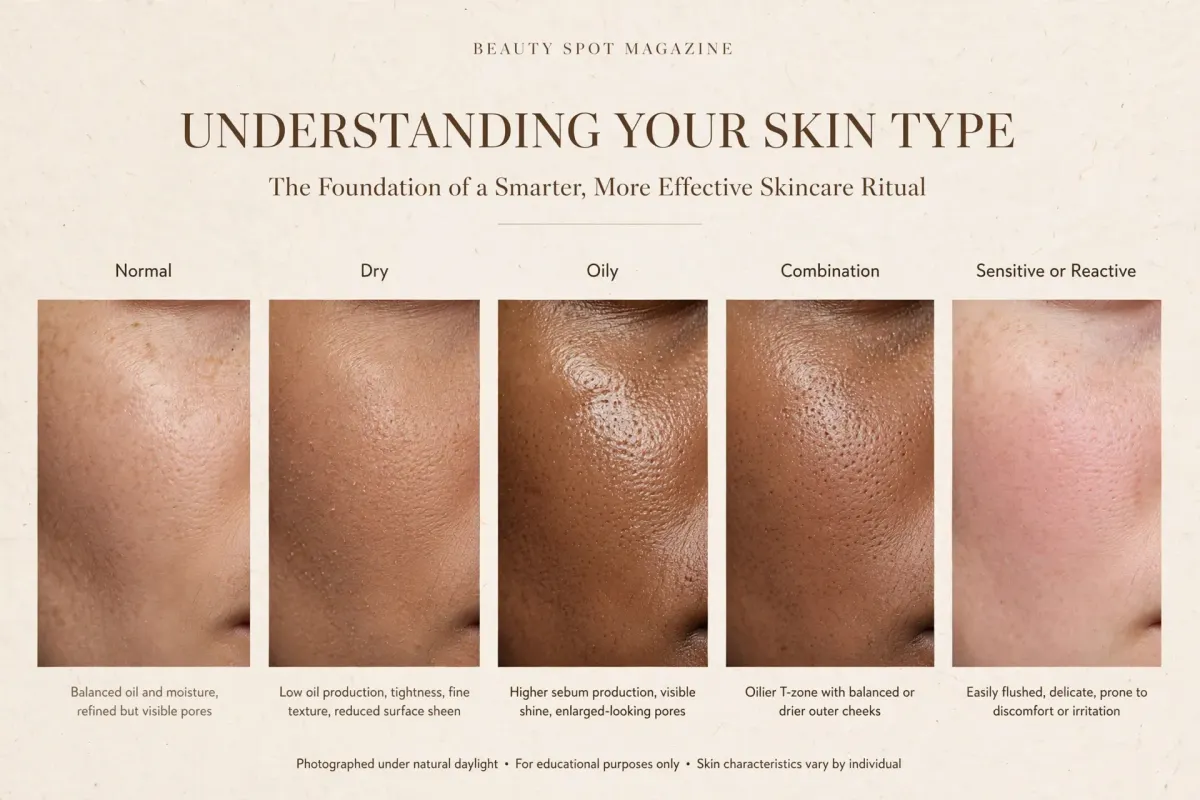
The Foundation of a Smarter, More Effective Skincare Ritual
Beautiful skin rarely begins with the latest serum, the strongest exfoliant, or the most luxurious treatment on the menu. It begins with something far less glamorous—and far more powerful: understanding what your skin is actually asking for.
Skin type is the baseline personality of the complexion. It influences how much oil the skin naturally produces, how comfortably it retains moisture, how visible the pores may appear, and how the complexion tends to respond to products, climate, makeup, stress, and professional treatments. Yet skin is not a static category waiting to be labeled once and forgotten. It is living tissue, constantly responding to hormones, age, environment, lifestyle, medication, seasonal shifts, and the condition of its protective barrier.
That distinction matters. Many people spend years treating the wrong problem because they confuse skin type with skin condition. Someone with naturally oily skin may also be dehydrated. Someone with dry skin may experience acne. A combination complexion may become sensitized after aggressive exfoliation. A person who has always considered their skin “sensitive” may actually be dealing with a temporarily impaired barrier, an inflammatory condition, or an ingredient reaction.
Understanding your skin type is not about placing the face into a rigid beauty category. It is about learning how to read the complexion with more accuracy, restraint, and intelligence.
Your skin type is the foundation. Your skin condition is the conversation happening on top of it.
Skin Type Versus Skin Condition
Skin type generally refers to the skin’s natural pattern of oil production and moisture balance. The most commonly recognized categories are normal, dry, oily, combination, and sensitive or reactive skin.
Skin conditions are different. Dehydration, congestion, acne, hyperpigmentation, visible redness, rough texture, dullness, and signs of barrier disruption may appear across several skin types. These conditions can change quickly, sometimes within days or weeks, while the underlying skin type tends to remain more consistent.
This is why product shopping based on a single concern can become misleading. A person may see flaking and immediately assume they have dry skin, when the real issue is dehydration caused by over-cleansing or excessive use of exfoliating acids. Another client may notice shine and reach for harsh oil-control products, even though the skin is producing more oil in response to irritation and water loss.
An experienced esthetician looks beyond the most visible symptom. Professional skin analysis considers texture, oil distribution, pore appearance, hydration, sensitivity, lesion type, lifestyle, current products, recent treatments, medications, and contraindications. Recognizing when a concern requires referral to a healthcare professional is also an essential part of responsible practice; diagnosing or treating disease is not within the cosmetology or esthetics role.
Normal Skin: Balanced, but Not Maintenance-Free
Normal skin is often described as balanced. Oil production is generally moderate, pores are usually less noticeable, and the complexion tends to feel comfortable rather than excessively tight or greasy. Texture may appear smooth, and breakouts are typically occasional rather than persistent.
The word “normal,” however, should not be mistaken for perfect. Balanced skin can still become dehydrated, sun-damaged, sensitized, congested, or uneven in tone. It still requires daily cleansing, moisturization, antioxidant support, and consistent sun protection.
The ideal routine for normal skin is less about correction and more about preservation. A gentle cleanser, a well-formulated moisturizer, broad-spectrum sunscreen, and carefully selected treatment products can help maintain resilience without overwhelming the complexion.
The greatest mistake made with normal skin is unnecessary intervention. Because the skin tolerates products well, clients may be tempted to layer multiple acids, retinoids, scrubs, masks, and active serums simply because they can. Over time, this can disturb a complexion that was functioning beautifully on its own.
Balanced skin does not need to be pushed. It needs to be protected.
Dry Skin: A Lipid Story
Dry skin naturally produces less sebum, the oily substance that helps soften and protect the skin’s surface. It may feel tight, especially after cleansing, and can appear thin, matte, rough, flaky, or more visibly lined. Pores are often less noticeable, although texture may become more pronounced when the skin lacks adequate lipids.
Dry skin is not the same as dehydrated skin. Dryness refers primarily to insufficient oil, while dehydration refers to insufficient water. A dry complexion is often dehydrated as well, but an oily complexion can also lack water.
The most supportive routine for dry skin focuses on comfort, replenishment, and barrier preservation. Cream or milk cleansers, humectants such as glycerin or hyaluronic acid, lipid-rich moisturizers, ceramides, fatty acids, and occlusive ingredients may help reduce water loss and improve suppleness.
Over-cleansing is particularly disruptive for dry skin. Foaming cleansers, hot water, frequent scrubbing, and strong exfoliation can remove the limited surface lipids the skin is already struggling to maintain. The result may be increased sensitivity, flaking, stinging, and a dull, fragile appearance.
In climates with intense heat, strong air conditioning, or low indoor humidity, dry skin may require more strategic layering. Texas clients, for example, may experience outdoor heat and perspiration followed by hours in aggressively cooled indoor environments. The skin can feel both warm and tight, making lightweight hydration beneath a protective moisturizer especially valuable.
Oily Skin: Abundant Sebum, Not Unlimited Strength
Oily skin produces more sebum and may show visible shine throughout the day, enlarged-looking pores, congestion, blackheads, or a greater tendency toward blemishes. The texture may feel thicker, and makeup may separate more quickly in oil-prone areas.
Oily skin is frequently overtreated. Many clients attempt to remove every trace of oil with stripping cleansers, alcohol-heavy toners, abrasive scrubs, and repeated clay masks. While these products may create an immediate matte finish, the longer-term result can be irritation, dehydration, barrier disruption, and an even more noticeable contrast between surface oil and underlying water loss.
The goal is not to eliminate sebum. Sebum contributes to softness and surface protection. The goal is to manage excess oil while maintaining a healthy barrier.
A balanced routine may include a gentle gel cleanser, lightweight hydration, non-comedogenic moisturization, sunscreen, and carefully introduced ingredients such as salicylic acid or niacinamide. Exfoliation should be purposeful rather than aggressive. More is not automatically better, particularly when inflammatory acne, open lesions, or persistent irritation is present.
Oily skin can also be sensitive. It can become dehydrated. It can experience rosacea, pigmentation, and barrier impairment. Shine does not equal resilience.
Combination Skin: Different Needs, One Complexion
Combination skin usually presents with greater oil production through the forehead, nose, and chin while the cheeks remain normal, dry, or less active. Pores may look more visible in the central face, and congestion may concentrate around the nose or chin.
This skin type requires flexibility. Treating the entire face as oily can leave the cheeks tight and irritated. Treating the entire face as dry can make the T-zone feel heavy or congested.
A zone-based approach is often more effective. A lightweight moisturizer may be sufficient across the face, with a richer layer applied only where needed. Clarifying masks or exfoliating products can be concentrated in oilier areas instead of being used from hairline to jawline. Hydrating serums can support the entire complexion without creating excessive weight.
Combination skin also changes noticeably with weather and hormones. The T-zone may become more active during humid months, while the cheeks feel drier during winter or after travel. The correct routine may therefore shift throughout the year.
Sophisticated skincare is not always symmetrical. Sometimes the forehead and the cheeks require different conversations.
Sensitive and Reactive Skin: A Pattern That Requires Attention
Sensitive skin is often characterized by stinging, burning, itching, flushing, or discomfort in response to products, weather, heat, friction, or environmental exposure. Some people are constitutionally more reactive, while others develop temporary sensitivity after over-exfoliation, sun exposure, professional treatments, medication changes, or damage to the skin barrier.
It is important not to treat “sensitive” as a complete diagnosis. Persistent redness, scaling, lesions, sudden swelling, or recurring inflammation may require evaluation by a qualified medical professional. Estheticians can observe, document, modify services, and refer when appropriate, but they should not diagnose disease.
A sensitive-skin routine should be edited rather than crowded. Fragrance-free or low-irritant formulations, gentle cleansing, barrier-supportive moisturizers, and daily sunscreen often form the foundation. New products should be introduced one at a time so reactions can be identified more clearly.
The luxury approach to sensitive skin is not excessive pampering. It is precision. Fewer variables, better formulations, careful observation, and respect for the skin’s threshold can create more meaningful improvement than an overflowing shelf of “calming” products.
How to Observe Your Skin More Accurately
To gain a clearer picture of your skin type, cleanse with a gentle product, avoid applying treatment serums or heavy moisturizers, and observe how the skin behaves over the next hour. Does the entire face feel tight? Does shine develop everywhere or mainly through the center? Are the cheeks comfortable while the nose becomes oily? Does the skin sting, flush, or feel unusually warm?
This simple observation can offer clues, but it is not a medical test. Recent exfoliation, weather, menstrual cycles, medication, travel, stress, and product use can influence what you see.
A professional consultation adds context. Client history and record keeping are central to responsible facial services, and a skilled provider should consider contraindications before recommending a treatment. In Texas, professional ambition must remain aligned with licensed scope. Training alone does not authorize every technique, device, or level of tissue interaction, and aggressive services that move into medical territory require appropriate oversight and credentials.
The Skin Can Change Without Becoming a Different Skin Type
Age, hormones, pregnancy, menopause, climate, stress, illness, medication, and treatment history can alter the complexion. Oil production may decrease over time. A once-comfortable routine may suddenly feel too active. Acne may appear in adulthood. A humid summer may intensify shine, while winter heating creates dehydration.
These changes do not always mean your foundational skin type has completely transformed. Often, a new condition has developed on top of it.
This is why skincare should be reviewed rather than repeated automatically. Products that worked five years ago may no longer serve the current complexion. A routine built during an acne flare may be too aggressive once inflammation has settled. A rich winter moisturizer may feel excessive in August. Intelligent skincare evolves.
The Real Goal: Skin Function, Not Skin Perfection
The beauty industry has spent decades encouraging consumers to chase poreless, textureless, permanently luminous skin. Real skin has pores. It produces oil. It responds to hormones, weather, sleep, stress, and time. The objective is not to erase every sign of biology.
The objective is to support healthy function.
When you understand your skin type, product selection becomes more deliberate. Treatments become more strategic. Irritation becomes easier to trace. You begin to recognize the difference between a temporary reaction and a long-term pattern. Most importantly, you stop treating your complexion according to trends and begin caring for it according to evidence.
The most elevated skincare ritual is not the one with the most steps.
It is the one that understands the skin in front of it.