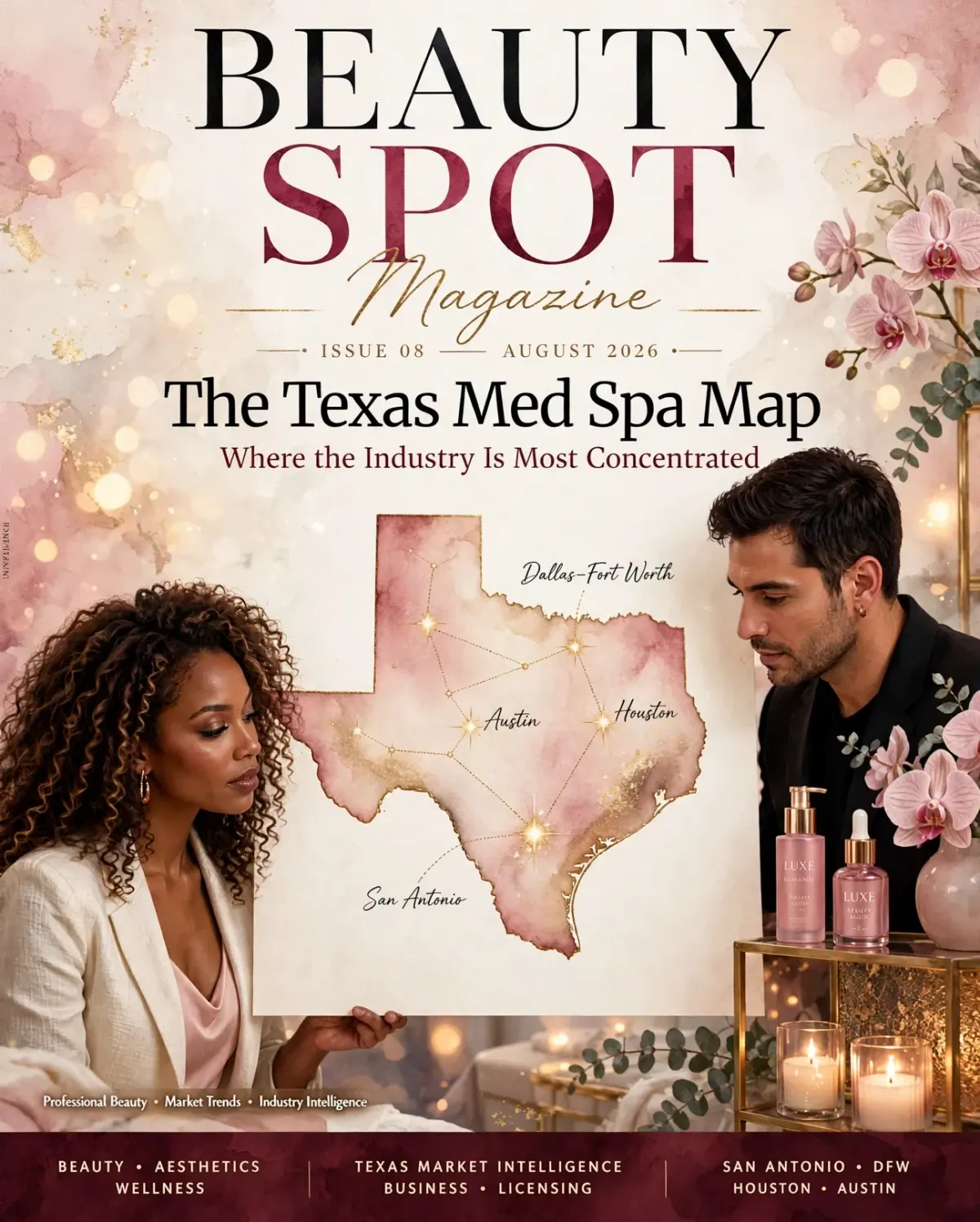
The Texas Med Spa Map: Where the Industry Is Most Concentrated
Explore where Texas’ med spa industry is most concentrated, from Dallas–Fort Worth and Houston to Austin and San Antonio. Beauty Spot Magazine examines the geographic forces shaping professional aesthetics, competition, growth corridors and emerging market opportunity across Texas.

Establishing the geographic footprint of Texas’ professional aesthetics sector
By Beauty Spot Magazine
Texas has never been a one-market beauty state. Its aesthetics economy stretches across sprawling metropolitan regions, affluent suburban corridors, fast-growing master-planned communities, medical districts, luxury retail centers and neighborhood beauty ecosystems that behave almost like industries unto themselves. Yet when the conversation turns to medical spas, injectables, corrective skin, laser services and advanced aesthetics, the geography begins to tighten. Professional aesthetics does not distribute itself evenly across the map. It clusters where population, discretionary income, medical infrastructure, beauty culture, commercial development and consumer appetite for recurring aesthetic services overlap. That makes the Texas med spa story fundamentally geographic: not simply how many practices exist, but where the infrastructure of modern aesthetics is becoming dense enough to create real markets, talent pipelines and competitive ecosystems.
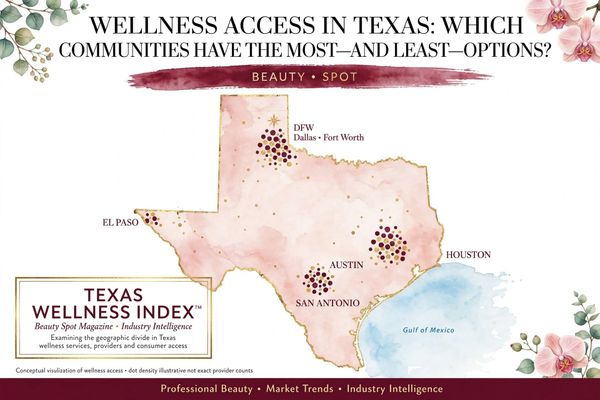
There is an important distinction at the outset. Beauty Spot’s current source library does not contain a validated statewide census of every Texas business operating as a medical spa, nor a verified ZIP-by-ZIP count sufficient to publish a definitive numerical ranking of Texas cities. Under the publication standards governing this analysis, geography should not be converted into a ranking without a defined comparison universe, methodology and verified source layer. The map presented here should therefore be read as an editorial market framework: a geographic interpretation of where Texas’ professional aesthetics economy is most visibly structured, paired with the data architecture required to turn that interpretation into a defensible statewide map. That distinction matters. A beautiful map can suggest authority; a Beauty Spot map should actually earn it.
The Texas Triangle Is Also an Aesthetics Triangle
Begin with the state’s dominant population and business geography: Dallas–Fort Worth, Houston, Austin and San Antonio. These four metropolitan systems form the clearest first layer of Texas’ professional aesthetics footprint because they combine the conditions that allow advanced beauty businesses to scale—large consumer populations, physician networks, affluent residential pockets, luxury retail corridors, high concentrations of personal-service businesses and a growing cultural expectation that skin, injectables, body treatments and aesthetic maintenance are routine components of personal care.
But these markets are not interchangeable.
Dallas–Fort Worth functions as Texas’ most expansive multi-node aesthetics environment. Rather than one compact luxury district, North Texas contains a constellation of affluent submarkets—Dallas proper, Plano, Frisco, Southlake and other high-income suburban corridors—capable of supporting boutique injectors, plastic-surgery-adjacent practices, sophisticated skin clinics, laser businesses and high-end wellness concepts simultaneously. The defining characteristic of DFW is scale. A provider is not simply competing with the clinic down the street; she may be competing across an entire suburban network in which clients routinely drive significant distances for a trusted injector, aesthetic provider or signature treatment.
Houston operates differently. Its aesthetic economy reflects the sheer size and diversity of the metro, but it also benefits from one of the state’s most powerful medical identities. That matters because medical aesthetics increasingly occupies the space between traditional beauty culture and physician-led care. Houston’s professional aesthetics geography therefore deserves to be understood not merely through med-spa addresses but through proximity to dermatology, plastic surgery, wellness medicine, luxury neighborhoods and destination retail. The market can support both clinically positioned practices and highly branded aesthetic concepts because the consumer base is large enough to sustain multiple versions of luxury.
Austin brings another model entirely. Here, aesthetics sits naturally beside wellness culture, fitness, longevity, technology-driven consumer behavior and a particularly strong appetite for brands that feel modern rather than traditionally “medical.” Austin’s market illustrates an important evolution in the med-spa category: the most competitive practices increasingly sell an integrated lifestyle philosophy rather than isolated procedures. Skin health, injectables, recovery, hormones, body treatments, wellness, nutrition and longevity can exist within the same consumer conversation. In that environment, branding becomes nearly as important as equipment.
And then there is San Antonio, a market that deserves far more attention than it often receives in statewide beauty conversations.
San Antonio Is Building a Serious Advanced-Aesthetics Identity
Beauty Spot’s own Texas source material places Stone Oak in northern San Antonio directly inside the conversation around high-end aesthetic demand. The Texas compliance framework notes that clients in the Stone Oak area expect results and describes the tension providers face between sophisticated consumer expectations and legal scope-of-practice boundaries. That detail is more revealing than it first appears. A neighborhood only develops that kind of expectation when professional skincare and advanced aesthetics have become culturally normalized enough for consumers to distinguish between ordinary beauty services and higher-performance treatment environments.
The presence of Evolve Texas Medical Group’s medical-aesthetics operation in Stone Oak offers a tangible example of the market’s clinical-luxury positioning. Its service presentation combines customized skin consultation, medical expertise, advanced technology, HydraFacial, skin renewal, hair removal and treatment planning under a medical-aesthetics identity. The significance is not one business alone; it is what the business model represents. San Antonio’s upper-income northern corridors are increasingly capable of supporting practices built around long-term skin health, individualized treatment plans and recurring aesthetic maintenance rather than the occasional facial.
San Antonio also has another asset that should matter to anyone studying its future aesthetic footprint: education. A separate Beauty Spot analysis of 56 local beauty-school license records found programs spread across 18 Bexar County ZIP codes, with specialized training represented in aesthetics, laser education, makeup, nails and other professional beauty disciplines. The education data cannot be used as a substitute for med-spa location data, but it does reveal something strategically important: the city has an existing beauty-workforce infrastructure capable of feeding multiple sectors of the professional market.
That matters because med spas do not grow on consumer demand alone. They require licensed talent, support staff, estheticians working within legal scope, medical oversight where required, educators, device representatives, skincare vendors and operators capable of creating a premium patient experience.
The Most Interesting Map May Be Inside the Metros
The statewide map is only the beginning. The more commercially valuable question is what happens when the analysis moves from city names to ZIP codes.
Medical aesthetics tends to behave like other premium consumer industries: concentration can change dramatically within ten miles. One part of a metropolitan area may contain dozens of luxury beauty, wellness, fitness and medical businesses while another, equally populated area may contain relatively little advanced-aesthetics infrastructure. This is why a serious Texas med spa map should eventually identify micro-markets, not simply metropolitan totals.
For San Antonio, that means examining areas such as Stone Oak and the broader northern growth corridors independently of the citywide average. For Dallas–Fort Worth, the meaningful geography may lie in the relationship between Dallas’ established luxury districts and rapidly expanding northern suburbs. Houston requires similar neighborhood-level analysis, while Austin demands attention to the suburban expansion surrounding the core.
This is where geography becomes business intelligence.
A ZIP with a large number of med spas may signal strong demand—but it may also signal saturation. A ZIP with fewer providers may indicate whitespace—or it may indicate insufficient consumer purchasing power. A high-income ZIP with explosive residential growth, strong beauty spending and relatively few advanced aesthetic providers may ultimately be more interesting to an entrepreneur than the ZIP containing the greatest raw number of med spas.
Concentration does not automatically equal opportunity. Sometimes concentration means competition.
What Actually Creates a Med Spa Cluster?
Professional aesthetics ecosystems rarely emerge from a single variable. They form through layers.
Affluence matters because many aesthetic services are elective and recurring. Population density matters because providers need a sufficiently large addressable market. Age distribution matters because demand for acne care, preventive aesthetics, injectables, pigment correction, body treatments and skin longevity changes across life stages. Medical infrastructure matters because many advanced procedures cross into medical practice. Luxury retail, fitness and wellness density matter because the same consumers frequently move between these categories.
Social behavior matters as well.
The modern aesthetics client increasingly discovers providers through Instagram, TikTok, Google reviews, local influencers, before-and-after content, referrals and highly visible personal branding. That means a provider no longer needs to occupy the most expensive retail address to build a premium practice. Strong brands can create destination behavior.
This is one reason suburban Texas deserves particular attention. As affluent households move farther from traditional urban cores, aesthetic spending can follow them. A new luxury shopping development, boutique fitness cluster or master-planned community may quietly create the conditions for the next high-performing med-spa corridor before conventional market reports recognize it.
The Regulatory Geography Matters Too
There is another layer that any Texas med spa map must respect: medical aesthetics is not simply the geographic distribution of facial rooms.
Texas practitioners operate inside distinct professional scopes. Beauty Spot’s Texas legal framework emphasizes that an esthetician’s license does not authorize every procedure a provider may have learned in a private training course. Services that move beyond permitted cosmetic practice or into medical territory require different authority and oversight.
That means a future statewide map should differentiate business types wherever the data allows: traditional esthetic establishments, laser facilities, physician-affiliated aesthetic practices, dermatology and plastic-surgery aesthetics, injectable-focused clinics and full medical-spa concepts should not be collapsed indiscriminately into one category.
Otherwise, the map may look impressive while measuring several different industries at once.
Building the Real Texas Med Spa Map
The next stage should move beyond editorial interpretation into governed geographic intelligence. Beauty Spot’s data framework is explicit that maps should preserve meaningful hotspots rather than smooth them away, and that geographic visualizations are strategic interpretation tools rather than decorative displays. A publication-grade Texas med spa map should therefore combine verified establishment records with ZIP, county and metropolitan geography, then layer population, income, growth, professional licensing, medical infrastructure and—where defensible—competitive density.
Only then can we answer the questions that actually matter.
Where are Texas’ densest professional-aesthetics corridors? Which ZIP codes have the most providers per 10,000 adults? Where is med-spa growth outpacing population growth? Which communities have high consumer capacity but relatively low provider density? Where are training institutions producing beauty professionals near expanding aesthetic markets? Which metros are approaching saturation, and which are still creating whitespace?
Those are not simply editorial questions. They are decisions about where to open, where to expand, where to recruit, where to educate and where the next generation of Texas aesthetic brands will be built.
The Map Is Becoming the Market
The most revealing thing about Texas aesthetics is no longer the existence of med spas. They are already embedded in the state’s beauty economy. The more important story is how quickly the category is becoming geographically sophisticated.
Dallas–Fort Worth offers scale. Houston brings medical depth and extraordinary consumer diversity. Austin merges aesthetics with wellness and lifestyle culture. San Antonio is developing a stronger clinical-luxury identity, with Stone Oak providing a particularly relevant northern-market case study and the city’s wider beauty-education infrastructure strengthening the professional pipeline. These should be treated as major metropolitan nodes—not as a verified numerical ranking until statewide establishment data is fully assembled and validated.
The next chapter lies beneath the metro level.
It will be visible in the ZIP codes where luxury housing, high-income consumers, wellness spending, physician networks, ambitious estheticians and aggressive beauty entrepreneurship begin occupying the same geography.
Because in modern aesthetics, location is no longer simply an address.
It is part of the business model.
Beauty Spot Data Note: This feature establishes an editorial geographic framework rather than claiming a complete statewide count of medical-spa establishments. Beauty Spot’s storytelling governance requires geographic rankings to disclose their comparison universe, methodology, period and limitations; unsupported precision should not be presented as a confirmed finding. A definitive “Texas Med Spa Map” should follow a verified statewide establishment-level build with ZIP-level geocoding, business-type classification, status validation and metropolitan rollups.