The Texas Beauty Economy: How Big Is the Industry Really?
How big is the Texas beauty industry? Beauty Spot Magazine examines businesses, licensed professionals, employment, consumer demand, education and economic activity to reveal the true scale of the statewide beauty economy.

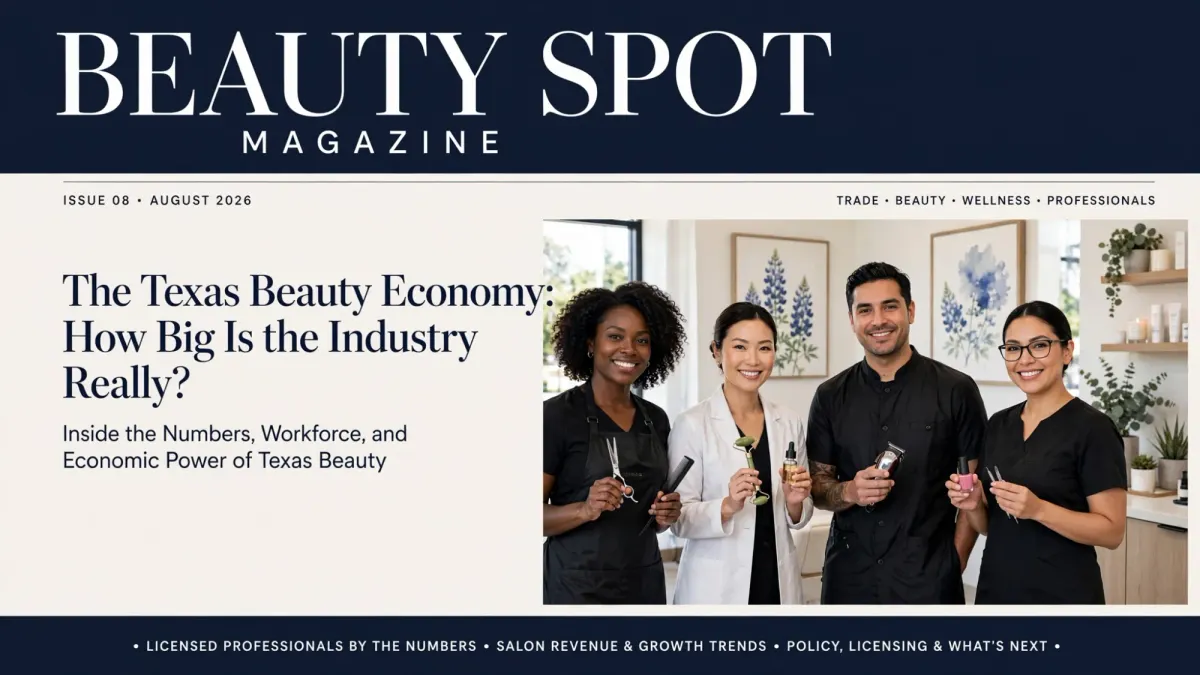
A statewide baseline reveals an industry that reaches far beyond the salon chair—connecting licensed professionals, independent businesses, education, consumer spending, entrepreneurship and local economic activity across Texas.
By Beauty Spot Magazine
Texas knows how to recognize an industry when it can see one. Oil has rigs. Technology has campuses. Healthcare has hospitals. Hospitality has hotels, restaurants and convention districts. Beauty is harder to see because much of its economic power is distributed across thousands of small businesses, individual practitioners, salon suites, barber chairs, nail tables, treatment rooms, retail shelves and independent brands. There is no single skyline announcing the size of the Texas beauty economy. Yet on almost every commercial corridor in the state, the industry is operating in plain sight.
The real question is no longer whether beauty matters economically. It is how we measure an industry whose money, labor and businesses are spread across multiple regulatory categories, occupational codes and consumer markets.
That distinction matters.
A conventional count of “beauty salons” will never capture the full Texas beauty economy. It can miss barbershops, nail establishments, esthetics practices, lash studios, salon suites, independent contractors, mobile providers, beauty schools, professional product businesses, makeup artists, some wellness-adjacent services and portions of medical aesthetics. It can also miss professionals whose businesses are structurally small but economically meaningful: the solo esthetician with a booked treatment room, the barber renting a suite, the nail professional building a six-figure clientele, the educator selling classes and products, or the cosmetologist who has moved from employee to independent owner.
Beauty Spot Magazine’s statewide baseline therefore begins with a broader proposition:
Texas beauty should be understood as an economic ecosystem, not a single business category.
And once it is viewed that way, the industry becomes considerably more important.
The First Measure: Businesses
The storefront is the most visible unit of the beauty economy, but even “business count” requires careful definition.
Texas law recognizes several types of establishments within barbering and cosmetology, including conventional establishments, specialty establishments, mini-establishments and mobile establishments. A mini-establishment can include an individual room or suite within a larger configuration—an important distinction in a state where salon-suite entrepreneurship has changed the physical structure of beauty business ownership.
That means one commercial address can contain multiple independent businesses.
A large salon may employ a team under one company. A suite complex, by contrast, can contain dozens of separately operated beauty businesses behind one exterior door. A traditional storefront count therefore risks understating entrepreneurial activity precisely where one of the industry’s strongest business-model shifts is occurring.
Texas law makes the business structure more explicit. A person may not own, operate or manage an establishment in which regulated barbering or cosmetology is practiced without the appropriate establishment license, and independent professionals leasing space must also hold the license required for the services they perform.
This is why establishment data should become one of the central pillars of any serious Texas beauty-economy baseline.
But establishment records alone still do not equal the entire industry.
Texas law excludes or separately treats certain forms of beauty activity. Makeup application only, for example, is among the activities identified outside the standard barbering and cosmetology framework under specified circumstances, while natural hair braiding and threading also receive distinct treatment in statute. That means the regulated establishment universe is economically important, but it is not synonymous with every person earning income from beauty.
The most defensible statewide business baseline must eventually combine regulatory establishments with business-registration and industry-classification data, while carefully removing duplicates and distinguishing one company from multiple operating locations.
That sounds technical. It is also the difference between counting beauty accurately and merely counting salons.
The Second Measure: Professionals
If establishments show where beauty happens, licensed practitioners show the human infrastructure behind it.
Texas law recognizes a surprisingly broad range of compensated activity within barbering and cosmetology: hair services, beard grooming, scalp and facial services, facial treatments, hair removal, nail services, hand and foot beautification, hair weaving and eyelash-extension services all appear within the statutory framework.
Within that framework are different professional licenses and specialties. Texas law specifically identifies estheticians, manicurist/estheticians, hair-weaving specialists, hair-weaving specialist/estheticians and eyelash-extension specialists alongside broader barber and cosmetology credentials.
This matters economically because the professional beauty workforce is not one occupation.
It is a network.
A hairstylist and an esthetician may serve the same client but operate under very different service models, appointment frequencies, product costs and revenue structures. A barber can build a high-frequency recurring clientele. A nail professional may see clients every two or three weeks. An esthetician may create revenue through treatments, home-care retail and membership structures. Lash professionals often depend on maintenance appointments. Makeup artists can work across weddings, photography, television, events and commercial production.
The economic value of the workforce therefore cannot be understood through head count alone. A meaningful statewide professional baseline should eventually distinguish at least four things: number of credentials, number of currently active practitioners, actual employment, and independent business ownership.
Those figures will not be identical.
A license does not automatically mean someone is practicing full time. An employed worker does not capture every self-employed practitioner. A single professional may hold more than one credential. And some beauty professionals build careers that combine services, education, retail, content creation and business ownership.
This is exactly why giant headline numbers deserve caution.
Beauty Spot’s own previous visual concepts have displayed figures such as more than one million licensed professionals and tens of thousands of businesses statewide. Those figures appear in internal magazine artwork, but the currently accessible source package does not establish the underlying statewide methodology required to treat them as verified economic findings. Until the license universe, status dates, duplication rules and occupational boundaries are audited, they should not be presented as the definitive size of the Texas beauty workforce.
That restraint strengthens the story rather than weakening it.
The beauty industry deserves a number that can survive scrutiny.
The Third Measure: Employment
Employment is where beauty becomes especially easy to underestimate.
Traditional labor statistics are designed around jobs. Modern beauty increasingly operates around work arrangements.
A stylist may be a salon employee. Another may rent a chair. Another may operate a private suite. Another may own a salon and employ several people. Another may provide services while earning additional revenue as an educator or brand representative.
All five participate in the beauty economy.
Only some will appear in the same employment datasets.
Beauty education materials themselves reflect how wide the career architecture has become. Professional cosmetology careers can extend beyond direct client services into specialties, salon training, manufacturer education and artistic direction. Modern professionals also use social media to build clientele and professional visibility, further blurring the older line between service worker, entrepreneur and media brand.
For Texas, this has major implications.
The beauty workforce should not be evaluated solely by payroll employment. A statewide baseline needs to consider wage-and-salary jobs alongside self-employment, independent contracting and owner-operated businesses. Otherwise, the industry’s most entrepreneurial segment may become statistically invisible.
That is particularly important in communities where beauty functions as an accessible route into small-business ownership.
The transition can happen incrementally: school, license, employment, chair rental, suite ownership, storefront, staff, education, products. Not every professional follows that path, and business ownership is never guaranteed. But the structure of the industry makes entrepreneurship unusually close to the technical occupation itself.
That proximity is economically significant.
A beauty professional does not necessarily need a warehouse, industrial plant or venture-capital round to become a business owner. In many cases, the first commercial infrastructure is a treatment room, a barber chair, a nail station or a suite.
The Fourth Measure: Education
No serious beauty-economy analysis should begin with the workforce and ignore the pipeline producing it.
Beauty and barber education represent a form of workforce infrastructure.
Texas law requires schools offering barbering or cosmetology instruction to hold the appropriate license, satisfy applicable requirements and meet health and safety standards. That educational network includes private career schools, specialty academies and public education pathways.
A Beauty Spot analysis of San Antonio records illustrates how extensive that pipeline can become at the local level. The supplied dataset contained 56 beauty-school license records across 18 ZIP codes, representing major cosmetology institutions, barber colleges, aesthetics programs, specialty academies, public high-school programs and a community-college offering.
The local data also revealed an unusually visible barber-training presence: 18 of those 56 records included “barber” or “barbers” in the institution name.
That is not a statewide count, and it should not be mistaken for one.
It is something equally useful: evidence of the mechanism by which the beauty economy reproduces itself.
Schools create students. Students become candidates for licensure. Licensed professionals enter establishments or become independent operators. Some later become owners, instructors or educators. Their businesses purchase products, equipment, insurance, software, furnishings, marketing, laundry services and commercial space. Employees and owners earn income. Clients spend money. The cycle begins again.
Beauty education is therefore not peripheral to the industry’s economic impact.
It is upstream economic infrastructure.
The Fifth Measure: Consumer Demand
None of this infrastructure exists without the client.
And consumer demand is where the scale of beauty becomes most culturally visible.
Beauty spending is unusually embedded in everyday life. Haircuts, color, grooming, nails, facials, waxing, lashes and skincare are rarely isolated purchases. Many operate on repeat cycles. That recurring demand can create something enormously valuable in local commerce: predictable client return.
Beauty also participates in life-event spending.
Weddings require hair and makeup. Tourism creates hotel and spa demand. Professional photography creates grooming and makeup demand. Entertainment and production use beauty professionals. Proms, graduations, quinceañeras, galas and cultural celebrations generate service activity. Affluent consumers may invest in high-performance skincare, advanced aesthetics and ongoing maintenance. Professional clients may view grooming as part of presentation and image.
Then there is retail.
A facial can generate a home-care skincare purchase. Hair color can generate shampoo, conditioner and styling retail. Nail and grooming businesses can develop product lines. Educators sell tools and training. Professionals become affiliates, creators and founders.
The treatment ticket, in other words, is not always the final economic transaction.
Beauty spending radiates outward.
The Sixth Measure: Economic Activity
This is where the conversation needs greater precision.
“Economic impact” is one of the most overused phrases in industry reporting.
A salon’s annual sales are economic activity. So are wages paid to employees. So is a professional’s self-employment income. So are purchases from distributors and manufacturers. Rent paid for commercial space has economic significance. Training tuition is another transaction. Retail products create additional sales.
But these figures cannot simply be added together without methodology. Doing so can create double counting.
A defensible Texas beauty-economy estimate should ultimately distinguish among direct economic activity, labor income, business revenue, consumer expenditures and any modeled indirect or induced effects.
The direct layer is the cleanest place to begin.
How many operating businesses are there?
How many licensed and active professionals?
How many people are employed?
How many are self-employed?
What are the estimated receipts of relevant beauty-service industries?
What do Texas households spend on personal-care services and products?
How much economic activity is generated by beauty education?
Only after those layers are reconciled should anyone announce a statewide “economic impact” figure.
That is especially important because Beauty Spot’s editorial governance requires the distinction between what evidence establishes and what it merely suggests. The publication system explicitly prohibits invented statistics, exaggerated market opportunity and unsupported certainty.
The correct statewide baseline is therefore not the biggest number we can print.
It is the strongest number we can defend.
Beauty Is Also a Geography Story
Texas is too large for one statewide total to tell the entire story.
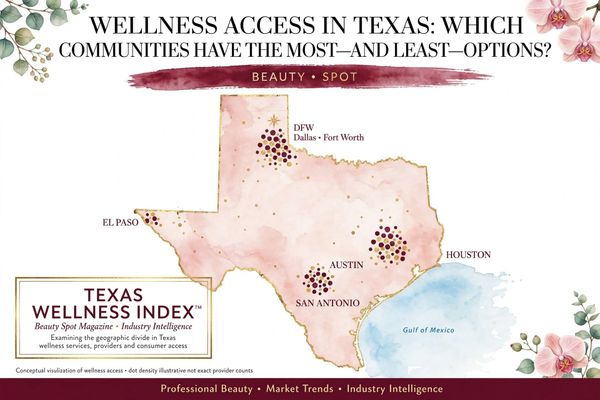
Houston does not operate exactly like San Antonio. Dallas–Fort Worth has different density, incomes and commercial patterns than the Rio Grande Valley. Austin’s wellness and aesthetics markets operate within a different consumer culture than smaller cities or rural counties. Border communities, tourism markets, military cities, college towns and affluent suburban corridors each create distinctive beauty economies.
The next generation of Texas beauty intelligence should therefore move below the state total.
Where are establishments concentrated?
Where are professionals concentrated?
Where are schools producing new license candidates?
Which ZIP codes have high numbers of providers relative to population?
Where does consumer purchasing power suggest strong demand?
Where does population growth outpace beauty infrastructure?
Where are there large numbers of licenses but limited business formation?
Where are salon suites accelerating independent ownership?
Those questions turn an industry count into market intelligence.
They can reveal saturation, opportunity, education gaps, workforce pressure and emerging beauty corridors.
And they matter to everyone from a student deciding where to train to a brand deciding where to distribute products.
The Compliance Economy
Texas beauty also has an economic dimension that rarely appears on a revenue chart: compliance.
A license determines more than professional identity. It defines legal boundaries.
Texas requires an individual practitioner license or permit for regulated barbering and cosmetology activity, and state law specifies where licensed practice can occur and how establishments must be authorized.
For estheticians and advanced beauty providers, that distinction becomes especially important as the market moves toward results-driven aesthetics.
The Beauty Spot Texas legal framework emphasizes that education in a procedure does not by itself expand legal scope of practice. In a marketplace increasingly filled with sophisticated devices, aggressive treatment language and medical-adjacent branding, regulatory literacy becomes part of business infrastructure.
That has economic consequences.
Compliance affects insurance, establishment design, equipment purchases, hiring, service menus, advertising language and risk. A professional who builds revenue around services outside lawful scope may not have built a stronger business. They may have built a more fragile one.
In the Texas beauty economy, legality and profitability cannot be separated indefinitely.
So, How Big Is the Texas Beauty Industry Really?
The most accurate answer today is both less dramatic and more important than a single glossy headline.
It is unquestionably a major statewide small-business and workforce ecosystem—but the source material currently available to Beauty Spot does not yet support one fully audited dollar figure for its total size.
That should become the starting point, not the ending.
We can already establish that the economic structure includes regulated establishments, individual practitioners, specialized licenses, beauty and barber schools, independent operators and businesses connected to hair, skin, nails, lashes and grooming. Texas statute itself demonstrates the diversity of services included within the regulated professional ecosystem.
We can see at the local level how deeply education penetrates communities and how strongly the professional pipeline can cluster geographically.
We can also see why simplistic counting fails.
One license is not necessarily one worker.
One address is not necessarily one business.
One employee does not capture one independent professional.
One salon category does not represent the entire beauty economy.
And one industry revenue statistic cannot automatically be described as statewide economic impact.
The next serious Texas beauty report should therefore build a governed baseline from five interconnected layers: licensed businesses, licensed professionals, employment and self-employment, consumer demand, and measurable economic activity. Those layers should then be analyzed by geography and over time.
That is the number Texas beauty deserves.
Not an estimate designed for applause.
An economic system capable of being measured, mapped and taken seriously.
Beauty is often described as personal. Economically, it is anything but small.
Every appointment represents labor. Every suite represents commercial occupancy. Every school represents workforce development. Every license represents professional infrastructure. Every product order connects to a supply chain. Every client returning three, six or twelve times a year creates recurring local spending.
Multiply those transactions across a state as large, young, urbanizing and entrepreneurial as Texas, and the beauty industry stops looking like a collection of individual appointments.
It begins to look like what it has been all along:
an economy.
Beauty Spot Editorial Baseline
For future editions, Beauty Spot should define the Texas Beauty Economy using a governed measurement system rather than a single industry code. The baseline should reconcile TDLR practitioner and establishment records; federal and Texas employment and wage data; Census business, nonemployer and receipts data; household personal-care expenditure measures; beauty-school infrastructure; and clearly bounded beauty-adjacent industries. Medical aesthetics should be analyzed as a connected but separately governed segment because medical services and esthetic services do not share the same scope-of-practice framework.
Until that reconciliation is complete, large statewide figures previously used in promotional concepts—including figures appearing on Beauty Spot cover artwork—should be treated as provisional editorial estimates rather than verified statewide findings.
That distinction is not a limitation.
It is how Beauty Spot turns beauty statistics into beauty intelligence.