The State of Beauty in Texas
Beauty Spot Magazine’s annual report examines how skin longevity, advanced aesthetics, memberships, specialization, cultural influence, and Texas compliance are reshaping the state’s beauty economy—and what professionals must do next.

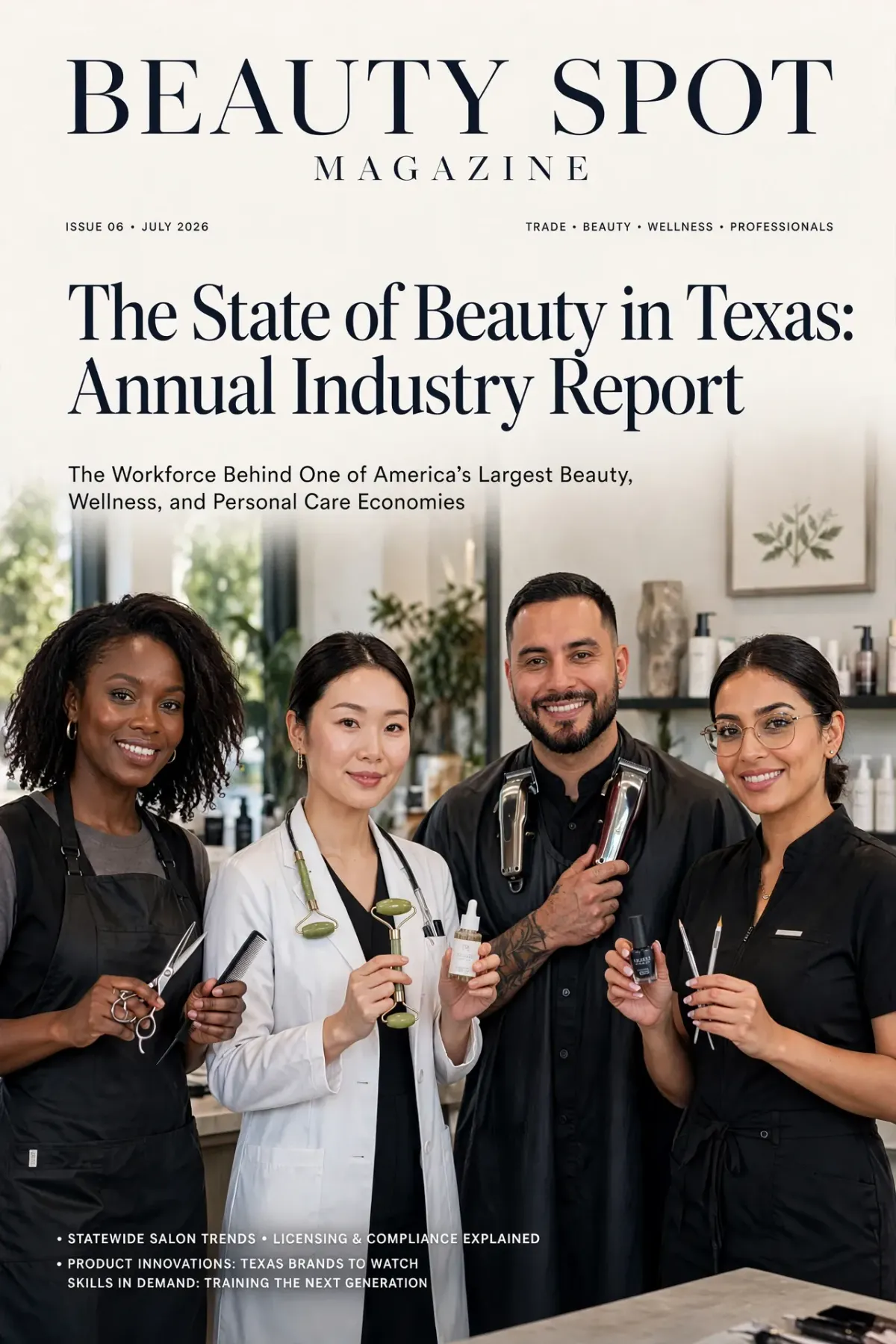
Beauty Spot Magazine’s Annual Industry Report
Texas beauty has entered its age of consequence.
Across Dallas, Houston, Austin, San Antonio, Fort Worth, El Paso, the Rio Grande Valley, and the fast-growing communities between them, beauty is no longer operating as a collection of disconnected salons, treatment rooms, nail studios, med spas, barbershops, and independent providers. It has become a sophisticated consumer economy shaped by migration, cultural identity, medical-aesthetic influence, entrepreneurship, social media, wellness, luxury positioning, and an increasingly informed client who expects both visible results and professional accountability.
The defining story of the Texas beauty industry is not simply growth. It is elevation under pressure.
Clients want more advanced treatments, more personalized care, more transparent education, more luxurious surroundings, and more meaningful long-term outcomes. Providers, meanwhile, are navigating rising operating costs, aggressive competition, rapidly changing technology, blurred professional boundaries, and a digital marketplace that can make an underqualified operator appear indistinguishable from a highly trained professional.
This tension is creating a new beauty hierarchy across the state. Technical talent still matters, but talent alone is no longer enough. The businesses gaining authority are those capable of combining treatment intelligence, legal awareness, hospitality, branding, documentation, client retention, and disciplined financial management.
The future of Texas beauty belongs to professionals who can make expertise visible.
From Appointment Culture to Beauty Infrastructure
For years, much of the beauty economy was built around appointments: the haircut, the facial, the manicure, the wax, the injectable visit, the special-event makeup application. Today, the strongest operators are building something more durable—beauty infrastructure.
They are creating treatment plans instead of isolated services. Memberships instead of unpredictable booking cycles. Consultation systems instead of casual recommendations. Home-care strategies instead of one-time product sales. Progress photography, intake forms, contraindication screening, and follow-up communication are becoming part of the premium experience.
This represents a profound shift in the psychology of the Texas client. Beauty spending is increasingly framed as maintenance, prevention, confidence, wellness, and professional self-presentation. The language of “skin investment” captures this transition: results are associated with consistency rather than luck, and the provider is positioned as a long-term guide rather than a temporary service vendor.
This is especially visible in affluent and aspirational markets, where clients may move fluidly between dermatology offices, med spas, esthetic studios, fitness concepts, wellness clinics, luxury salons, and specialized beauty providers. They are not comparing businesses by category alone. They are comparing the total experience: trust, convenience, aesthetics, communication, visible expertise, emotional comfort, and outcome continuity.
Skin Has Become the Center of the Conversation
Texas is firmly inside the skin-longevity era.
The traditional facial has not disappeared, but its role is changing. Clients increasingly arrive with concerns shaped by active ingredients, viral routines, cosmetic procedures, environmental stress, hormonal changes, acne, pigmentation, barrier disruption, and premature aging. They are asking more sophisticated questions while often carrying more confused skin.
The modern Texas esthetician must therefore function as an interpreter. Product knowledge, skin analysis, facial procedure selection, contraindication awareness, recordkeeping, electrotherapy, light-based modalities, and client consultation are no longer separate educational topics; together, they form the architecture of responsible treatment planning. Professional curriculum materials similarly place chemistry, skin analysis, treatment-room practice, products, consultation, contraindications, facial procedures, and light or electrical modalities within the same competency ecosystem.
The most credible providers are moving away from indiscriminate intensity. Instead of treating redness, peeling, or discomfort as proof of effectiveness, they are learning to respect barrier function, inflammation, recovery time, skin tone, lifestyle, climate, and cumulative treatment load.
That matters in Texas. Heat, intense sun exposure, air conditioning, outdoor lifestyles, travel, and seasonal environmental changes can complicate dehydration, sensitivity, pigmentation, and post-treatment recovery. A protocol that looks impressive on social media may be inappropriate for a client who drives long distances, works outdoors, cannot avoid sun exposure, or is already layering multiple active products at home.
The new luxury is not aggression. It is precision.
Advanced Aesthetics Is Expanding—and So Is the Compliance Gap
Few areas reveal the industry’s tension more clearly than advanced aesthetics.
Microneedling, regenerative-style treatments, corrective procedures, sophisticated peel programs, light-based services, and device-assisted protocols continue to attract consumer interest. Training materials may discuss fibroblast stimulation, collagen and elastin production, tissue remodeling, treatment depths, topical anesthetics, additives, contraindications, and post-treatment instructions. Yet education in a technique does not independently establish legal authority to perform it.
This distinction is one of the most important issues facing Texas beauty professionals.
Texas law defines regulated barbering and cosmetology services and separately recognizes activities and licensed professions that fall outside those categories. Advertising oneself as licensed to perform regulated services is itself legally significant. Beauty Spot’s Texas legal framework further emphasizes that a professional license is permission to perform what the law allows—not everything a person may have been taught in a private course. It identifies aggressive peeling, deeper tissue alteration, and devices that enter medical territory as high-risk areas requiring careful scrutiny.
The compliance gap grows when treatment education travels faster than legal understanding. A provider may purchase equipment, complete a certificate program, watch manufacturer demonstrations, and see competitors advertise the same service. None of those facts alone confirms scope of practice.
For Texas beauty businesses, compliance is becoming a brand issue as much as a legal one. Informed clients increasingly want to know who is performing the treatment, under which license, with what supervision, using what protocol, and how complications will be managed.
The sophisticated operator does not hide from those questions. The sophisticated operator builds trust through them.
The Med Spa Influence Is Reshaping Every Category
Medical aesthetics has changed consumer expectations far beyond the medical spa.
Hair professionals are expected to understand scalp health. Nail professionals are being asked about ingredient sensitivity and natural-nail preservation. Estheticians are expected to discuss treatment sequencing and home-care chemistry. Makeup artists are expected to understand skin preparation, texture, longevity, inclusive complexion work, and post-procedure sensitivity. Waxing and hair-removal specialists must navigate medication use, exfoliation habits, contraindications, and increasingly complex client routines.
Even businesses that perform no medical procedures are being influenced by medical-aesthetic culture: clinical photography, treatment plans, elevated consultations, sterile visual language, outcome tracking, and high-performance product positioning.
The opportunity is significant, but imitation has limits. A salon or spa should not borrow medical language merely to sound more advanced. Terms such as “medical grade,” “regenerative,” “corrective,” and “clinical” can create expectations that exceed the service, the evidence, or the provider’s authority.
Texas beauty needs fewer borrowed claims and more clearly articulated expertise.
Memberships Are Becoming the New Stability Strategy
The economic pressure inside beauty businesses is changing the revenue model.
A fully booked calendar can still conceal fragility. Cancellations, seasonal fluctuations, inconsistent rebooking, inventory costs, payroll pressure, rent, equipment financing, merchant fees, and advertising expenses can leave a busy business financially unstable.
Memberships are increasingly attractive because they transform occasional demand into a relationship. The strongest models are not discount clubs. They are continuity systems built around maintenance, access, preferred scheduling, treatment planning, product support, or carefully designed enhancements.
The difference is essential.
A poorly structured membership reduces margins and traps the business in constant fulfillment. A strong membership improves client retention, forecasting, treatment consistency, and lifetime value while giving the client a reason to remain connected between visible concerns.
Texas operators are also becoming more attentive to the gap between revenue and financial health. The next level of beauty entrepreneurship requires understanding service profitability, inventory movement, compensation structures, marketing performance, retention, and the operational demands of management. Industry education identifies budgeting, profit-and-loss literacy, marketing, inventory control, team education, and client satisfaction as core salon-management competencies—not optional administrative knowledge.
Specialization Is Winning
The era of trying to be everything to everyone is losing power.
Texas consumers are increasingly drawn to specialists: acne-focused estheticians, corrective-skin practitioners, blonding experts, curl specialists, scalp professionals, bridal artists, men’s grooming authorities, structured-gel nail artists, mature-skin experts, brow designers, and providers known for serving particular skin tones or lifestyle needs.
Specialization gives clients a reason to choose. It also gives professionals a clearer educational path, stronger referral language, and more defensible pricing.
Formal beauty education recognizes specialization, training, brand education, artistic direction, editorial work, management, and creative leadership as distinct career paths requiring additional experience and continuing development. In Texas, where independent entrepreneurship is culturally powerful, this creates an expansive professional landscape—but also a responsibility to distinguish genuine specialty training from social-media positioning alone.
The market is becoming less impressed by titles and more interested in evidence: portfolios, consultations, client education, repeatable protocols, documented outcomes, and professional boundaries.
Texas Beauty Is Cultural, Local, and Impossible to Flatten
There is no single Texas beauty consumer.
Houston’s global complexion culture, Dallas luxury, Austin wellness minimalism, San Antonio’s heritage and event traditions, Fort Worth’s polished Western identity, El Paso’s border influence, Gulf Coast humidity, suburban med-spa expansion, college-market experimentation, and the distinct aesthetics of the Rio Grande Valley all shape demand differently.
Texas beauty is equally influenced by Black, Mexican American, Indigenous, Asian, Middle Eastern, immigrant, Southern, Western, urban, suburban, and rural beauty traditions. The providers who understand this do not treat inclusion as a campaign. They build it into shade range, imagery, consultation language, hair knowledge, pigmentation awareness, treatment selection, accessibility, and respect.
San Antonio’s long-standing civic and cultural institutions also demonstrate how beauty, presentation, philanthropy, ceremony, and women’s leadership have remained intertwined across generations. The Woman’s Club of San Antonio, founded in 1898, documents a history of women’s education, community service, scholarships, civic participation, and Fiesta traditions—evidence that beauty culture in Texas has never existed apart from identity, social life, and public leadership.
The Industry’s Greatest Risk Is Not Competition
Competition is visible. The deeper risk is inconsistency.
Inconsistent sanitation. Inconsistent consultations. Inconsistent pricing. Inconsistent treatment decisions. Inconsistent boundaries. Inconsistent follow-up. Inconsistent financial discipline. Inconsistent brand presentation.
Texas does not lack talented beauty professionals. It lacks enough systems that help talent become sustainable authority.
The businesses most likely to lead the next chapter will invest in education without confusing certificates with licensure; pursue innovation without abandoning restraint; build luxury without becoming inaccessible; adopt technology without losing human connection; and increase revenue without sacrificing professional ethics.
What the Industry Should Watch Next
The next year will be shaped by deeper interest in skin longevity, scalp health, barrier repair, personalized home care, treatment recovery, mature-client services, hormonal beauty concerns, membership refinement, male grooming, inclusive complexion expertise, and highly specialized independent brands.
Artificial intelligence and automated client communication will become more visible, but human judgment will remain the premium differentiator. Consumers may use technology to research ingredients, compare services, preview looks, or schedule care. They will still rely on professionals to recognize nuance, contraindications, emotional concerns, cultural context, and the difference between what is possible and what is appropriate.
Regulatory literacy will also become a competitive advantage. Beauty Spot’s legal framework warns that treatment rooms are legal environments governed by sanitation, documentation, equipment safety, establishment requirements, and individual responsibility. The professionals who understand this will not appear less creative. They will appear more trustworthy.
The Bottom Line
The state of beauty in Texas is ambitious, culturally rich, technically curious, commercially powerful, and still uneven.
The industry is moving from service performance toward professional ecosystems. From trend chasing toward treatment strategy. From broad menus toward specialization. From casual entrepreneurship toward operational discipline. From beauty as an occasional indulgence toward beauty as ongoing personal infrastructure.
But the next era will not be defined by the provider with the loudest marketing, the deepest discount, or the most aggressive device.
It will belong to the provider who can unite artistry with judgment, innovation with legality, luxury with care, and business growth with standards.
Texas beauty is not waiting to become influential.
It already is.
The question now is whether the industry will become as disciplined, educated, and trusted as it is visible.