The Rise of Functional Medicine in Texas
Functional medicine is changing the Texas wellness conversation. Beauty Spot explores how skin, longevity, lifestyle, and medical care are becoming more connected—and why estheticians, spa owners, and wellness brands need clear scope, smart referrals, and responsible positioning.

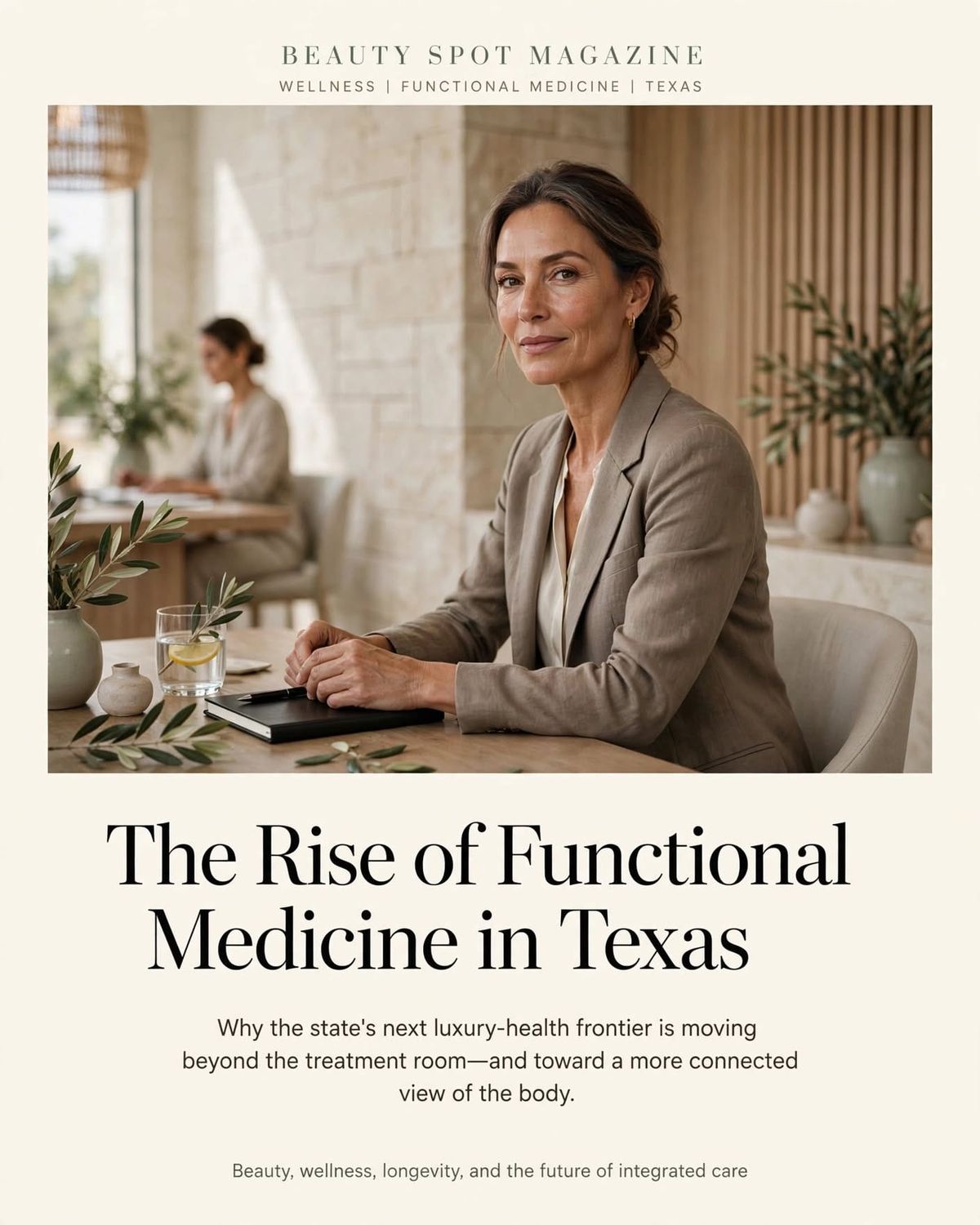
Why the state’s next luxury-health frontier is moving beyond the treatment room—and toward a more connected view of the body
There is a subtle shift happening inside Texas wellness culture. You can see it in the language clients use when they walk into an aesthetics practice. The conversation no longer begins and ends with wrinkles, weight, breakouts, fatigue, or hair loss. Increasingly, people want to understand what sits underneath the visible complaint. They are asking about sleep. Stress. Nutrition. Hormones. Metabolism. Inflammation. Gut health. Energy. Recovery. They want to know why their skin suddenly feels different at 42 than it did at 32, why a sophisticated skincare routine has stopped delivering the same glow, why weight management feels more complicated than calories, or why looking “well” has become inseparable from actually feeling well. In Texas—a state already fluent in medical entrepreneurship, aesthetics, fitness, performance culture, and highly personalized service—that curiosity is creating fertile ground for functional medicine.
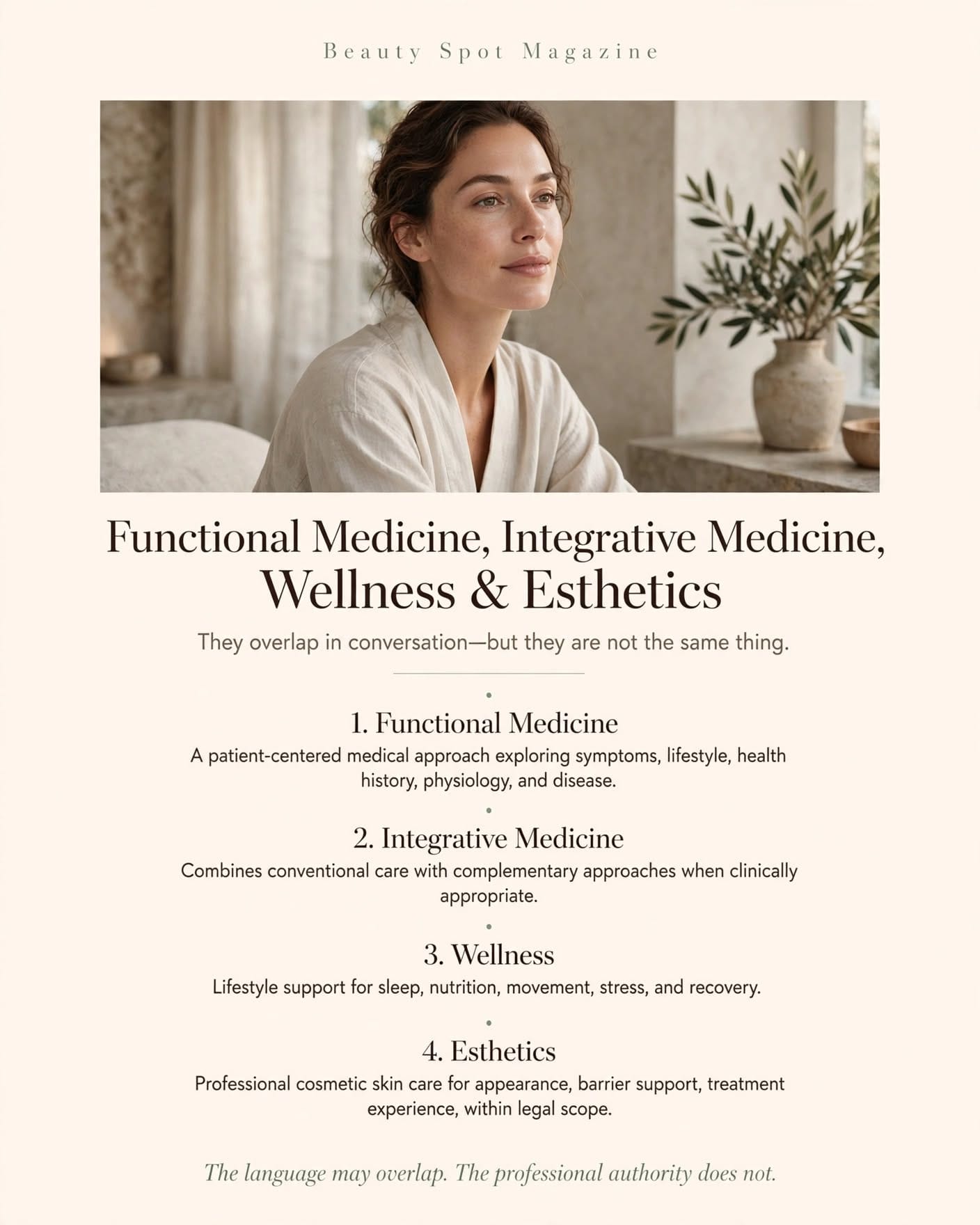
Functional medicine is broadly understood as a patient-centered approach that looks for relationships among symptoms, health history, lifestyle, environment, nutrition, physiology, and disease processes rather than viewing every complaint as an isolated event. Its practitioners may spend more time exploring patterns across multiple systems and may incorporate conventional diagnostics, lifestyle interventions, nutrition strategies, and other individualized approaches depending on the clinician’s license, training, and clinical judgment. It is not a separate permission slip to practice medicine without a medical license, nor should the phrase itself be mistaken for proof that every test, supplement, protocol, or therapeutic claim marketed under its banner is scientifically established. That distinction matters enormously as functional medicine moves deeper into the luxury-wellness marketplace.
What makes the Texas moment especially interesting is not simply the existence of another wellness category. It is the collapsing distance between industries that were once sold separately. Medical aesthetics, primary care, metabolic health, fitness, longevity, skin health, hormone conversations, nutrition, recovery, and luxury spa culture increasingly occupy the same consumer imagination. A client may encounter a physician or advanced-practice clinician for medical management, work with a nutrition professional, participate in strength training, and maintain an esthetic treatment plan—all while thinking of those experiences as part of one personal longevity strategy. Beauty, in this new model, is not being abandoned. It is being placed inside a much larger conversation about function.
The new luxury is not simply looking rested. It is understanding what may be keeping you from feeling restored.
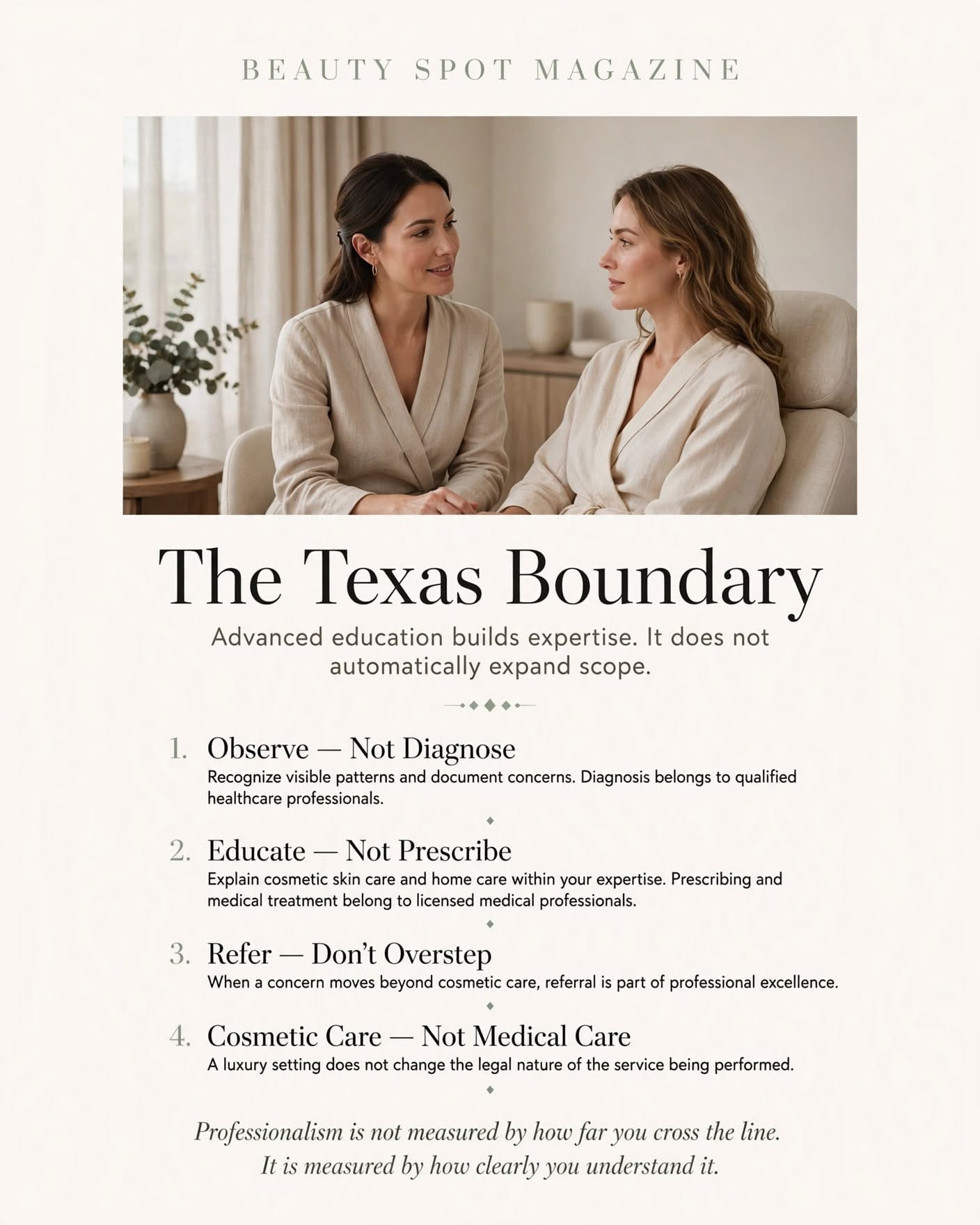
That shift is particularly relevant to beauty professionals because skin has always been one of the body’s most visible storytellers. Estheticians routinely observe changes in dryness, sensitivity, oil production, pigmentation, texture, healing behavior, congestion, and perceived aging. Those observations can make an experienced provider extraordinarily valuable—but they do not turn an esthetician into a diagnostician. Beauty Spot’s Texas compliance framework draws a sharp professional line here: education and technical skill do not expand a practitioner’s legal scope merely because a treatment or concept has been taught. The framework emphasizes that Texas estheticians must remain inside the services their license permits and should not cross into deeper tissue alteration or medical practice simply because a client wants a more aggressive result.
Functional medicine makes that distinction even more important because the vocabulary of modern wellness can sound deceptively universal. “Hormonal acne,” “inflammation,” “insulin resistance,” “thyroid,” “cortisol,” “gut imbalance,” and “autoimmune” are not simply branding words when they are being used to describe medical conditions. The esthetician may document a visible pattern, ask appropriate intake questions, adapt a cosmetic service within scope, and recommend medical evaluation when warranted. Diagnosing the cause, ordering medical tests, prescribing treatment, changing medication, or presenting a wellness theory as a confirmed diagnosis belongs elsewhere in the care structure.
That is not a limitation on the value of the esthetician. It is precisely what could make the next generation of high-level beauty practices more sophisticated.
The smartest luxury practices are beginning to understand that authority does not come from pretending to do everything. It comes from knowing exactly where one professional discipline ends and another begins. Texas law itself reflects the existence of distinct professional lanes. The state’s cosmetology statutes, for example, distinguish licensed medical and nursing professionals operating within their own professional scopes from cosmetology practice. In a modern wellness ecosystem, that separation can become an advantage: the physician practices medicine, the qualified medical professional manages medical care within authorized scope, and the esthetician owns the cosmetic skin experience with depth, precision, and excellent communication.
This is where functional medicine may exert its greatest influence on Texas aesthetics—not by transforming every spa into a medical clinic, but by changing the questions sophisticated providers ask.
Instead of viewing a difficult complexion only as a product problem, a provider may become more attentive to the client’s broader history and recognize when referral is appropriate. Instead of promising that a facial will “fix hormones” or “detox the body,” a luxury esthetic practice can become exceptionally good at identifying what it can responsibly influence: barrier support, cosmetic exfoliation, hydration, appearance of texture, home-care consistency, treatment tolerance, client education, and the sensory and emotional quality of the treatment experience. When something appears to require medical assessment, the referral becomes part of the luxury service rather than an admission of inadequacy.
The future may belong to the practice that can say, with confidence: this is what we can address here, and this is who should evaluate the rest.
From “Anti-Aging” to Longevity
The cultural language around aging is changing at the same time. The beauty industry spent decades promising correction—erase, reverse, fight, eliminate. The emerging longevity conversation is softer in tone but larger in ambition. Clients increasingly want resilience. They want sustained energy, strong bodies, healthy-looking skin, cognitive clarity, better recovery, and a sense that their beauty investments belong to a coherent life strategy.
Functional medicine fits naturally into that psychological shift because it sells, at its best, a form of investigation. The appeal is not simply “take this supplement.” It is the idea that the body may be examined as an interconnected system.
For the luxury consumer, that experience can feel radically different from fragmented care. A consultation that explores sleep, nutrition, symptoms, medical history, stress patterns, movement, laboratory findings when clinically appropriate, and long-term goals can create a perception of extraordinary personalization. In a culture accustomed to bespoke facials, custom injectables, biometric wearables, personalized fitness programming, concierge services, and increasingly individualized skincare, personalized health feels like the logical next category.
Texas is especially compatible with this evolution because its premium wellness market already rewards integration. The beauty client and the health consumer are increasingly the same person. She may move between a med spa, strength-training studio, physician’s office, specialty wellness clinic, dermatology practice, recovery service, and esthetician without mentally separating them into the rigid categories professionals use behind the scenes.
The opportunity for businesses is therefore not necessarily to own every service.
It is to own the relationship.
The New Wellness Ecosystem
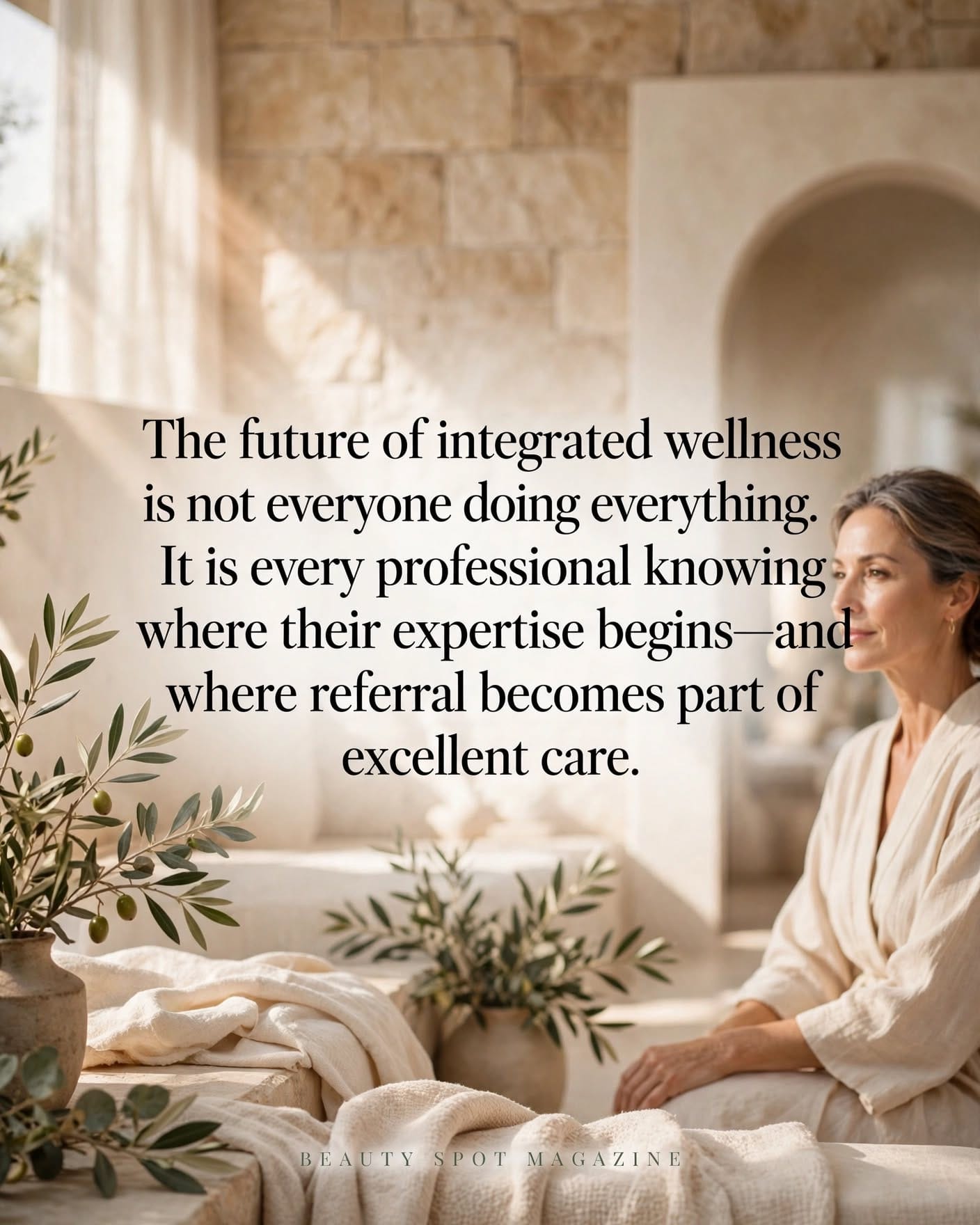
Imagine the modern Texas wellness practice not as a menu, but as an ecosystem. A client presents with concerns about changing skin quality, body composition, low energy, or another health issue. Medical questions remain with qualified healthcare practitioners. Aesthetics remains within appropriately licensed professional boundaries. Fitness professionals work within their expertise. Nutrition care is delivered according to applicable credentials and legal requirements. Each discipline can remain distinct while the consumer experience becomes more connected.
One existing Texas medical-wellness business framework in Beauty Spot’s source library illustrates this direction clearly. A proposed collaboration for Evolve Texas Medical Group combines fitness-community engagement with medical wellness and aesthetics while explicitly reserving diagnosis, treatment recommendations, prescriptions, and medical claims for qualified clinical personnel. That separation is more than legal housekeeping. It is a blueprint for how sophisticated wellness brands can expand culturally without blurring professional authority.
There is also a powerful branding lesson here.
For years, the beauty industry often treated compliance as the least glamorous part of the business. In the new wellness economy, compliance can become part of luxury positioning. A client who is investing significantly in her face, health, metabolism, body, or longevity does not simply want access. She wants judgment. She wants to know that the people around her understand what they are qualified to do, what they are not qualified to do, and when another professional should enter the conversation.
Beauty Spot’s Texas framework makes this point directly: client trust is built not only through results, but through safety, expertise, and confidence.
That idea deserves far more attention.
Because functional medicine’s growth in visibility creates opportunity—but it also creates a branding temptation. “Functional,” “integrative,” “root cause,” “clinical,” “medical-grade,” “longevity,” and “hormone balancing” have become powerful marketing vocabulary. Powerful words, however, can outrun evidence and licensure quickly. A beautiful website does not establish clinical authority. A certification does not automatically expand a state license. A supplement protocol is not necessarily a diagnosis. A wellness coach should not be presented as a physician. An esthetician cannot inherit medical scope simply by working inside a medical-looking environment.
The larger the wellness market becomes, the more valuable precision will become.
What the Beauty Industry Should Be Watching
For Texas spa owners and estheticians, functional medicine should not be viewed simply as competition. It may be one of the clearest signals about where the premium consumer is headed.
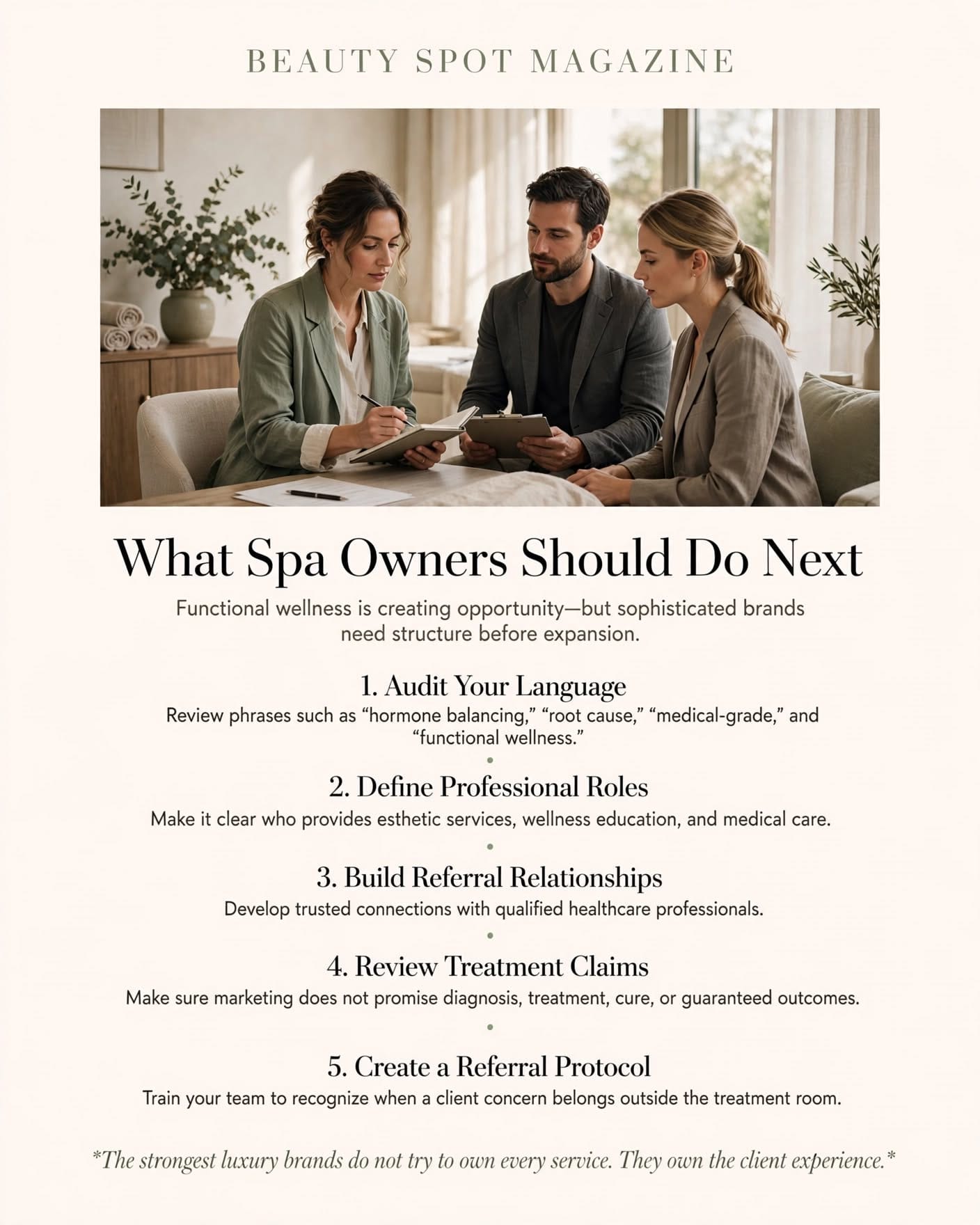
Clients are becoming less interested in isolated appointments and more interested in connected outcomes. That creates room for thoughtfully built professional networks: dermatology relationships, appropriately credentialed medical providers, nutrition expertise, fitness professionals, mental-health resources when relevant, and esthetic services that are genuinely excellent rather than artificially medicalized.
For medical spas, the opportunity is equally significant. Adding the language of wellness is easy. Creating a clinically responsible wellness infrastructure is much harder. Medical decisions need qualified oversight. Claims need discipline. Patient information requires proper handling. Marketing arrangements involving medical services require careful legal review. Even a Texas collaboration proposal in Beauty Spot’s source material specifically cautions against allowing nonclinical ambassadors to diagnose, recommend treatment, prescribe, guarantee results, or make unapproved medical claims, and recommends legal review of applicable healthcare marketing arrangements.
The brands that understand this will likely age better than the brands that simply chase the vocabulary.
Functional medicine also raises a deeper question for the beauty profession: How much should we know about the body without pretending to practice medicine?
The answer may be: considerably more.
An advanced esthetician benefits from understanding skin physiology, healing, ingredient chemistry, contraindications, treatment interactions, and the broad ways in which health status can affect the treatment experience. That education improves observation, communication, treatment planning within scope, and referral intelligence. But education should make professional boundaries clearer, not fuzzier.
This is the distinction between becoming medically adjacent and becoming medically reckless.
The former can elevate a career.
The latter can endanger one.
A More Intelligent Definition of Luxury
Perhaps the most interesting consequence of functional medicine’s influence will have nothing to do with supplements, laboratory panels, or wellness trends. It may simply force the beauty industry to develop a more mature understanding of luxury.
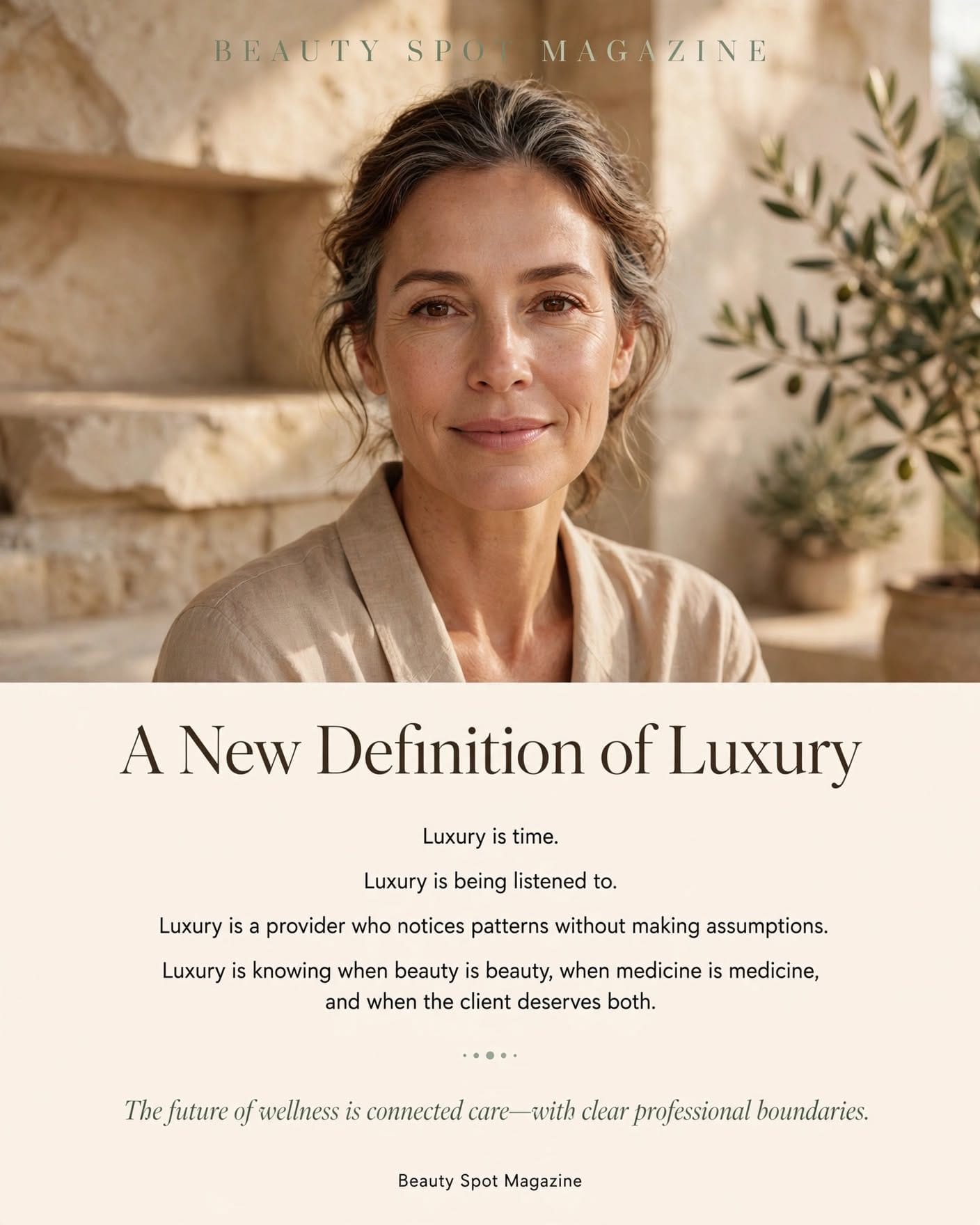
Luxury used to mean more: more products, longer menus, grander spaces, stronger treatments.
The emerging definition feels different.
Luxury is time.
Luxury is being listened to.
Luxury is a provider who notices patterns without making reckless assumptions.
Luxury is knowing that your facialist will not diagnose your endocrine system.
Luxury is knowing that your medical provider will not reduce every concern to a cosmetic defect.
Luxury is a team that communicates well enough to know when beauty is beauty, when medicine is medicine, and when the client deserves both.
That may be where functional medicine’s influence becomes most enduring. Not in replacing conventional medicine. Not in medicalizing every spa. Not in convincing every beauty professional to become a wellness practitioner.
But in teaching a generation of consumers to expect connection.
And Texas beauty businesses would be wise to pay attention.
The functional-medicine conversation is ultimately part of a larger movement toward personalized health, skin longevity, metabolic awareness, performance, recovery, and whole-person wellness. Some elements of that movement will withstand scientific scrutiny. Others will evolve as evidence changes. Some commercial trends will disappear entirely. Beauty Spot’s narrative-governance standard is useful here: health stories should distinguish what evidence establishes from what it merely suggests, and they should not invent causality or certainty where it does not exist.
That same discipline belongs in the treatment room.
Texas does not need a beauty industry that borrows a white coat to appear more advanced.
It needs an industry confident enough to collaborate with the people who earned one.
And perhaps that is the most sophisticated promise of this new era: a beauty and wellness culture in which expertise is not measured by how far a professional is willing to reach beyond their lane, but by how intelligently they understand their place within a larger system of care.
The future of Texas wellness may be integrated. But the most credible version of integration will still know exactly where every professional boundary begins.