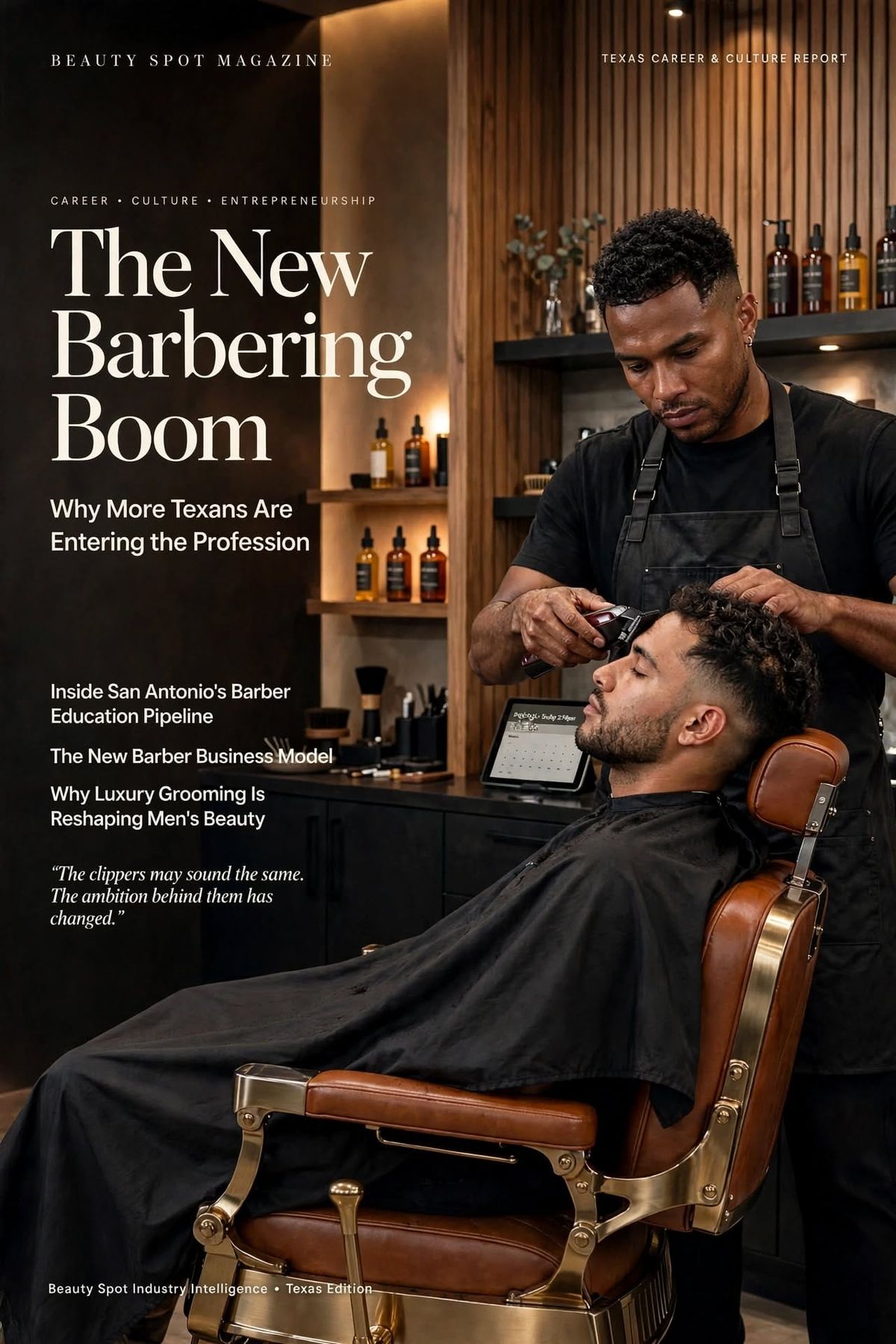
The New Barbering Boom: Why More Texans Are Entering the Profession
Texas barbering is entering a new era—where technical skill, cultural influence, personal branding, and entrepreneurship meet. From classrooms to luxury grooming studios, a new generation of barbers is turning craft into career, community, and business.

Across Texas, the barbershop is becoming something bigger than a place for a haircut. It is a creative studio, a neighborhood institution, a personal brand, a small-business incubator—and for a growing generation of Texans reconsidering what a successful career can look like, barbering represents something increasingly valuable: a profession they can build with their own hands.
Walk into the right Texas barbershop today and the old stereotypes disappear almost immediately. The space may still carry the familiar soundtrack of clippers and conversation, but everything around it has evolved. Appointment software replaces the handwritten book. Ring lights stand beside barber chairs. Retail shelves display beard oils, texture products and grooming systems. A barber checks a phone between clients—not simply for messages, but to post a transformation video, answer a booking inquiry or engage an audience that may stretch far beyond the neighborhood. Somewhere in the shop, a young apprentice is watching not only how a fade is executed, but how a professional carries himself, communicates with clients, prices his work and builds a reputation.
This is the new barbering economy, and Texas may be one of its most interesting stages.
The profession has always carried cultural importance. Barbershops have long functioned as gathering places, especially within Black and Latino communities, where grooming, identity, conversation and entrepreneurship have occupied the same room for generations. What is changing is the visibility of the opportunity surrounding the chair. Barbering is increasingly being seen not simply as a trade someone “falls into,” but as a deliberate career capable of combining technical mastery, creative expression, community influence and business ownership.
In Texas, that shift deserves attention.
A Career Path That Feels Tangible Again
For many people entering the workforce, the traditional formula for professional success has become less convincing. A four-year degree remains the right path for millions, but it is no longer the only culturally respected definition of ambition. Tuition costs, uncertainty around some entry-level office careers, the appeal of entrepreneurship and the desire to develop a skill with an immediate real-world application have all helped restore interest in skilled professions.
Barbering fits naturally inside that conversation.
The work is physical, visual and measurable. A student can watch technique become competency in real time. The difference between an average fade and exceptional precision is visible. So is progress in consultation, shear control, beard design, sanitation, time management and client retention.
And once the technical foundation is established, the profession offers something especially compelling to entrepreneurial personalities: the ability to connect skill directly to reputation.
A barber does not have to wait for a corporate promotion to become more valuable in the marketplace. Better technique, stronger client experience, greater reliability and a more distinctive brand can change earning potential much more directly.
That does not make barbering easy money. It makes barbering unusually transparent.
Your work follows you.
So does your reputation.
San Antonio Is Showing Us What the Pipeline Can Look Like
Beauty Spot Magazine’s examination of a supplied San Antonio beauty-school dataset revealed a particularly strong barber-education presence. Eighteen records—nearly one-third of that dataset—contained “barber” or “barbers” in the institution name, including programs such as Most High Barber College, Game Changers Barber Academy, Deluxe Barber College, Enrichment Barber College, Top of the Line Barber School, Dapper G Barber College, Fade’Em All Barber College, Gloria’s Barber College, Maverick Barber School and Alamo City Barber College.
That does not establish, by itself, that barber enrollment is rising across the entire state. The supplied dataset does not contain enrollment counts, graduation rates, licensing-examination performance or employment outcomes, and several records require additional status verification.
But it reveals something worth noticing: barber education has enough presence in one of Texas’ largest metropolitan areas to form a recognizable training ecosystem rather than a fringe category.
More significant still is where some of that exposure begins.
The same San Antonio records include public high schools and career-education programs, among them Lanier High School, Harlandale High School, Sam Houston High School, John Jay High School, Edgewood Academy and NextGenBarbers through Harlandale ISD, alongside postsecondary options such as Palo Alto College.
That changes the conversation.
When barbering appears inside career and technical education, students can encounter the profession before adulthood as a legitimate occupational pathway—not as a backup plan discovered after another plan fails.
For families, schools and workforce leaders, that distinction matters.
A student who responds to technical learning, creative work and entrepreneurship may see in barbering something that a conventional classroom never made visible: the possibility of turning disciplined craft into economic identity.
The modern barber is not only selling a haircut. The strongest professionals are building trust, ritual, identity and recurring client relationships around a highly personal service.
The Social-Media Effect Changed the Chair
Part of barbering’s new magnetism is cultural.
A generation ago, extraordinary barbering skill could be famous inside a neighborhood. Today, it can be famous before lunch.
Instagram, TikTok, YouTube and short-form video transformed a traditionally local profession into a visual performance category. Skin fades, lineups, beard transformations, freestyle designs and dramatic before-and-after work are naturally suited to the camera. The craft photographs well. More importantly, mastery can be demonstrated without explanation.
That visibility changed how young people encounter the profession.
They no longer see only the barber who cuts their hair. They see educators with classes, creators with sponsorships, traveling barbers, competition artists, suite owners, shop founders and professionals who have built audiences around their technique.
The phone became a portfolio.
And the portfolio became distribution.
For an ambitious barber, social media can now do what expensive advertising once did: demonstrate quality repeatedly to an audience before that audience ever sits in the chair.
Yet this is where the profession separates quickly into two categories.
Visibility may bring the first appointment.
Professionalism determines whether the client returns.
The barber who understands camera angles but not sanitation, consultation, punctuality, boundaries, service consistency or business fundamentals has not built a brand. That person has built attention.
Texas barbering remains a licensed profession, not simply an online aesthetic.
Texas Law Makes the Profession Broader Than Many Consumers Realize
Under the Texas Occupations Code, barbering and cosmetology encompass a broad range of regulated beauty services involving hair, scalp, face and grooming. The law specifically distinguishes barbering by including shaving of the face, neck, mustache or beard with a razor of any type in addition to the broader regulated services defined in the statute.
Texas also requires the appropriate practitioner license or permit to perform regulated barbering or cosmetology services, and even restricts use of professional terms such as “barber” or “barbering” when a person does not hold the appropriate license.
That legal framework matters because the modern barber’s value proposition is expanding.
Clients increasingly expect expertise in hair texture, scalp presentation, beard architecture, face shape, grooming products and complete image maintenance. The strongest professionals are not racing through 15-minute cuts. They are learning to consult.
What is the client trying to communicate with this look?
How does the hair actually grow?
Where does density change?
What happens to this cut two weeks from now?
How much maintenance will the client realistically perform at home?
What shape complements the face rather than simply reproducing a reference photograph?
Those questions elevate barbering from execution into professional judgment.
And professional judgment is where premium service begins.
The Return of the Neighborhood Entrepreneur
Texas has always celebrated independence, and barbering translates that cultural instinct into a remarkably visible business model.
A barber can begin as an employee or commissioned professional, progress into independent work where legally structured, establish a personal clientele, develop retail revenue, educate other professionals and potentially move toward ownership.
The progression is easy to imagine.
That does not mean each step is automatic.
Texas law requires barbering and cosmetology practice to occur in properly licensed settings except for specific statutory circumstances, and establishment operation itself carries licensing requirements. The law also addresses professionals leasing space to practice independently.
That makes business literacy just as important as clipper literacy.
A talented barber entering the profession today should understand that becoming busy is not the same as becoming profitable.
Chair rent, product costs, payment-processing fees, taxes, equipment replacement, no-shows, insurance, scheduling gaps and continuing education all live inside the price of a service whether a barber calculates them or not.
The industry sometimes romanticizes independence without explaining its mathematics.
The more sophisticated generation of Texas barbers will not make that mistake.
They will know their service cost.
They will know their rebooking rate.
They will know which clients return every two weeks and which disappear after one appointment.
They will understand retail without becoming pushy.
They will treat deposits, cancellation policies and booking systems as infrastructure rather than attitude.
And they will recognize that a booked schedule can still conceal a weak business if pricing and operating costs are poorly managed.
The Barbershop Is Becoming a Lifestyle Brand
Perhaps the most compelling shift is aesthetic.
The category is moving beyond the visual language of either the old neighborhood shop or the hyper-masculine “man cave.” Across the industry, newer concepts are experimenting with quiet luxury, hospitality, fragrance, beverage service, scalp care, elevated retail and interiors designed with the same sophistication expected from boutique fitness studios and premium spas.
This is not about making barbering less masculine.
It is about recognizing that male grooming itself has become more sophisticated.
Today’s client may understand skincare. He may invest in fragrance, brows, beard products, hair-loss conversations, scalp health and professional styling products. He may expect digital booking, minimal waiting, excellent lighting, privacy and a service that feels intentional from arrival to checkout.
That creates enormous room for differentiation.
The barber who understands hospitality can compete differently from the barber who competes primarily on price.
The shop that develops a distinctive sensory identity—music, scent, interiors, service ritual, product assortment—can become much more than somewhere a client goes because his hair has become too long.
It becomes part of his routine.
That is the luxury opportunity hidden inside barbering.
Luxury is not chandeliers.
Luxury is consistency, anticipation and trust.
Barbering Is Also Becoming More Diverse
Another reason the profession feels newly expansive is that its image is widening.
Barbering historically has been coded heavily male, but women are increasingly visible within barber culture as practitioners, educators, shop owners and specialists. The profession is also attracting creatives who might once have chosen fashion, design, photography or another visually driven career.
That diversification is healthy.
Beauty clients themselves are increasingly fluid in how they move between traditional categories. Short cuts, fades, undercuts, textured styling and precision grooming are not owned by one gender. Technical excellence travels.
The future barber will need cultural competency alongside cutting competency.
Texas is extraordinarily diverse. Hair texture, grooming traditions and beauty expectations vary across communities and generations. A professional who can work intelligently across those differences enters the marketplace with a considerable advantage.
The days of mastering one haircut on one hair type and calling it expertise are fading.
The Client Relationship Is the Real Asset
The economics of barbering are especially interesting because the service naturally supports recurrence.
Hair grows.
Edges soften.
Beards lose structure.
A properly matched barber-client relationship therefore has an embedded reason to continue.
That recurrence is one of the profession’s greatest business advantages, but only when the experience is strong enough to earn it.
The highest-value client is rarely the stranger who books one impressive transformation.
It is the person who returns every two, three or four weeks for years.
That relationship compounds.
A barber learns how the client’s hair behaves. He learns the preferred length, the cowlick, the sensitive area around the neckline, whether the beard needs more weight through the chin or less volume at the sides. Conversation becomes easier. Trust increases. Rebooking becomes routine.
The technical service becomes personalized intellectual property.
That is why exceptional barbers can develop fiercely loyal followings.
Clients are not merely buying cutting.
They are buying the relief of no longer having to explain themselves.
Education Has to Grow With the Opportunity
A profession becoming more desirable also creates responsibility.
Prospective students should evaluate barber programs with the same seriousness they would bring to any career investment.
What license is the program designed to prepare them for?
Is the school appropriately licensed?
What does tuition include?
What equipment must students purchase?
What are the actual schedules?
What student-support systems exist?
How is state examination preparation handled?
What can the school demonstrate about completion and graduate outcomes?
The San Antonio data illustrates why this due diligence is important. The supplied records include multiple licenses associated with some school names, expired entries and many blank status fields. The dataset also does not provide tuition, graduation rates, exam outcomes, student debt, disciplinary history or employment results.
A beautiful Instagram page is not educational due diligence.
Neither is a charismatic recruiter.
Students should understand precisely what they are purchasing.
Texas continuing-education requirements also reinforce the fact that licensure is not the finish line. Current TDLR course-approval materials specify renewal education topics that include sanitation and human trafficking awareness, with additional hours available in areas including Texas laws and rules, ethics, business practices and mental-health awareness.
The larger lesson is simple: a professional license establishes legal entry into the field. Mastery requires much more.
What the Next Generation of Texas Barbers Will Understand
The boom will eventually separate professionals from participants.
Technique will matter.
But technique alone will not be enough.
The barber positioned for longevity will understand hair science, texture, consultation, sanitation and grooming aesthetics. That professional will also understand photography, customer experience, personal branding, booking technology, retention, retail, pricing and the legal structure surrounding the work.
In other words, tomorrow’s strongest barber may look less like the traditional definition of a tradesperson and more like a hybrid of artist, hospitality professional, content creator and small-business operator.
That is precisely why the field is becoming more attractive.
It offers something many careers struggle to provide simultaneously: craftsmanship and ownership.
A barber can point to the work.
Name the client.
See the transformation.
Measure the loyalty.
Build the business.
And, eventually, create something capable of existing beyond the individual chair.
The Bigger Texas Story
The most important thing happening in barbering may not actually be the haircut.
It is the revaluation of skilled beauty work.
For decades, America created an unnecessary hierarchy between professions requiring a traditional academic degree and professions requiring technical mastery. Beauty careers were too often discussed as alternatives for people who supposedly could not do something else rather than sophisticated occupations chosen by people who wanted to do this.
That framing is becoming harder to defend.
Inside today’s strongest barbershops, craft meets commerce every hour.
A precise taper is technical.
Understanding textured hair is technical.
Safe sanitation is professional.
Retaining hundreds of recurring clients is business intelligence.
Opening and operating a compliant establishment is entrepreneurship.
Training another barber is education.
Building a recognizable aesthetic is branding.
Creating a shop that becomes important to a neighborhood is community development.
This is what makes the new Texas barbering moment worth watching.
Not because everyone should become a barber.
And not because the profession promises effortless entrepreneurship.
It does not.
The opportunity is more interesting than that.
Barbering gives people willing to master a craft the possibility of building an identity, a clientele and eventually an enterprise around expertise that cannot be outsourced to an algorithm or reduced entirely to a screen.
The clippers may still sound the same.
The ambition behind them has changed.
And across Texas—from school classrooms and high-school career programs to independent chairs and increasingly polished grooming studios—a new generation is beginning to see what has been sitting inside the barbershop all along:
Not simply a job.
A profession.
A business.
And, for the people prepared to take it seriously, a future.