How Stress Shows Up on Your Skin
Stress can leave visible clues on the skin—from breakouts and dullness to sensitivity, dehydration and inflammation. This Beauty Spot feature explores the skin-stress connection, why the barrier can become reactive, and how smarter, gentler care can support a more resilient complexion.

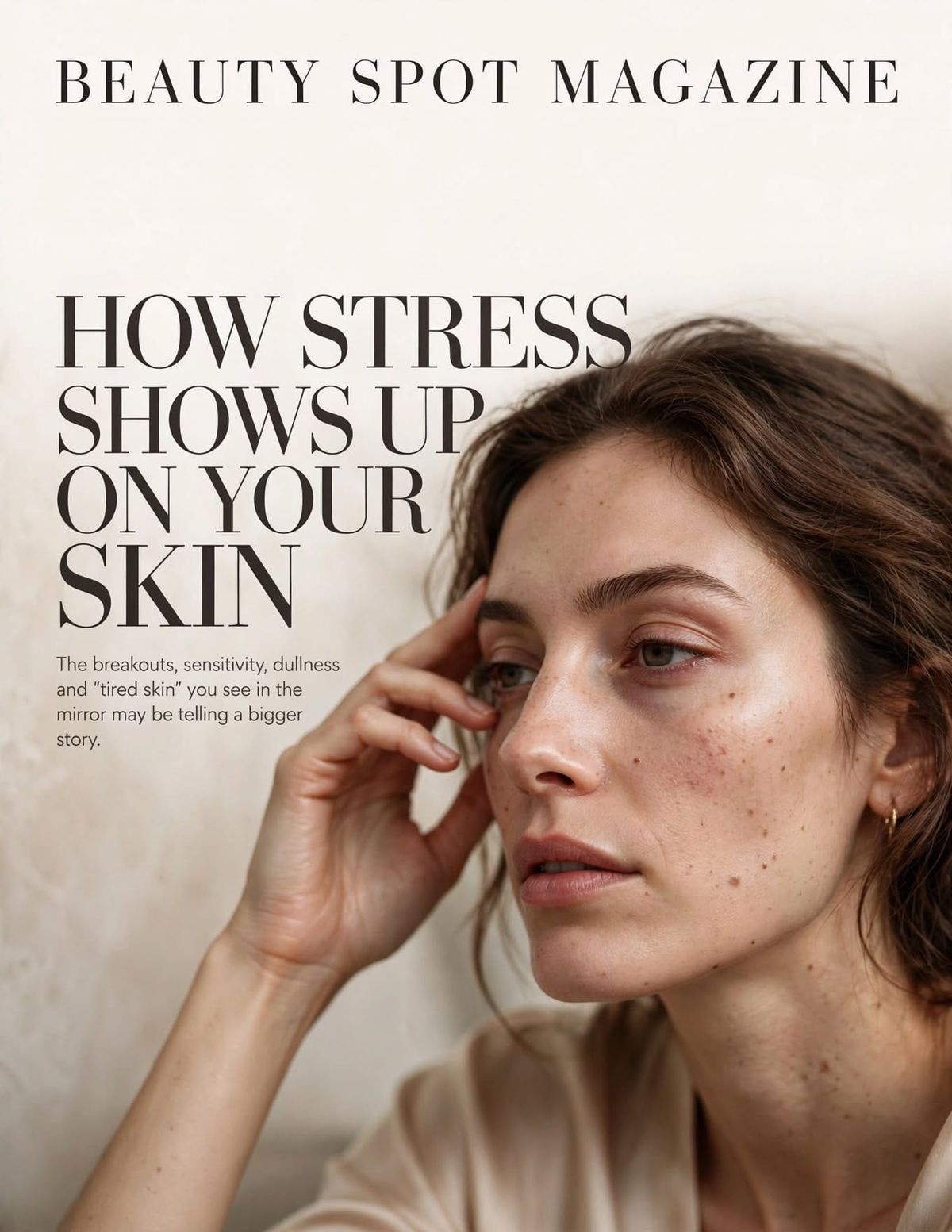
The breakouts, sensitivity, dullness and “tired skin” you see in the mirror may be telling a bigger story.
There are weeks when your skincare routine has not changed, your products are the same, and you have not suddenly abandoned every healthy habit you know—yet your skin seems to wake up speaking an entirely different language. A breakout appears along the jawline. Your complexion looks flatter than usual. Products you normally love suddenly sting. Your face seems puffy in the morning, dehydrated by afternoon and inexplicably irritated by evening. You look in the mirror and think, What happened to my skin?
Sometimes, the better question is: What has been happening to you?
Stress has a way of becoming visible.
Not because every pimple is psychological or every flare is caused by a difficult week, but because the skin is not operating independently from the rest of the body. It exists inside a larger biological conversation involving the nervous system, hormones, immune activity, sleep, inflammation, circulation, environmental exposure and behavior. When life becomes demanding for long enough, the skin can become one of the places where that internal pressure starts to show.
And in an era obsessed with glass skin, poreless finishes and highly edited complexions, that matters.
Because sometimes skin does not need to be punished into behaving better.
Sometimes it needs to be understood.
Stress Is Not Just a Feeling
We tend to talk about stress as though it lives entirely in the mind: a deadline, an argument, financial pressure, caregiving, grief, a packed calendar, a sleepless night.
But the body experiences stress physiologically.
When we perceive a threat or prolonged demand, the body activates systems designed to help us respond. Stress hormones and signaling molecules shift. Heart rate may increase. Sleep can become disrupted. Digestion may change. Muscles stay tense. Behavior changes almost without us noticing.
And when that state becomes chronic rather than temporary, skin can become caught in the ripple effect.
This is one reason stress-related skin changes are rarely about a single mechanism. Stress may interact with oil production, barrier function, inflammation, immune response, sleep quality, healing and everyday habits all at once.
That is why two people can experience the same demanding season completely differently. One breaks out. Another becomes dry and reactive. Someone else develops more noticeable redness. Another simply says, “I look exhausted.”
The skin is responding to the person, not to a beauty trend.
The Breakout That Arrives Right Before Everything Important
Few things feel more suspiciously timed than the blemish that appears before a wedding, presentation, vacation, date, photoshoot or major event.
Stress is not the sole cause of acne, but it can become part of the environment that makes acne harder to manage in some people. Shifts in hormonal signaling, inflammatory activity and sebaceous behavior may influence skin that is already acne-prone.
Then behavior enters the equation.
During stressful periods, people may sleep less, touch their face more, pick at blemishes, eat differently, skip cleansing, over-cleanse out of frustration or introduce too many “emergency” products at once.
Suddenly, one breakout becomes five problems.
This is where sophisticated skincare requires restraint.
The temptation is to attack: stronger acids, another exfoliant, a drying spot treatment, a scrub, a peel, a new active serum.
But skin under stress is not always asking for more intensity.
Sometimes it is asking for less chaos.
Your Barrier Can Start Acting Different
The skin barrier is one of modern beauty’s favorite talking points, but behind the marketing language is something profoundly important: your outermost skin layers help limit water loss while protecting the body from external irritants and environmental exposure.
When barrier function becomes compromised, skin may feel tight, dry, rough, uncomfortable or unusually reactive.
That can create one of the most confusing stress-skin experiences: products that seemed perfectly comfortable last month suddenly feel aggressive.
Your usual vitamin C tingles more than normal. Your retinoid feels impossible. A cleanser leaves your face tight. Even moisturizer seems to “sit wrong.”
This is when consumers often assume the answer is a completely new routine.
Not necessarily.
A stressed complexion may benefit from a temporary shift away from performance obsession and toward barrier support: gentle cleansing, adequate moisturization, sunscreen, hydration and a more disciplined approach to exfoliation.
There is something deeply luxurious about knowing when not to add another active.
Quiet luxury in skincare is not simply expensive packaging.
Sometimes it is biological restraint.
Why Stress Can Make Skin Look Dull
There is dull skin—and then there is the unmistakable complexion of someone who has been running on too little sleep and too much responsibility.
Stress often travels with lifestyle disruption. Late nights. Poor-quality sleep. Less consistent nutrition. Dehydration. Alcohol. More caffeine. Less exercise. Less daylight. More screen time. More unconscious tension.
The result may be a complexion that appears less fresh, less even and less luminous.
The irony is that this is exactly when people often exfoliate hardest.
We see dullness and think: Remove more.
But radiance is not created through exfoliation alone.
Healthy-looking luminosity depends on hydration, surface smoothness, barrier integrity, circulation, consistent sun protection and overall skin condition. Over-exfoliating a tired, dehydrated complexion can make it look more irritated rather than more radiant.
Glow is not something you sand into the face.
Stress Can Turn Sensitivity Up
For some people, stressful periods seem to make the skin more reactive.
That may appear as increased flushing, itching, dryness, discomfort or heightened awareness of products that previously felt benign.
This is particularly important for anyone already managing a diagnosed inflammatory skin condition. Stress can coincide with flares of certain skin disorders, but an esthetician should not turn that observation into a medical diagnosis.
There is an important difference between saying:
“Your skin appears more reactive today.”
and
“Stress caused your condition.”
One is professional observation.
The other may cross into a conclusion the provider is not qualified to make.
High-level beauty professionals understand that knowing when to refer is part of expertise.
Then Comes the Picking
Stress is not only biochemical.
It is behavioral.
Some people chew their nails. Some clench their jaw. Some scroll.
Some pick their skin.
One small clogged pore becomes an evening project under a magnifying mirror. By morning there is redness, swelling, broken skin and a mark that may remain far longer than the original blemish would have.
This pattern is particularly important for clients prone to post-inflammatory discoloration. Repeated manipulation can make the aftermath of a breakout far more visible.
The premium treatment-room conversation is not shame.
It is strategy.
Reduce opportunities to pick. Keep hands away from healing lesions. Cover tempting blemishes when appropriate. Simplify the home routine. Stop trying to “win” against the skin overnight.
Skin rarely rewards aggression.
Stress, Sleep and the Face You Wake Up With
Beauty culture frequently treats sleep as an indulgence.
Skin physiology does not.
Sleep is part of recovery.
A poor night can show up as puffiness, a tired eye area, diminished brightness and a complexion that simply looks less rested. Repeated sleep disruption can also make a complicated skincare situation harder to interpret because so many variables are changing simultaneously.
This is why the most advanced skin consultation may occasionally sound less glamorous than consumers expect.
How are you sleeping?
Have you started new medication?
Have you been traveling?
Did anything change at home?
How often are you exfoliating?
Are you drinking enough water?
Are you picking?
Did the irritation begin before or after the new product?
These questions are not filler.
They are context.
A face does not walk into a treatment room by itself.
A person does.
The Texas Factor: Heat, Sun, Air-Conditioning and Real Life
In Texas, stressed skin is rarely dealing with stress alone.
There is heat. Intense sun exposure. Long stretches in air-conditioned environments. Outdoor-to-indoor temperature shifts. Sweat. Travel. Allergens. Commuting. And, for many clients, a cultural preference for visible results delivered quickly.
That combination can encourage overcorrection.
A client experiencing congestion may request something aggressive. Someone worried about texture may want deeper exfoliation. Someone preparing for an event may want several advanced services stacked together in a short timeframe.
That is where professional judgment matters.
Texas estheticians should remain attentive to legal scope of practice and should not equate consumer demand with permission to perform increasingly aggressive procedures. A premium client experience is not defined by how far a provider is willing to push the skin.
It is defined by judgment.
The smartest provider in the room is often the one who knows when to slow down.
What Stressed Skin May Need Instead
There is no universal “stress facial,” because there is no universal stress complexion.
One client may be oily and congested. Another dehydrated. Another sensitized. Another breaking out because stress has disrupted sleep and home care rather than directly changing the skin itself.
So the strategy begins with observation.
During periods of obvious reactivity, the home routine may need to become beautifully boring: a gentle cleanser, moisturizer suited to the skin, daily broad-spectrum sunscreen and carefully selected supporting products.
That does not mean advanced skincare disappears.
It means advanced skincare becomes more intelligent.
Exfoliation can be adjusted.
Potent actives can be reassessed.
Hydration can be emphasized.
Treatment timing can be reconsidered.
And when there is persistent inflammation, significant pain, suspected infection, severe acne, unexplained rash, rapidly changing pigmentation or another concern outside cosmetic skincare, referral to an appropriate medical professional is not a failure of esthetics.
It is professional maturity.
The New Definition of High-Performance Skin Care
For years, beauty culture rewarded intensity.
Stronger.
Deeper.
Faster.
More active ingredients.
More treatments.
More correction.
But the industry is entering a more sophisticated era—one that understands that skin longevity is not built by constantly provoking the skin into submission.
It is built through consistency, protection, intelligent intervention and respect for biological limits.
That matters especially when stress is high.
Your skin may not need a twelve-step reinvention simply because your life has become complicated.
It may need recovery.
It may need sleep.
It may need hydration.
It may need sunscreen.
It may need you to stop touching it.
It may need a provider who knows that “doing more” and “doing better” are not the same thing.
And occasionally, it may need medical evaluation rather than another beauty product.
Your skin does not exist outside your life. It reflects the environment you create around it, the habits you repeat and, sometimes, the pressure you have been carrying quietly.
That does not mean every breakout should become a wellness diagnosis. It means we should stop treating skin as though it were merely decorative.
Skin is living tissue.
It adapts.
It communicates.
It protects.
And when your complexion suddenly seems more temperamental, dull, congested or reactive during a demanding season, consider the possibility that the answer is not hidden at the bottom of another serum bottle.
Your skin may be asking for something beauty culture does not sell particularly well:
restraint.
In the new era of skin longevity, that may be one of the most sophisticated treatments of all.