Dry Skin vs. Dehydrated Skin
Dry skin lacks oil. Dehydrated skin lacks water—and the difference can completely change how a complexion should be treated. This Beauty Spot guide breaks down barrier health, hydration, product strategy, and why even oily skin can be dehydrated.

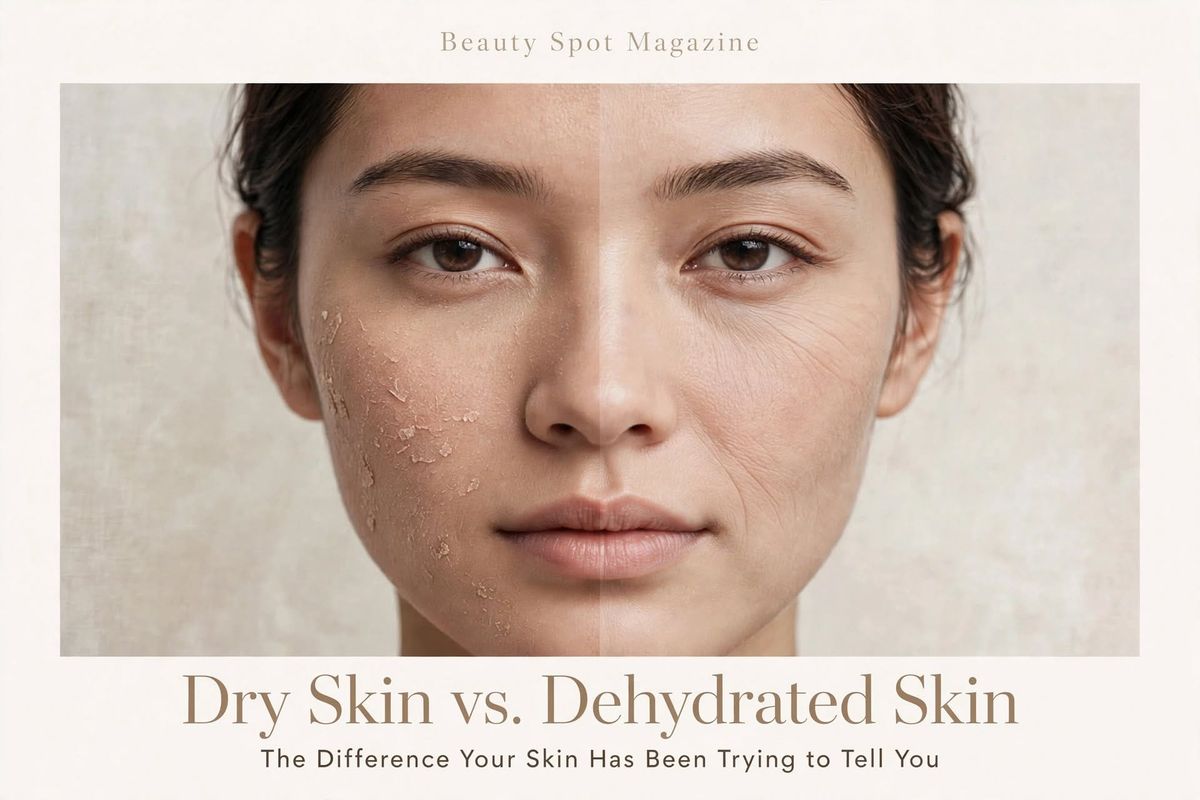
The Difference Your Skin Has Been Trying to Tell You
There is a particular kind of complexion frustration that sends people straight to the richest cream on the shelf: skin feels tight, makeup suddenly looks textured, fine lines appear sharper, and the glow that was there a few weeks ago seems to have disappeared overnight. The immediate conclusion is almost always the same—my skin is dry. But in the treatment room, that description tells only part of the story. Dry skin and dehydrated skin can look remarkably similar, yet they are not interchangeable conditions. One is primarily associated with insufficient oil; the other involves insufficient water. And because healthy-looking skin depends on both an adequate lipid barrier and appropriate water content, confusing the two can lead to an expensive cycle of applying the wrong products, over-exfoliating the wrong problem, and wondering why the complexion never quite settles.
This distinction has become even more relevant in the era of high-performance skincare. Retinoids, exfoliating acids, acne treatments, cleansing balms, foaming cleansers, resurfacing pads and elaborate routines have given consumers unprecedented access to sophisticated ingredients. They have also created a generation of clients whose skin may be simultaneously oily, breakout-prone, sensitized and dehydrated. The old beauty vocabulary—dry, oily, normal, combination—is simply not descriptive enough for what many professionals now see under the magnifying lamp.
Dry Skin Is a Skin Type. Dehydration Is a Condition.
The simplest distinction is also the most important: dry skin generally refers to a skin type characterized by lower levels of sebum, while dehydration describes a state in which the skin lacks adequate water.
Sebum is part of the skin's natural protective environment. Along with epidermal lipids such as ceramides, cholesterol and fatty acids, it contributes to the supple, comfortable quality we associate with a healthy barrier. A naturally dry complexion may produce less oil and commonly feels rough, delicate or persistently tight. Flaking can occur, particularly around the cheeks, mouth or eye area, and the skin may absorb richer creams quickly without ever developing much surface shine.
Dehydrated skin behaves differently. Because dehydration can occur in virtually any skin type, a person may have significant oil production while still experiencing water deficiency within the outermost layers of the skin. That is why the client with a shiny forehead, congestion around the nose and visible fine dehydration lines can be genuinely confused when an esthetician recommends more hydration. To the client, oiliness feels like proof that the skin already has “too much moisture.” Physiologically, however, oil and water are not the same thing.
A complexion can have plenty of oil and still be thirsty.
This is one of the most important concepts an esthetician can teach.
The Barrier Changes Everything
To understand dehydration, we have to talk about the stratum corneum—the outermost portion of the epidermis and one of the most important structures in modern skin-health conversations. This layer is frequently compared to a brick-and-mortar wall: corneocytes form the “bricks,” while intercellular lipids help form the surrounding “mortar.” Together, they help limit excessive water loss while protecting the skin from the outside environment.
When this barrier is compromised, water can escape more readily through a process known as transepidermal water loss, or TEWL. The result may be tightness, roughness, sensitivity, dullness and fine surface lines that become especially obvious when makeup settles into them. Strong cleansers, excessive exfoliation, frequent hot water exposure, low-humidity environments and aggressive combinations of active ingredients can all contribute to a complexion that feels increasingly uncomfortable.
This is where skincare can become paradoxical. A client notices texture, so she exfoliates more. The skin becomes tighter, so she assumes she needs another acid to remove the “dead skin.” Makeup begins separating, prompting even more cleansing. Within weeks, what began as mild dehydration can become a barrier-management problem.
The answer is not always more correction.
Sometimes the most sophisticated treatment strategy is restraint.
What Dry Skin Tends to Look Like
Truly dry skin often presents as a consistent pattern rather than a temporary episode. There may be minimal visible oil throughout the day, small or barely noticeable pores in some areas, roughness, flaking and a general preference for creamier formulations. The complexion may feel uncomfortable shortly after cleansing and frequently benefits from products containing emollient and barrier-supportive ingredients.
This is where ingredient architecture matters. Emollients help soften and smooth the spaces between surface cells. Occlusive ingredients help reduce water loss by forming a protective layer over the skin. Barrier-supportive lipid formulations may incorporate components such as ceramides, cholesterol and fatty acids. For genuinely dry skin, adding water without adequately supporting the lipid environment may provide only temporary relief.
A beautifully formulated hydrating serum can make dry skin feel better—but if the routine provides no meaningful emollient or occlusive support, that hydration may not be retained as effectively as the client expects.
What Dehydrated Skin Tends to Look Like
Dehydrated skin can be far more deceptive.
It may look dull rather than visibly flaky. It may feel tight immediately after cleansing but become oily several hours later. Fine lines can suddenly seem more pronounced, particularly around the eyes and forehead. Foundation may appear patchy or settle unevenly despite visible surface oil. Some clients describe the skin as feeling both greasy and tight at the same time—a combination that sounds contradictory until water balance and lipid production are considered separately.
Hydration-focused formulations commonly rely on humectants, ingredients that help attract and retain water within the stratum corneum. Familiar examples include glycerin, hyaluronic acid, sodium PCA, panthenol and urea in appropriately formulated cosmetic products. But even here, formulation matters more than ingredient celebrity. A single trending ingredient cannot compensate for an entire routine that continually strips or irritates the barrier.
The luxury skincare conversation is slowly moving beyond “Which active is strongest?” toward a more intelligent question:
What does this skin actually need today?
That shift is the foundation of skin longevity.
Yes, Oily and Acne-Prone Skin Can Be Dehydrated
This is perhaps the point clients resist most.
Dehydration is not reserved for mature, dry or winter-stressed complexions. Oily skin can become dehydrated through over-cleansing, frequent exfoliation, environmental exposure, poorly tolerated acne products or an overly aggressive home regimen. And when that happens, the instinct to strip away even more oil may make the skin feel progressively less comfortable.
For professionals, this is where consultation becomes more valuable than simply assigning a skin “type.” How does the skin feel after cleansing? What happens by midday? How many exfoliating products are being used? Has the client recently introduced a retinoid? Is there seasonal change? Has travel altered the routine? Is makeup suddenly behaving differently? Has sensitivity increased?
Skin assessment is pattern recognition.
The more sophisticated the provider, the less likely she is to diagnose an entire complexion from one visible characteristic.
Texas Skin Has Its Own Environmental Conversation
For Texas estheticians, hydration assessment deserves particular attention because clients routinely move between dramatically different environments: outdoor heat, intense sun exposure and climate-controlled interiors can all influence how the skin feels and behaves. A San Antonio client may spend part of the day in high outdoor temperatures and the rest beneath aggressive indoor air-conditioning. Frequent cleansing after workouts, swimming, travel and year-round use of active skincare can complicate the picture further.
That does not mean every tight complexion is dehydrated, nor does climate alone explain barrier disruption. It means environment belongs in the consultation.
Professional judgment matters here. Beauty Spot's Texas compliance framework places facial treatments, cleansing, stimulation and cosmetic product application within the professional esthetics conversation while repeatedly emphasizing that education does not expand legal scope of practice. Skin concerns that appear inflammatory, persistent, unusual or potentially medical deserve appropriate referral rather than cosmetic overreach.
The Treatment-Room Mistake to Avoid
One of the easiest mistakes in professional skincare is treating every rough surface as an exfoliation problem.
Not every flake needs to be dissolved.
Not every texture irregularity needs stronger resurfacing.
And not every lack of glow is evidence that the skin needs another peel.
A dehydrated or compromised complexion may look instantly smoother after aggressive exfoliation because surface cells have been removed—but immediate smoothness does not necessarily mean the underlying condition has improved. Skilled esthetics is not simply about creating the fastest visual transformation. It is about reading the skin well enough to know when correction is appropriate and when replenishment should come first.
That distinction separates protocol-following from professional skin intelligence.
Building a Smarter Home Routine
For many clients, improving dry or dehydrated skin begins by simplifying rather than expanding the routine. A gentle cleansing strategy, thoughtful hydration, an appropriate moisturizer and consistent daytime sun protection create a stronger foundation than six competing actives applied without strategy.
For dehydration, the emphasis often shifts toward water-binding ingredients and reducing unnecessary sources of barrier stress. For genuinely dry skin, lipid-rich and emollient products may deserve a more substantial role. For someone who is both dry and dehydrated—a very common combination—the routine may need both.
This is why the question should never be simply, “What moisturizer do you recommend?”
The better question is:
“What is this skin missing, and what is causing it to lose what it already has?”
That is where professional consultation becomes valuable. The answer may involve product selection, application order, cleansing habits, environmental exposures, frequency of active ingredients, treatment scheduling or several of these factors working together.
The New Luxury Is Skin That Functions Well
Beauty culture spent years teaching consumers to chase perfection: poreless, polished, glass-like, resurfaced, filtered. The more sophisticated movement now emerging is different. It values resilient skin. Comfortable skin. Skin that tolerates intelligent treatment without constantly being pushed into recovery mode.
That is why understanding dry skin versus dehydrated skin is far more than a vocabulary lesson. It changes the entire strategy.
Dryness asks us to consider oil and lipid support.
Dehydration asks us to consider water and water retention.
Barrier disruption asks us to consider why that water may be escaping in the first place.
And professional skin analysis asks us to stop pretending those questions can be answered by looking at a single patch of flaking skin.
The future of high-level esthetics will not belong to professionals who simply know the most ingredients or perform the strongest treatments. It will belong to those who can interpret the skin in context—its oil, water, barrier behavior, environment, product history and changing needs—and translate those observations into a restrained, intelligent plan.
Because sometimes the complexion asking for more moisture does not need a heavier cream.
Sometimes oily skin is thirsty.
Sometimes “dryness” is really dehydration.
And sometimes the most luxurious thing we can give the skin is exactly what it has been asking for all along: balance.