The Hormone Health Revolution
Hormone health is changing the beauty conversation. Beauty Spot Magazine explores how life-stage transitions can influence skin, hair, sleep, energy, and self-image—and why professionals must pair elevated care with medical boundaries, responsible referrals, and deeper client listening.

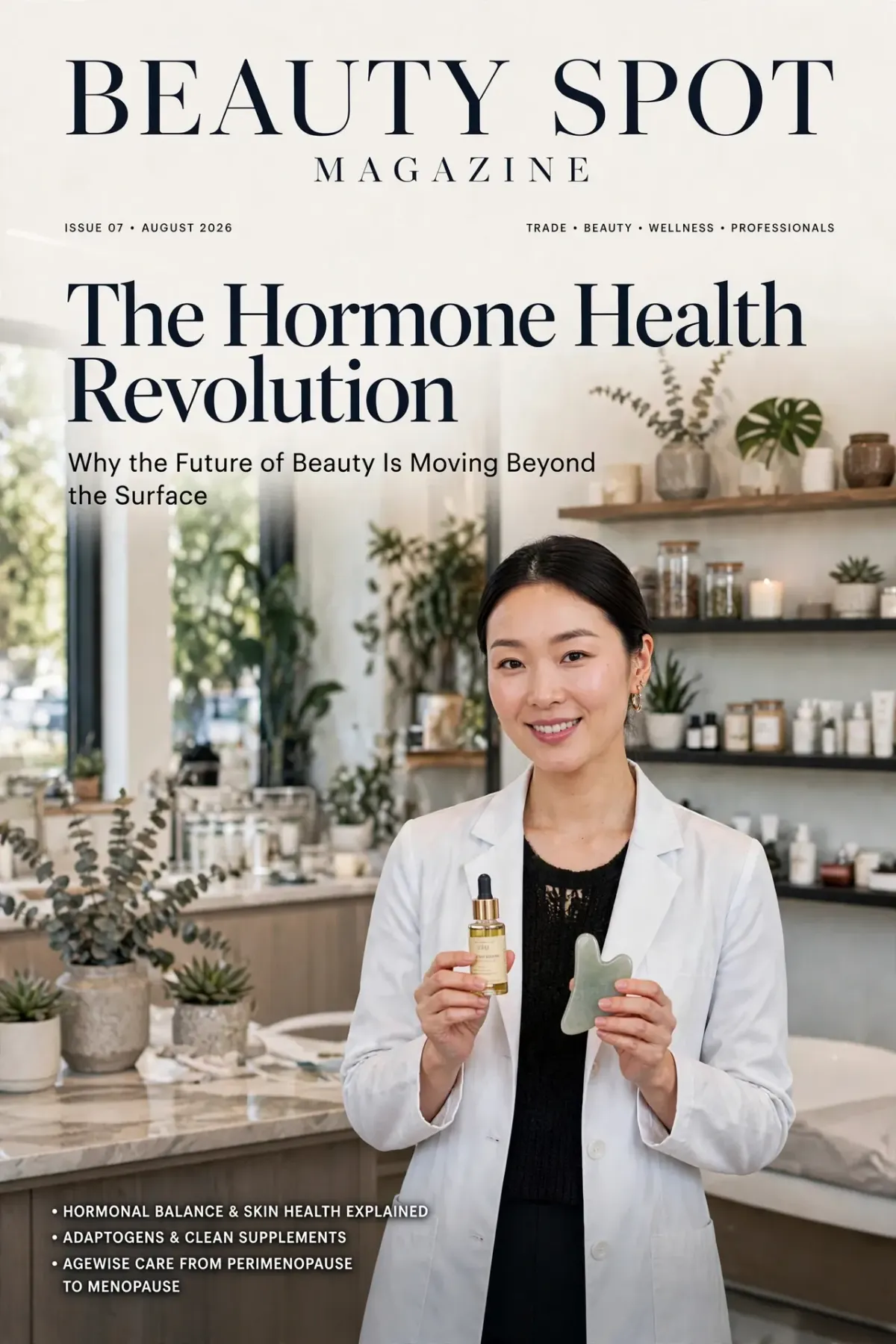
Why the Future of Beauty Is Moving Beyond the Surface
For decades, the beauty industry approached the face and body as though every visible concern began at the surface. Dryness called for a richer moisturizer. Breakouts demanded stronger exfoliation. Hair shedding inspired a new scalp serum. Sudden weight changes became a conversation about discipline, while exhaustion was quietly disguised with concealer, caffeine, and determination.
That era is ending.
A new generation of consumers is asking a more intelligent question: What is happening inside the body that may be influencing what I see on the outside?
This shift has placed hormone health at the center of one of wellness culture’s most important transformations. Women are speaking more openly about menstrual changes, fertility, postpartum recovery, thyroid health, insulin resistance, perimenopause, menopause, sleep disruption, sexual wellness, stress, body composition, hair thinning, and skin changes that no longer respond to familiar routines. Men, too, are entering conversations around testosterone, metabolic health, fatigue, muscle retention, hair loss, mood, and healthy aging.
Hormones have become part of the beauty conversation because beauty has become part of the health conversation.
This is not simply another wellness trend wrapped in polished branding. It is a cultural correction—a movement away from treating every change as a cosmetic failure and toward understanding the body as an interconnected system.
The next era of beauty will not be built on correcting the body’s appearance while ignoring the body’s communication.
The Body Is Always Speaking
Hormones are chemical messengers produced within the endocrine system. They participate in growth, reproduction, metabolism, stress response, sleep, energy regulation, and many other functions. Beauty professionals do not diagnose endocrine disorders, but they routinely work with tissues and structures that can reflect internal changes.
Professional cosmetology education recognizes that the endocrine system controls hormone levels associated with growth, development, reproduction, and whole-body health—and that hormones can directly affect the hair and skin. It also emphasizes that healthy hair, skin, and nails depend on the coordinated function of multiple body systems.
That connection can become visible in ways that feel deeply personal.
A client who once had balanced skin may begin experiencing persistent dryness or adult acne. Another may notice that her scalp feels different, her hair density is changing, or the texture she has known for years suddenly seems unfamiliar. Someone entering perimenopause may report disrupted sleep, increased sensitivity, slower recovery, changes in body composition, or a sense that her usual beauty rituals are no longer delivering the same result.
These signs do not automatically prove that hormones are the cause. Skin, hair, energy, and weight can change for many reasons. But they do remind us that the body cannot be reduced to a single product recommendation or treatment protocol.
The sophisticated beauty professional observes without diagnosing. She notices patterns, asks appropriate intake questions, documents changes, modifies services when necessary, and refers the client to a qualified healthcare provider when concerns fall outside cosmetic practice.
That distinction is not merely legal protection. It is elevated care.
Perimenopause Has Entered the Beauty Room
One of the most significant forces driving the hormone health revolution is the public awakening around perimenopause—the transitional period leading toward menopause.
For years, many women entered this stage with little meaningful preparation. They were often told that symptoms were simply part of aging, stress, or an overloaded life. Meanwhile, the beauty industry continued marketing “anti-aging” as though the solution to every midlife change could be found inside a jar.
Today, clients are arriving with better questions.
Why has my skin become more reactive? Why does my face feel drier even though I have not changed my routine? Why is my hair shedding? Why am I waking during the night? Why does my body respond differently to the same workouts and meals? Why do I feel less like myself?
These questions deserve more than a sales pitch.
Hormonal transitions may coincide with changes in oil production, hydration, perceived firmness, temperature regulation, sleep quality, mood, scalp condition, and hair behavior. Yet the responsible response is not to blame every concern on estrogen, cortisol, thyroid function, or “hormone imbalance.” That language can sound authoritative while oversimplifying complex medical questions.
The better approach is collaborative. A licensed esthetician may support the skin barrier, reduce unnecessary irritation, adjust exfoliation frequency, prioritize hydration, and create a treatment experience that respects increased sensitivity. A hairstylist or scalp specialist may recognize changes in density or shedding patterns and encourage medical evaluation when appropriate. A qualified medical professional may assess symptoms, history, medications, laboratory findings, and treatment options.
The revolution is not one profession attempting to become every profession.
It is the rise of a more connected standard of care.
Skin Longevity Replaces the War on Aging
Hormone-aware beauty also challenges the language the industry has used around age.
For too long, aging was positioned as an aesthetic emergency: a line to erase, a body to reclaim, a face to restore to an earlier version of itself. This framing was profitable, but it often created shame where education should have existed.
The new conversation is about skin longevity.
Skin longevity does not promise agelessness. It focuses on maintaining barrier function, resilience, comfort, hydration, evenness, and healthy-looking vitality across changing life stages. It recognizes that a 48-year-old client does not need to be treated like a 28-year-old client with more aggressive products. She may need a more intelligent strategy—one built around inflammation awareness, recovery capacity, sun protection, consistency, and appropriate professional collaboration.
This philosophy is especially important in advanced aesthetics, where clients may request increasingly aggressive services because they believe intensity equals effectiveness. Hormonal transitions, medication changes, health conditions, and altered skin sensitivity can influence treatment suitability and recovery. More treatment is not always better treatment.
The luxury provider of the future will not impress clients by pushing every boundary.
She will earn trust by knowing where the boundary belongs.
The Cortisol Conversation
No hormone has been absorbed into beauty and wellness language more dramatically than cortisol.
Social media has turned “high cortisol” into an explanation for nearly everything: facial puffiness, abdominal weight, acne, fatigue, insomnia, irritability, cravings, and burnout. Some of these concerns can occur alongside prolonged stress, but online content often collapses an intricate physiological system into a marketable diagnosis.
Stress matters. Sleep matters. Recovery matters. But a beauty professional should never tell a client that she has a cortisol disorder based on appearance, lifestyle assumptions, or a trending checklist.
What the professional can do is recognize that the modern client is often overstimulated and under-recovered. She may arrive from a demanding job, caregiving responsibilities, financial pressure, interrupted sleep, or a relentless digital environment. Her nervous system may need the treatment room to feel less like a performance laboratory and more like a place of restoration.
This is where the sensory intelligence of beauty becomes powerful.
Warm towels. Controlled lighting. Thoughtful pacing. Gentle touch. Clear communication. Fewer unnecessary steps. A treatment plan that does not punish the skin. A provider who listens without dramatizing.
Luxury wellness is increasingly defined not by excess, but by regulation: less noise, less urgency, less aggressive intervention, more precision.
When Hormone Health Becomes a Marketing Problem
Every revolution attracts opportunism.
The growing interest in hormone health has created valuable education, but it has also produced vague testing packages, unsupported supplement claims, fear-based messaging, unqualified “hormone coaching,” and promises that one protocol can solve a client’s skin, weight, mood, energy, and sex drive at once.
The beauty and wellness industries must be especially careful here. Hormonal symptoms can overlap with medical conditions, medication effects, nutritional concerns, sleep disorders, mental health challenges, and normal life-stage transitions. A polished Instagram page does not convert speculation into diagnosis.
Words matter.
“Supports healthy-looking skin” is different from “balances hormones.”
“May complement a wellness plan” is different from “treats thyroid dysfunction.”
“Encourages relaxation” is different from “lowers cortisol.”
The strongest brands will resist miracle language. They will use transparent claims, qualified professionals, appropriate referrals, informed consent, and clear distinctions between cosmetic support, general wellness education, and medical care.
This restraint does not weaken the brand.
It strengthens its authority.
The Texas Professional Standard
In Texas, hormone health conversations require a particularly clear understanding of professional scope.
Estheticians may provide legally permitted cosmetic skin services, but diagnosing endocrine conditions, interpreting laboratory results, prescribing medications, managing hormone therapy, and treating disease belong within qualified medical practice. Texas beauty professionals must understand that being trained in a technique or familiar with a condition does not automatically authorize them to perform medical services or make medical claims.
The Beauty Spot Texas legal framework emphasizes a crucial principle: a license does not grant permission to perform everything a provider has been taught; it permits only what the law allows. It also identifies aggressive procedures and services that blur the line between cosmetic and medical practice as high-risk areas requiring caution.
Texas law separately recognizes licensed medical and nursing professionals operating within their own scopes, reinforcing the importance of distinguishing cosmetology services from medical practice.
For a Texas spa, salon, esthetic practice, or wellness studio, the intelligent model is not to imitate a medical clinic. It is to build responsible referral relationships.
That may include dermatologists, primary care physicians, gynecologists, endocrinologists, registered dietitians, mental health professionals, pelvic health providers, and properly structured medical wellness practices. The beauty professional remains a valuable part of the client’s care ecosystem without crossing into diagnosis or treatment.
A New Client Experience
The hormone health revolution will change more than treatment menus. It will change intake, consultation, retention, education, and brand positioning.
A modern consultation should make space for life-stage awareness. Has the client recently given birth? Has she entered perimenopause or menopause? Has there been a significant medication change? Is she undergoing medical treatment? Has her skin suddenly become reactive? Is hair shedding new, rapid, or unexplained? Has a healthcare professional diagnosed a condition that affects treatment planning?
The provider does not need to interrogate or interpret. She needs to listen for relevance.
Treatment plans may become more adaptive. A client’s skin may require barrier repair before corrective work. A once-reliable peel schedule may need reconsideration. A high-frequency membership may shift toward restorative maintenance. Home care may become simpler rather than stronger. Progress may be measured through comfort, stability, hydration, and resilience—not merely visible exfoliation or dramatic post-treatment response.
This creates a more sophisticated membership model as well. Instead of selling identical monthly services, practices can design life-stage programs centered on skin resilience, scalp wellness, restorative care, healthy-aging education, and coordinated referral support.
The opportunity is not to monetize fear around hormones.
It is to create continuity of care during seasons when clients often feel unseen.
The Future Is Collaborative
The hormone health revolution is ultimately a revolution in perspective.
It asks the beauty industry to stop viewing every visible change as an isolated flaw. It asks medical and wellness providers to take appearance-related concerns seriously without reducing patients to vanity. It asks brands to replace exaggerated promises with intelligent education. And it asks professionals to know both the value and the limits of their expertise.
The future beauty provider will be technically skilled, legally aware, emotionally intelligent, and fluent in collaboration. She will understand that a facial can support comfort and confidence without pretending to treat an endocrine disorder. She will recognize that hair shedding may deserve compassion and referral—not a guaranteed product claim. She will know that menopause is not a disappearance of beauty but a biological transition requiring a new standard of care.
Most importantly, she will understand that clients are no longer satisfied with being told to hide what their bodies are expressing.
They want context.
They want options.
They want professionals who listen closely, communicate honestly, and treat beauty as part of a larger human story.
Hormone health is not replacing skincare, aesthetics, hair care, fitness, or wellness. It is connecting them—carefully, responsibly, and with a deeper respect for the body beneath the beauty.
And that may be the most meaningful revolution of all.
Medical and hormone-related claims should receive review from a qualified healthcare professional before publication.