The Future of Continuing Education in Texas
Discover how Texas continuing education is evolving beyond certificates toward competency, compliance, skin science, and career longevity for beauty professionals. Subscribe and read more at beautyspotmagazine.com.

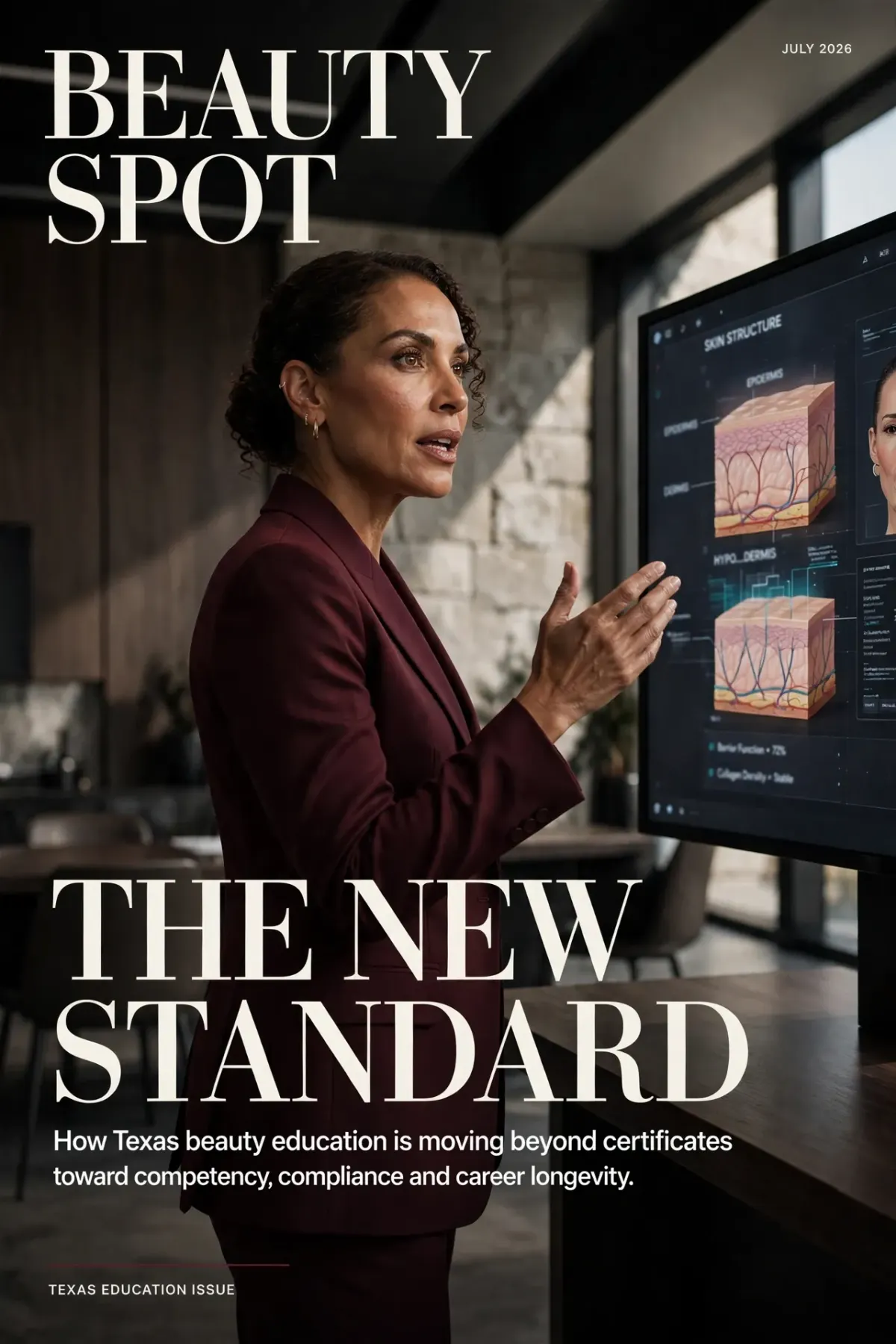
Why the Next Era of Beauty Education Will Be Defined by Compliance, Clinical Intelligence and Career Longevity
Texas beauty professionals have never had greater access to advanced training—or more reasons to question what that training actually qualifies them to do.
Across San Antonio, Dallas, Houston, Austin and the rapidly expanding suburban beauty markets surrounding them, estheticians are enrolling in courses on corrective skincare, chemical resurfacing, device-based treatments, microneedling, scalp health, regenerative beauty, luxury client experience and medical-spa operations. The appetite for knowledge is unmistakable. Today’s professional does not want to remain frozen at the level of entry-school instruction. She wants to understand inflammation, pigmentation, barrier disruption, ingredient chemistry, treatment sequencing, client retention and the sophisticated business systems that turn technical talent into a durable career.
But the future of continuing education in Texas will not be determined by how many certificates a provider can collect.
It will be determined by whether education becomes more credible, more transparent and more closely connected to the realities of licensure, client safety and professional scope.
The next generation of beauty education must teach professionals not only how a treatment works, but whether they are legally positioned to perform it.
That distinction is becoming one of the most important conversations in the Texas beauty industry.
The Certificate Era Is Losing Its Power
For years, advanced education was often marketed through transformation language: become certified, add a profitable new service, elevate your treatment menu, enter the medical-aesthetics space or position yourself as an advanced provider. The promise was aspirational and commercially compelling. In many cases, the education itself offered genuine value.
The problem is that a private training certificate and a state-issued professional license do not carry the same legal authority.
A certificate may document that someone attended a course, completed a module or demonstrated a technique under the standards of a private educator. It does not automatically expand that person’s state-defined scope of practice. The Texas legal framework makes this distinction especially consequential because license renewal, permitted services, establishment compliance and professional conduct remain governed by state law and administrative rules—not by the language printed on a course completion document.
The Beauty Spot Texas legal framework captures the issue directly: a license does not grant permission to perform everything a professional has been taught. It grants permission to perform what the law authorizes.
This does not make advanced education less valuable. It makes responsible advanced education more valuable.
The strongest future programs will state, with unusual clarity, what a course is designed to teach, which license types it may be relevant to, what portions are theoretical, what portions are hands-on, what supervision may be required and where state law places limits on implementation. Education providers will need to become as fluent in professional boundaries as they are in protocols.
In the next era, ambiguity will no longer feel sophisticated. It will feel unsafe.
Texas Is Moving Toward Education With a Public-Safety Purpose
Texas law already positions continuing education as more than a routine renewal exercise. The state’s statutory framework allows the commission to establish continuing-education requirements and directs attention toward both new skill acquisition and the identification and assistance of trafficked persons. A human-trafficking continuing-education requirement was added to the occupations code with an effective date of September 1, 2025.
That shift matters.
Beauty professionals often work in intimate, trust-based environments. They see clients regularly, notice changes in behavior and appearance, and may become part of a person’s broader support network. Continuing education is therefore being asked to perform two roles at once: strengthen professional competency and increase public awareness.
The future will likely demand more of this dual-purpose education.
Sanitation, infection control, contraindication recognition, ethical consultation, documentation, referral judgment, trafficking awareness and client safeguarding cannot remain the least glamorous portion of a training day. They are part of the professional infrastructure that allows beauty businesses to operate with legitimacy.
In a luxury treatment room, compliance is not the opposite of elevated service.
It is what makes elevated service believable.
Advanced Education Must Become Scope-Literate
The most urgent challenge in Texas continuing education is the widening space between consumer demand and professional authority.
Clients are increasingly familiar with treatment terminology. They arrive asking about collagen induction, clinical-grade resurfacing, growth factors, exosomes, platelet-rich plasma, corrective peels and aggressive pigmentation protocols. Social platforms collapse medical, cosmetic and esthetic services into a single visual feed, making radically different procedures appear equally accessible.
For the provider, this creates pressure.
A client may interpret confidence as qualification. A practitioner may assume that equipment availability implies legal usability. A business owner may believe that a physician’s proximity automatically changes the scope of every person working inside the facility. A course may focus heavily on technical execution while devoting only a few minutes to state-specific restrictions.
This is where continuing education must mature.
The Texas legal source identifies aggressive chemical peels, advanced exfoliation, devices that mimic medical procedures and services marketed as “medical-grade” without appropriate oversight as high-risk areas for estheticians. The same source emphasizes sanitation, equipment safety, inspection readiness and the individual responsibility of professionals working independently or within rented spaces.
Future-forward education cannot simply demonstrate a procedure. It must teach professionals how to classify it.
Does the treatment remain superficial? Does it intentionally affect living tissue? Is the device cosmetic, medical or regulated under another framework? Is the product intended for topical cosmetic use, or is it being used in a manner that changes the legal character of the service? Does a supervising clinician have an actual role in the treatment model, or is medical language being used primarily as branding?
Those questions should become standard curriculum.
Not because Texas professionals should be taught to fear advanced beauty, but because intelligent boundaries protect careers.
Theory Can Travel. Competency Still Requires Contact.
The future of continuing education will undoubtedly be digital. Online learning offers extraordinary access for professionals in rural Texas, working parents, solo practitioners and providers who cannot repeatedly travel to major metropolitan training centers.
Texas law recognizes a role for distance education in licensed-school curriculum, while distinguishing theory from practical instruction. The occupations code permits distance education for theory but states that it does not satisfy practical curriculum requirements.
That principle should influence the broader continuing-education market.
Certain subjects translate beautifully online: anatomy, ingredient chemistry, business operations, legal awareness, consultation psychology, treatment planning and case review. Other competencies require direct observation. Hand pressure, tissue response, device control, sanitation behavior, client positioning and recognition of an unsafe endpoint cannot always be evaluated through a pre-recorded video and a multiple-choice quiz.
The strongest educational models will therefore become hybrid.
Professionals may complete foundational theory digitally, attend live demonstrations, practice under qualified supervision, submit case documentation and return for competency reassessment. Education will become less event-based and more developmental.
A single weekend may introduce a skill.
It should not be expected to create mastery.
Continuing Education Will Become a Career Architecture
For ambitious Texas professionals, education is already becoming more than license maintenance. It is becoming a way to design a career.
An esthetician may deepen her authority in barrier repair, acne management, pigmentation, mature skin or luxury facial protocols. A cosmetologist may move toward education direction, editorial work, salon leadership or brand development. A nail professional may build systems around retention, sanitation, team performance and premium service positioning. A spa owner may study membership design, financial literacy, inventory control and client-experience strategy.
Traditional beauty education often concentrates on service performance. The future must include the full commercial environment around that service.
Industry education materials recognize that leadership roles require far more than technical ability. Education directors, creative leaders and salon managers need communication, budgeting, product intelligence, marketing knowledge, operational skill and the ability to guide other professionals.
This is especially relevant in Texas, where beauty businesses range from private suites and boutique facial studios to luxury spas, multidisciplinary wellness concepts and physician-led medical-aesthetic practices.
A provider who understands skin but not pricing may remain overworked.
A provider who understands technique but not documentation may remain exposed.
A provider who understands trends but not scope may build a business on unstable ground.
Continuing education must address the entire professional, not only the treatment room.
The Rise of the Educator as a Trusted Authority
The Texas educator of the future will need more than a polished presentation and an impressive social following.
She will need curriculum integrity.
That means identifying the source of technical claims, distinguishing cosmetic benefits from medical outcomes, disclosing conflicts of interest, maintaining updated course materials, documenting learning objectives and explaining where evidence remains incomplete.
It also means resisting the pressure to make every class sound revolutionary.
Beauty professionals are becoming more discerning. They want to know whether a protocol is evidence-informed, manufacturer-led, clinically established, commercially emerging or largely anecdotal. They want to understand whether an instructor is teaching within personal expertise. They want clarity about which claims are educational, which are promotional and which require medical interpretation.
The future educator will not lose authority by acknowledging limitations.
She will gain it.
Credibility in advanced beauty education will belong to the instructor who can explain both the opportunity and the boundary.
This will also create a stronger market for specialized Texas education. State-specific legal modules, inspection-readiness courses, medical-spa role clarification, consultation documentation, adverse-event response and ethical marketing could become as commercially important as technique-based training.
The professional community does not need less ambition.
It needs ambition with infrastructure.
Micro-Credentials Will Need Real Meaning
The beauty industry is likely to embrace shorter, stackable credentials: certificates in pigmentation, acne consultation, scalp analysis, advanced facial massage, ingredient literacy, spa leadership, membership strategy and other focused competencies.
This could be a positive development. Professionals do not always need another large program. They may need a precise educational solution to a specific business or technical gap.
But micro-credentials will only retain value if they communicate exactly what has been assessed.
Did the learner attend?
Did the learner pass a knowledge examination?
Was hands-on competency observed?
Were case studies reviewed?
Does the credential expire?
Does it require renewal or ongoing practice?
Does it represent education, manufacturer authorization, professional certification or state licensure?
These distinctions should be visible to both professionals and consumers.
The future may also bring stronger systems for verifying educator status, course approval, credential history and completion records. Texas already maintains a formal process for continuing-education provider registration, reinforcing that education offered for regulatory credit exists within an administrative structure.
Digital verification could reduce confusion, protect reputable educators and make it harder for weak programs to hide behind luxury branding.
Education Must Follow the Client, Not Just the Trend
The most sophisticated continuing education will not be organized around whatever service is currently dominating social media.
It will be organized around the client journey.
That means teaching professionals how to assess the skin in front of them, recognize when expectations are unrealistic, sequence treatments appropriately, support the barrier, interpret product use, monitor tolerance and refer when a condition falls outside cosmetic practice.
It also means understanding the Texas client culturally and geographically.
A treatment strategy for a client managing chronic sun exposure, heat, outdoor work and pigmentation concerns may require a different emphasis than a trend imported from a cooler climate. Urban luxury clients may be familiar with high-performance treatment language, while clients in smaller communities may need more foundational education and more careful access planning.
Texas is not one beauty market. It is a collection of distinct markets shaped by climate, income, culture, geography and access.
Continuing education should reflect that complexity.
A future curriculum might teach not only a protocol, but how to adapt consultation language across different client populations, how to avoid bias in skin assessment, how to photograph diverse skin tones accurately and how to discuss outcomes without promising perfection.
Technical sophistication without cultural intelligence is incomplete education.
The Business Case for Better Education
For spa owners and beauty entrepreneurs, stronger continuing education is not simply a professional ideal. It is a business strategy.
Well-educated teams consult more effectively, explain services more clearly and recognize contraindications earlier. They are more likely to document appropriately, follow sanitation standards and avoid marketing language that creates unrealistic expectations. They can also build treatment plans around consistency rather than novelty.
That creates trust.
And in luxury beauty, trust is the product beneath every product.
The Beauty Spot legal framework argues that professionals can use legal knowledge as a form of positioning. Clients are not only choosing a visible result. They are choosing safety, expertise and confidence.
This is where continuing education becomes commercially intelligent.
A spa may invest in advanced protocol training, but it should also educate its team on client communication, service recovery, referral procedures, product claims, informed consent and scope-specific language. A medical-spa team should understand the differences among administrative delegation, supervision, licensed authority and promotional association. A solo practitioner should know that independence does not remove compliance responsibility.
Education reduces preventable friction.
It also gives premium brands a deeper story to tell.
What Texas Professionals Should Expect Next
The future of continuing education in Texas is likely to become more structured, more digital and more closely scrutinized.
Professionals should expect greater emphasis on documentation, state-specific learning, public-safety topics, measurable competencies and transparent credential language. Hybrid learning will expand, but quality programs will preserve hands-on assessment where physical skill matters. Business education will become less optional as independent practice continues to grow. Scope-of-practice instruction will move from the final slide of a course to the center of curriculum design.
The industry may also begin to separate education into clearer levels: foundational, advanced, specialty, leadership and medical-collaborative. Such a framework could help professionals identify what a course actually prepares them to do.
Most importantly, education will need to become continuous in the truest sense.
Not a renewal task completed every two years.
Not a collection of certificates stored in a drawer.
Not a frantic response to whatever treatment is trending.
Continuous education should become a professional operating system: a disciplined cycle of learning, practicing, reviewing, documenting, refining and remaining aware of legal change.
The Future Belongs to the Scope-Smart Professional
Texas beauty is moving toward a more advanced era. Clients are educated. Technology is accelerating. Luxury standards are rising. Medical and cosmetic environments increasingly overlap in the public imagination.
The professional who thrives in this environment will not necessarily be the one who offers the most services.
She will be the one who understands her services most completely.
She will know the science behind the treatment, the business model supporting it, the language appropriate for marketing it and the professional boundary surrounding it. She will know when to proceed, when to modify and when to refer. She will treat continuing education as part of her brand, not simply a regulatory obligation.
The future of continuing education in Texas is therefore not about producing more classes.
It is about producing better judgment.
Because technique may create a visible result.
But judgment protects the client, the license and the longevity of the career.
And in the next era of Texas beauty, longevity may become the most luxurious credential of all.
Editorial compliance note: This article is educational and reflects the supplied Texas source materials. Licensees, schools and establishment owners should confirm current requirements, administrative rules and scope interpretations directly with the Texas Department of Licensing and Regulation and qualified legal counsel before implementing regulated services.
Texas beauty professionals have never had greater access to advanced training—or more reasons to question what that training actually qualifies them to do.
Across San Antonio, Dallas, Houston, Austin and the rapidly expanding suburban beauty markets surrounding them, estheticians are enrolling in courses on corrective skincare, chemical resurfacing, device-based treatments, microneedling, scalp health, regenerative beauty, luxury client experience and medical-spa operations. The appetite for knowledge is unmistakable. Today’s professional does not want to remain frozen at the level of entry-school instruction. She wants to understand inflammation, pigmentation, barrier disruption, ingredient chemistry, treatment sequencing, client retention and the sophisticated business systems that turn technical talent into a durable career.
But the future of continuing education in Texas will not be determined by how many certificates a provider can collect.
It will be determined by whether education becomes more credible, more transparent and more closely connected to the realities of licensure, client safety and professional scope.
The next generation of beauty education must teach professionals not only how a treatment works, but whether they are legally positioned to perform it.
That distinction is becoming one of the most important conversations in the Texas beauty industry.
The Certificate Era Is Losing Its Power
For years, advanced education was often marketed through transformation language: become certified, add a profitable new service, elevate your treatment menu, enter the medical-aesthetics space or position yourself as an advanced provider. The promise was aspirational and commercially compelling. In many cases, the education itself offered genuine value.
The problem is that a private training certificate and a state-issued professional license do not carry the same legal authority.
A certificate may document that someone attended a course, completed a module or demonstrated a technique under the standards of a private educator. It does not automatically expand that person’s state-defined scope of practice. The Texas legal framework makes this distinction especially consequential because license renewal, permitted services, establishment compliance and professional conduct remain governed by state law and administrative rules—not by the language printed on a course completion document.
The Beauty Spot Texas legal framework captures the issue directly: a license does not grant permission to perform everything a professional has been taught. It grants permission to perform what the law authorizes.
This does not make advanced education less valuable. It makes responsible advanced education more valuable.
The strongest future programs will state, with unusual clarity, what a course is designed to teach, which license types it may be relevant to, what portions are theoretical, what portions are hands-on, what supervision may be required and where state law places limits on implementation. Education providers will need to become as fluent in professional boundaries as they are in protocols.
In the next era, ambiguity will no longer feel sophisticated. It will feel unsafe.
Texas Is Moving Toward Education With a Public-Safety Purpose
Texas law already positions continuing education as more than a routine renewal exercise. The state’s statutory framework allows the commission to establish continuing-education requirements and directs attention toward both new skill acquisition and the identification and assistance of trafficked persons. A human-trafficking continuing-education requirement was added to the occupations code with an effective date of September 1, 2025.
That shift matters.
Beauty professionals often work in intimate, trust-based environments. They see clients regularly, notice changes in behavior and appearance, and may become part of a person’s broader support network. Continuing education is therefore being asked to perform two roles at once: strengthen professional competency and increase public awareness.
The future will likely demand more of this dual-purpose education.
Sanitation, infection control, contraindication recognition, ethical consultation, documentation, referral judgment, trafficking awareness and client safeguarding cannot remain the least glamorous portion of a training day. They are part of the professional infrastructure that allows beauty businesses to operate with legitimacy.
In a luxury treatment room, compliance is not the opposite of elevated service.
It is what makes elevated service believable.
Advanced Education Must Become Scope-Literate
The most urgent challenge in Texas continuing education is the widening space between consumer demand and professional authority.
Clients are increasingly familiar with treatment terminology. They arrive asking about collagen induction, clinical-grade resurfacing, growth factors, exosomes, platelet-rich plasma, corrective peels and aggressive pigmentation protocols. Social platforms collapse medical, cosmetic and esthetic services into a single visual feed, making radically different procedures appear equally accessible.
For the provider, this creates pressure.
A client may interpret confidence as qualification. A practitioner may assume that equipment availability implies legal usability. A business owner may believe that a physician’s proximity automatically changes the scope of every person working inside the facility. A course may focus heavily on technical execution while devoting only a few minutes to state-specific restrictions.
This is where continuing education must mature.
The Texas legal source identifies aggressive chemical peels, advanced exfoliation, devices that mimic medical procedures and services marketed as “medical-grade” without appropriate oversight as high-risk areas for estheticians. The same source emphasizes sanitation, equipment safety, inspection readiness and the individual responsibility of professionals working independently or within rented spaces.
Future-forward education cannot simply demonstrate a procedure. It must teach professionals how to classify it.
Does the treatment remain superficial? Does it intentionally affect living tissue? Is the device cosmetic, medical or regulated under another framework? Is the product intended for topical cosmetic use, or is it being used in a manner that changes the legal character of the service? Does a supervising clinician have an actual role in the treatment model, or is medical language being used primarily as branding?
Those questions should become standard curriculum.
Not because Texas professionals should be taught to fear advanced beauty, but because intelligent boundaries protect careers.
Theory Can Travel. Competency Still Requires Contact.
The future of continuing education will undoubtedly be digital. Online learning offers extraordinary access for professionals in rural Texas, working parents, solo practitioners and providers who cannot repeatedly travel to major metropolitan training centers.
Texas law recognizes a role for distance education in licensed-school curriculum, while distinguishing theory from practical instruction. The occupations code permits distance education for theory but states that it does not satisfy practical curriculum requirements.
That principle should influence the broader continuing-education market.
Certain subjects translate beautifully online: anatomy, ingredient chemistry, business operations, legal awareness, consultation psychology, treatment planning and case review. Other competencies require direct observation. Hand pressure, tissue response, device control, sanitation behavior, client positioning and recognition of an unsafe endpoint cannot always be evaluated through a pre-recorded video and a multiple-choice quiz.
The strongest educational models will therefore become hybrid.
Professionals may complete foundational theory digitally, attend live demonstrations, practice under qualified supervision, submit case documentation and return for competency reassessment. Education will become less event-based and more developmental.
A single weekend may introduce a skill.
It should not be expected to create mastery.
Continuing Education Will Become a Career Architecture
For ambitious Texas professionals, education is already becoming more than license maintenance. It is becoming a way to design a career.
An esthetician may deepen her authority in barrier repair, acne management, pigmentation, mature skin or luxury facial protocols. A cosmetologist may move toward education direction, editorial work, salon leadership or brand development. A nail professional may build systems around retention, sanitation, team performance and premium service positioning. A spa owner may study membership design, financial literacy, inventory control and client-experience strategy.
Traditional beauty education often concentrates on service performance. The future must include the full commercial environment around that service.
Industry education materials recognize that leadership roles require far more than technical ability. Education directors, creative leaders and salon managers need communication, budgeting, product intelligence, marketing knowledge, operational skill and the ability to guide other professionals.
This is especially relevant in Texas, where beauty businesses range from private suites and boutique facial studios to luxury spas, multidisciplinary wellness concepts and physician-led medical-aesthetic practices.
A provider who understands skin but not pricing may remain overworked.
A provider who understands technique but not documentation may remain exposed.
A provider who understands trends but not scope may build a business on unstable ground.
Continuing education must address the entire professional, not only the treatment room.
The Rise of the Educator as a Trusted Authority
The Texas educator of the future will need more than a polished presentation and an impressive social following.
She will need curriculum integrity.
That means identifying the source of technical claims, distinguishing cosmetic benefits from medical outcomes, disclosing conflicts of interest, maintaining updated course materials, documenting learning objectives and explaining where evidence remains incomplete.
It also means resisting the pressure to make every class sound revolutionary.
Beauty professionals are becoming more discerning. They want to know whether a protocol is evidence-informed, manufacturer-led, clinically established, commercially emerging or largely anecdotal. They want to understand whether an instructor is teaching within personal expertise. They want clarity about which claims are educational, which are promotional and which require medical interpretation.
The future educator will not lose authority by acknowledging limitations.
She will gain it.
Credibility in advanced beauty education will belong to the instructor who can explain both the opportunity and the boundary.
This will also create a stronger market for specialized Texas education. State-specific legal modules, inspection-readiness courses, medical-spa role clarification, consultation documentation, adverse-event response and ethical marketing could become as commercially important as technique-based training.
The professional community does not need less ambition.
It needs ambition with infrastructure.
Micro-Credentials Will Need Real Meaning
The beauty industry is likely to embrace shorter, stackable credentials: certificates in pigmentation, acne consultation, scalp analysis, advanced facial massage, ingredient literacy, spa leadership, membership strategy and other focused competencies.
This could be a positive development. Professionals do not always need another large program. They may need a precise educational solution to a specific business or technical gap.
But micro-credentials will only retain value if they communicate exactly what has been assessed.
Did the learner attend?
Did the learner pass a knowledge examination?
Was hands-on competency observed?
Were case studies reviewed?
Does the credential expire?
Does it require renewal or ongoing practice?
Does it represent education, manufacturer authorization, professional certification or state licensure?
These distinctions should be visible to both professionals and consumers.
The future may also bring stronger systems for verifying educator status, course approval, credential history and completion records. Texas already maintains a formal process for continuing-education provider registration, reinforcing that education offered for regulatory credit exists within an administrative structure.
Digital verification could reduce confusion, protect reputable educators and make it harder for weak programs to hide behind luxury branding.
Education Must Follow the Client, Not Just the Trend
The most sophisticated continuing education will not be organized around whatever service is currently dominating social media.
It will be organized around the client journey.
That means teaching professionals how to assess the skin in front of them, recognize when expectations are unrealistic, sequence treatments appropriately, support the barrier, interpret product use, monitor tolerance and refer when a condition falls outside cosmetic practice.
It also means understanding the Texas client culturally and geographically.
A treatment strategy for a client managing chronic sun exposure, heat, outdoor work and pigmentation concerns may require a different emphasis than a trend imported from a cooler climate. Urban luxury clients may be familiar with high-performance treatment language, while clients in smaller communities may need more foundational education and more careful access planning.
Texas is not one beauty market. It is a collection of distinct markets shaped by climate, income, culture, geography and access.
Continuing education should reflect that complexity.
A future curriculum might teach not only a protocol, but how to adapt consultation language across different client populations, how to avoid bias in skin assessment, how to photograph diverse skin tones accurately and how to discuss outcomes without promising perfection.
Technical sophistication without cultural intelligence is incomplete education.
The Business Case for Better Education
For spa owners and beauty entrepreneurs, stronger continuing education is not simply a professional ideal. It is a business strategy.
Well-educated teams consult more effectively, explain services more clearly and recognize contraindications earlier. They are more likely to document appropriately, follow sanitation standards and avoid marketing language that creates unrealistic expectations. They can also build treatment plans around consistency rather than novelty.
That creates trust.
And in luxury beauty, trust is the product beneath every product.
The Beauty Spot legal framework argues that professionals can use legal knowledge as a form of positioning. Clients are not only choosing a visible result. They are choosing safety, expertise and confidence.
This is where continuing education becomes commercially intelligent.
A spa may invest in advanced protocol training, but it should also educate its team on client communication, service recovery, referral procedures, product claims, informed consent and scope-specific language. A medical-spa team should understand the differences among administrative delegation, supervision, licensed authority and promotional association. A solo practitioner should know that independence does not remove compliance responsibility.
Education reduces preventable friction.
It also gives premium brands a deeper story to tell.
What Texas Professionals Should Expect Next
The future of continuing education in Texas is likely to become more structured, more digital and more closely scrutinized.
Professionals should expect greater emphasis on documentation, state-specific learning, public-safety topics, measurable competencies and transparent credential language. Hybrid learning will expand, but quality programs will preserve hands-on assessment where physical skill matters. Business education will become less optional as independent practice continues to grow. Scope-of-practice instruction will move from the final slide of a course to the center of curriculum design.
The industry may also begin to separate education into clearer levels: foundational, advanced, specialty, leadership and medical-collaborative. Such a framework could help professionals identify what a course actually prepares them to do.
Most importantly, education will need to become continuous in the truest sense.
Not a renewal task completed every two years.
Not a collection of certificates stored in a drawer.
Not a frantic response to whatever treatment is trending.
Continuous education should become a professional operating system: a disciplined cycle of learning, practicing, reviewing, documenting, refining and remaining aware of legal change.
The Future Belongs to the Scope-Smart Professional
Texas beauty is moving toward a more advanced era. Clients are educated. Technology is accelerating. Luxury standards are rising. Medical and cosmetic environments increasingly overlap in the public imagination.
The professional who thrives in this environment will not necessarily be the one who offers the most services.
She will be the one who understands her services most completely.
She will know the science behind the treatment, the business model supporting it, the language appropriate for marketing it and the professional boundary surrounding it. She will know when to proceed, when to modify and when to refer. She will treat continuing education as part of her brand, not simply a regulatory obligation.
The future of continuing education in Texas is therefore not about producing more classes.
It is about producing better judgment.
Because technique may create a visible result.
But judgment protects the client, the license and the longevity of the career.
And in the next era of Texas beauty, longevity may become the most luxurious credential of all.
Editorial compliance note: This article is educational and reflects the supplied Texas source materials. Licensees, schools and establishment owners should confirm current requirements, administrative rules and scope interpretations directly with the Texas Department of Licensing and Regulation and qualified legal counsel before implementing regulated services.