Physical vs. Chemical Exfoliation:
Physical and chemical exfoliation can both smooth, brighten, and refine the complexion—but only when matched to the skin. This Beauty Spot guide explains how each method works, when to use it, when to pause, and why barrier health should always lead the treatment plan.

The Modern Esthetician’s Guide to Smoother, Smarter Skin
Exfoliation has always carried a certain beauty mythology. The grainy scrub that promises instant softness. The tingling peel that feels like something important must be happening. The luminous, almost lacquered complexion appearing days later in the mirror. For decades, consumers were taught to equate sensation with performance and visible peeling with progress.
Modern skin science has complicated that fantasy.
The question is no longer simply whether physical or chemical exfoliation is better. The more intelligent question is which method the skin can tolerate, which mechanism supports the treatment objective, and whether exfoliation is even appropriate at that moment.
In the current era of barrier repair, skin longevity, active-heavy routines, and increasingly sophisticated facial treatments, exfoliation should never be treated as an automatic step. It is a controlled intervention. Used well, it can refine texture, improve surface clarity, support more even-looking pigmentation, and elevate the performance of a professional facial. Used recklessly, it can leave the skin inflamed, dehydrated, sensitized, and more vulnerable than it was before the treatment began.
The best exfoliation does not announce itself through damage. It reveals itself through better-functioning skin.
Exfoliation should create refinement—not force the skin into recovery.
What Exfoliation Is Actually Doing
The skin is the body’s protective covering and its first line of defense. That protective role should shape every professional decision made in the treatment room.
At the surface of the epidermis, older corneocytes naturally loosen and shed through a process known as desquamation. When this process becomes uneven or sluggish, the complexion may appear rough, dull, congested, or less reflective. Exfoliation assists in removing some of that accumulated surface material.
The distinction between physical and chemical exfoliation lies primarily in how that removal occurs.
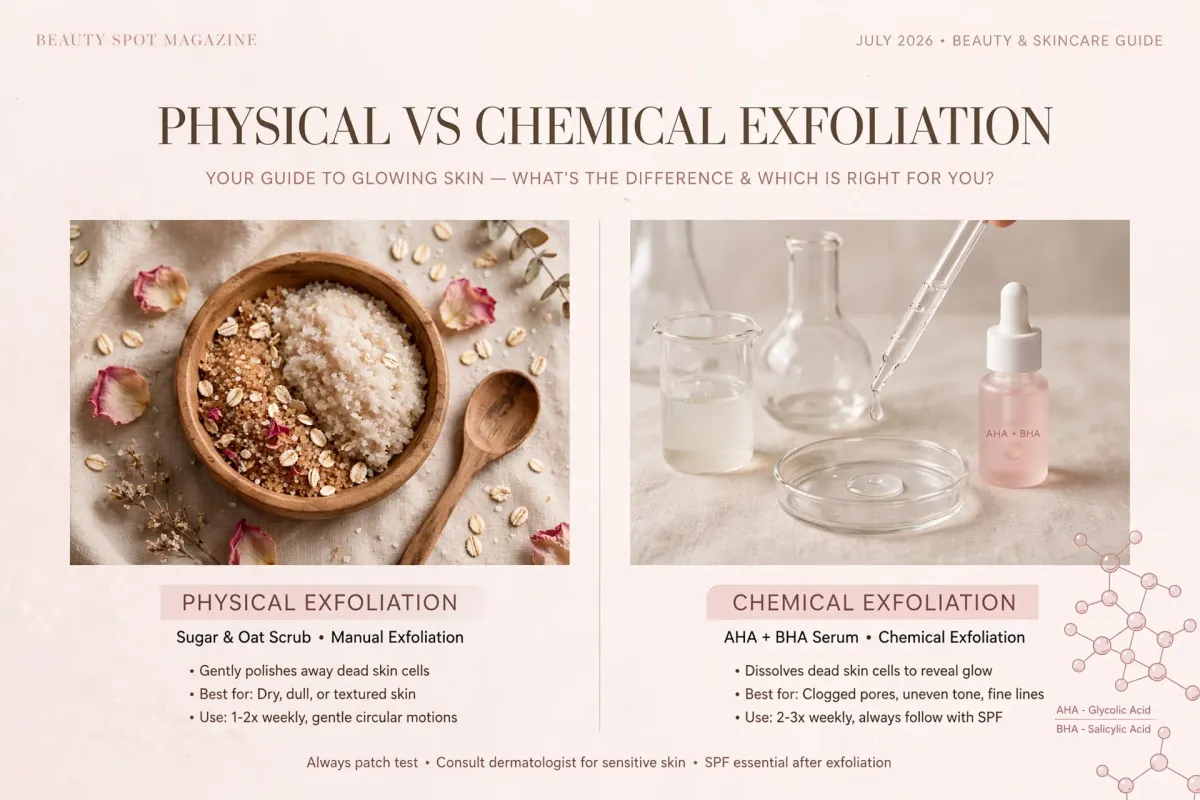
Physical exfoliation relies on mechanical action. Chemical exfoliation relies on ingredients that alter the bonds or cohesion between surface cells. Both can be effective. Both can be overused. Neither should be selected without considering the client’s barrier condition, treatment history, medications, home care, inflammation level, pigment response, and upcoming procedures.
This is where professional judgment becomes more valuable than product popularity.
Physical Exfoliation: Immediate Polish Through Mechanical Action
Physical exfoliation removes surface buildup through friction, abrasion, or controlled mechanical movement. Familiar examples include scrubs, polishing powders, textured cleansing materials, brushes, microdermabrasion, and certain professional resurfacing tools.
Its appeal is immediate. The skin often feels smoother as soon as the product is removed. Makeup may glide more evenly. Surface flaking appears reduced. For clients who want a tactile sense of renewal, physical exfoliation can feel satisfying and luxurious.
But texture matters.
A carefully formulated polishing product with uniform, rounded particles behaves very differently from a coarse scrub containing irregular fragments. Pressure matters as well. Even a sophisticated formula can become aggressive when worked too forcefully, used for too long, or applied to compromised skin.
Physical exfoliation may be especially useful for resilient skin with visible surface roughness, noninflamed buildup, or a need for gentle pre-extraction preparation. It can also offer the esthetician a high degree of control. The provider can adjust pressure, duration, movement, and treatment area in real time.
That control, however, depends on restraint.
Physical exfoliation is generally a poor match for active inflammatory acne, open lesions, recently waxed skin, fragile capillaries, significant rosacea activity, sunburn, or a visibly impaired barrier. Dragging abrasive particles across inflamed papules and pustules can intensify discomfort and irritation. Aggressive friction may also provoke a stronger inflammatory response in clients prone to post-inflammatory hyperpigmentation.
The professional goal is not to scrub the skin into submission. It is to lift excess surface buildup without disrupting the integrity of the tissue beneath it.
Chemical Exfoliation: Precision Through Product Chemistry
Chemical exfoliants work by loosening the bonds between surface cells or changing how those cells adhere to one another. Depending on the ingredient, formulation, concentration, pH, delivery system, contact time, and condition of the skin, the result may range from very gentle surface refinement to a more intensive resurfacing response.
Alpha hydroxy acids, beta hydroxy acids, polyhydroxy acids, enzymes, and professional peeling solutions all sit within the larger chemical-exfoliation category, but they should not be treated as interchangeable.
Alpha hydroxy acids such as glycolic and lactic acid are commonly associated with surface smoothing, improved radiance, and more even-looking tone. Glycolic acid has a relatively small molecular size and may feel more active on some complexions. Lactic acid is often positioned as a more hydration-supportive option, though its tolerability still depends on the complete formula and the client’s skin.
Salicylic acid, a beta hydroxy acid, is oil soluble and is frequently selected for oily, congested, or breakout-prone conditions. Its ability to work within oil-rich environments makes it a strategic choice for certain forms of congestion, but it is not universally appropriate.
Polyhydroxy acids are often discussed as gentler alternatives because of their larger molecular structure. Enzymes, including those derived from fruits, digest keratinized surface material and may be incorporated when a softer, less acid-forward experience is desired.
What makes chemical exfoliation sophisticated is not merely the ingredient name printed on the bottle. Performance depends on formulation.
A high percentage does not automatically create a superior treatment. A lower-percentage product with an intentionally acidic pH may behave more actively than a higher-percentage formula buffered closer to the skin’s natural range. Vehicle, layering, occlusion, preparation, contact time, and neutralization requirements all influence the outcome.
This is why professional exfoliation should never become a numbers competition.
The Sensation Trap
Many clients have learned to judge exfoliation by how intensely it tingles. Some providers have absorbed the same message.
But tingling is not a reliable measurement of efficacy.
Sensation may be influenced by barrier impairment, recent retinoid use, dehydration, shaving, waxing, environmental exposure, or previous over-exfoliation. A product that feels unusually intense may not be “working better.” It may be revealing that the skin is less protected.
Likewise, visible peeling is not the only sign that a treatment created change. Some well-designed exfoliating protocols produce refinement without dramatic shedding. In luxury aesthetics, the most elegant result is often controlled, progressive, and socially wearable.
A client should not have to hide for a week to believe the treatment was effective.
Which Method Is Better?
Neither method wins universally.
Physical exfoliation may be preferable when the objective is immediate surface polishing and the skin is healthy, resilient, and free from active inflammation. Chemical exfoliation may be more appropriate when the provider wants ingredient-specific action for congestion, uneven texture, dullness, or visible discoloration.
In many professional facials, the most intelligent answer may be a carefully calibrated combination. An enzyme may be followed by minimal mechanical removal of loosened debris. A gentle polishing step may prepare resilient skin for a mild acid formulation. The sequence should be intentional, not excessive.
Combination protocols become risky when every step is designed to “do more.” A scrub, enzyme, acid, extractions, retinoid booster, and resurfacing device performed in one appointment may look impressive on a treatment menu while creating an unnecessarily high inflammatory burden.
The luxury client does not need the most steps. The luxury client needs the right steps.
When the Skin Is Already Doing Too Much
One of the defining problems of modern skincare is cumulative exfoliation.
A client may use an acid cleanser in the morning, exfoliating toner at night, retinoid several times a week, vitamin C, acne medication, polishing powder, and a weekly peel—then arrive for a professional facial without realizing that nearly every part of the routine is increasing turnover or reducing surface cohesion.
The skin may look shiny but feel tight. Products may sting. Foundation separates. Redness lingers. Breakouts appear around the mouth or nose. The client may describe the complexion as congested and respond by exfoliating even more.
This is the over-exfoliation cycle: irritation is mistaken for buildup, and the attempt to correct it deepens the barrier disruption.
In these cases, the correct professional decision may be to suspend exfoliation altogether. A restorative facial focused on cleansing, hydration, cooling, barrier support, and sun protection can be more corrective than another peel.
Knowing when not to exfoliate is one of the clearest signs of advanced esthetic judgment.
Exfoliation Around Advanced Treatments
Treatment timing matters.
The supplied microneedling training protocol instructs clients to avoid retinol and exfoliation for at least 72 hours after treatment, while keeping the skin moisturized and protected with SPF. This reinforces a larger professional principle: exfoliation should not be casually layered around procedures that have already increased skin vulnerability.
Waxing, laser procedures, microneedling, intense light-based services, prescription retinoids, and certain medical treatments may require modified timing or complete avoidance. Providers should screen carefully, document recent services, and coordinate with medical professionals when appropriate.
A polished consultation should ask not only what the client applied that morning, but what has happened to the skin during the preceding days and weeks.
The Texas Scope-of-Practice Perspective
For Texas estheticians, exfoliation is not only a treatment-selection issue. It is a scope-of-practice issue.
Beauty Spot’s Texas legal framework recognizes cleansing, exfoliation, stimulation, product application, and certain device-based services as part of esthetic practice while warning that aggressive chemical peels, advanced exfoliation beyond superficial layers, and treatments crossing into medical territory create significant risk.
The central boundary is depth and tissue effect.
An esthetic license is not permission to perform every procedure encountered in advanced education, observed in a medical spa, or promoted by a product manufacturer. Texas professionals must remain within the services legally permitted under their specific license and work only in properly licensed settings. Texas law also requires licensed practitioners to perform regulated services within authorized establishments, with limited exceptions defined by statute.
Professionals should verify current Texas Department of Licensing and Regulation requirements before introducing a new peel, device, protocol, or treatment claim. Training expands knowledge. It does not independently expand legal scope.
The New Exfoliation Standard
The future of exfoliation is not more aggressive. It is more discerning.
Clients are increasingly educated about barrier health, inflammatory aging, pigment sensitivity, and the consequences of stacking active ingredients. They are no longer impressed by discomfort for its own sake. They want visible refinement without losing the calm, resilient quality of healthy skin.
That shift creates an opportunity for estheticians.
The provider who can explain why a treatment was softened, postponed, or replaced demonstrates more authority than the provider who performs the same aggressive protocol on every face. The most valuable consultation may end with fewer actives, a slower treatment cadence, and a home routine designed to restore tolerance before pursuing correction.
Physical exfoliation offers control, polish, and immediacy. Chemical exfoliation offers formulation-driven precision and targeted resurfacing. The art lies in understanding when each belongs—and when neither does.
Because truly advanced skin work is not defined by how much the esthetician can remove.
It is defined by how intelligently the esthetician protects what remains.
This version is structured for a luxury magazine feature and can also be adapted into a provider-training article or print editorial spread.