
Massage Therapy and the Growing Texas Wellness Economy
Massage therapy is emerging as a powerful force inside Texas’ expanding wellness economy, connecting luxury spa culture, recovery, hospitality, memberships, and modern self-care while creating new opportunities for licensed professionals and wellness-focused businesses.

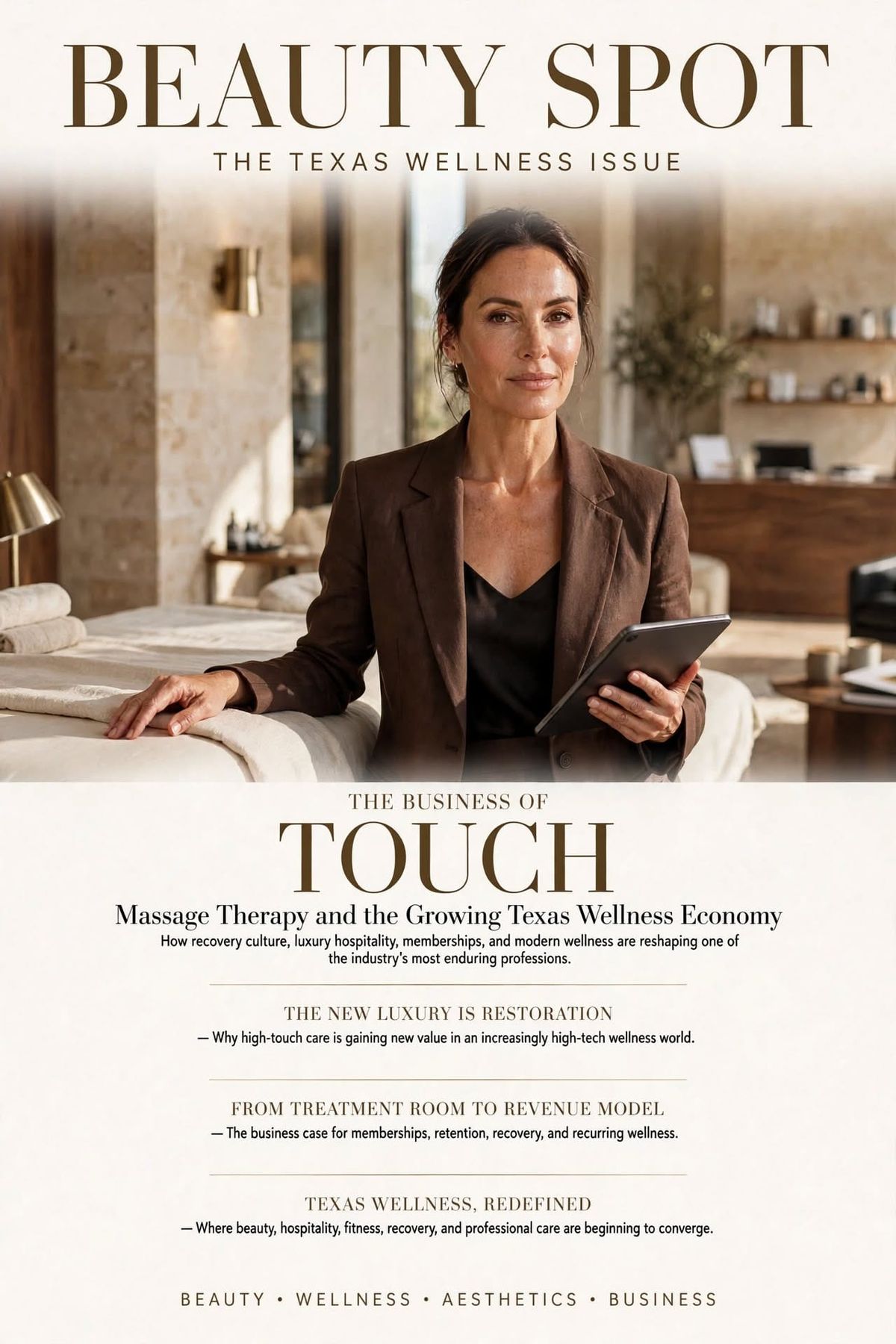
Why one of wellness culture’s oldest practices is becoming increasingly relevant to the way Texans work, recover, age, travel—and spend.
There is a quiet shift happening inside the Texas wellness economy, and it does not arrive in a syringe, a high-tech device, or a perfectly merchandised bottle of clinical skincare. It happens in a dimly lit treatment room, beneath warm linens, with deliberate pressure, trained hands and an hour in which the nervous system is finally given permission to stop performing. Massage therapy, one of the oldest forms of professional wellness care, is finding new relevance in a culture obsessed with optimization. The modern Texas consumer may arrive because of tight shoulders, athletic recovery, travel fatigue, stress, mobility concerns or simply the need to feel restored, but the larger story is economic. Massage is increasingly connected to the same ecosystem now shaping luxury spas, destination wellness, fitness, hospitality, medical wellness, aesthetics, longevity culture and premium self-care. The service itself may be ancient. The market surrounding it feels distinctly modern.
Texas is especially fertile territory for that evolution. The state’s beauty and wellness landscape is no longer contained inside the traditional salon or day spa. Beauty Spot’s own editorial framework increasingly treats licensed beauty and wellness professionals as part of a much larger workforce ecosystem touching entrepreneurship, education, tourism, personal care and local economic activity. Previous Beauty Spot workforce concepts have positioned licensed professionals as part of a statewide industry operating across Texas communities rather than as isolated service providers. That distinction matters. When massage is viewed only as a single appointment, its economic influence is easy to underestimate. When it is viewed as an anchor service capable of driving repeat visits, memberships, hospitality upgrades, wellness itineraries and cross-disciplinary partnerships, its strategic importance becomes clearer.
The Texas client has changed as well. Wellness is becoming less episodic and more integrated into lifestyle. Consumers are building routines around strength training, Pilates, running, golf, recreational sports, skin maintenance, body composition, sleep, stress management and healthy aging. In that environment, massage therapy occupies valuable territory because it can live alongside many of those behaviors without needing to become something it is not. A licensed massage therapist does not need to mimic a medical provider, an esthetician or a physical therapist to remain relevant. In fact, the strongest business positioning may come from doing the opposite: becoming exceptionally sophisticated within the professional boundaries of massage while learning how to collaborate intelligently with adjacent disciplines.
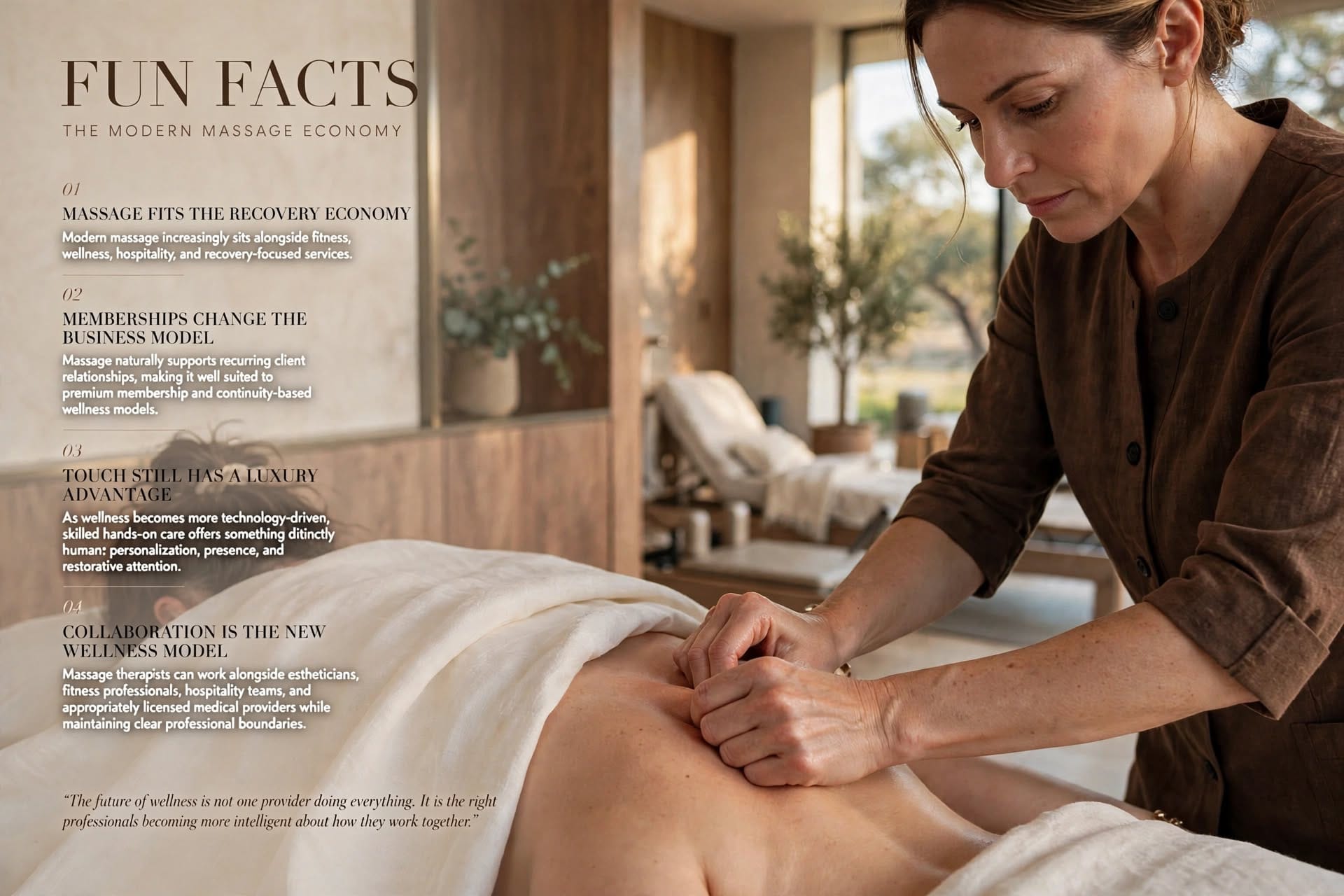
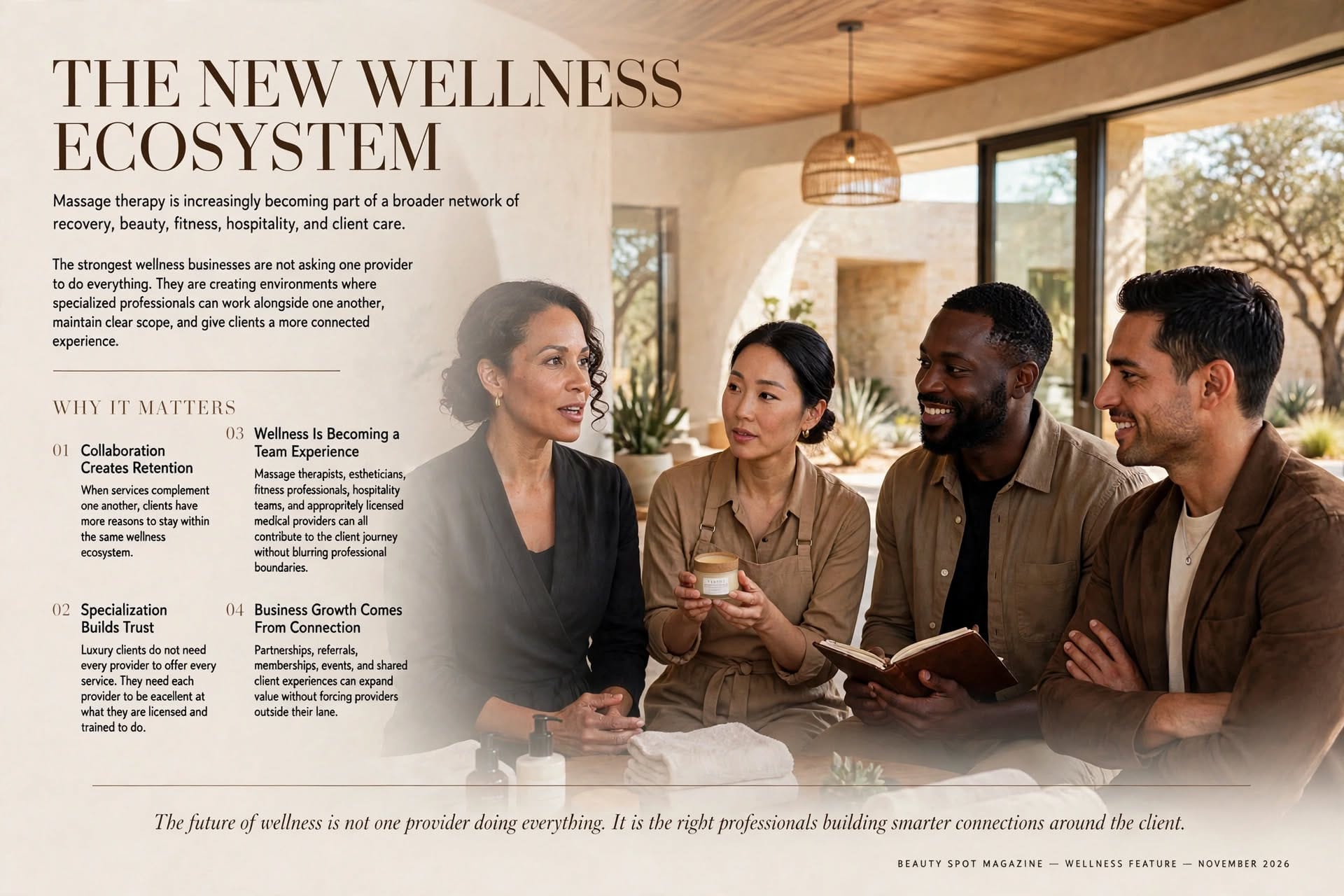
That collaborative model is already visible in the broader Texas wellness conversation. Materials in the Beauty Spot knowledge base describing a Texas fitness-and-medical-wellness partnership specifically identify massage therapists among the complementary professionals who can participate in a larger ecosystem involving fitness, recovery, wellness education and appropriately licensed clinical providers. That is more than a marketing idea. It represents where premium wellness businesses are heading: away from isolated services and toward connected experiences. A client might train with a fitness professional, book massage as part of a recovery routine, receive skincare from an esthetician, consult a medical provider for services that require medical authority and participate in educational wellness events—all without collapsing those professions into one another.
The future of wellness is not one provider doing everything. It is the right professionals becoming more intelligent about how they work together.
That idea has enormous implications for massage businesses. For decades, many therapists built careers primarily around the treatment hour: fill the schedule, perform the service, rebook the client, repeat. The emerging wellness economy rewards a broader business architecture. Massage can become the recurring heartbeat of a membership program, a signature amenity within a luxury hotel, an elevated recovery experience inside a fitness concept, a complementary service within a multidisciplinary wellness center or a highly specialized independent practice known for a particular clientele. The commercial opportunity is not necessarily to add endless modalities. It is to design a clearer reason for the client to return.
Memberships are particularly powerful in this category because massage naturally lends itself to continuity. A well-designed membership shifts the client conversation from indulgence to routine while giving the business more predictable recurring revenue. But luxury positioning matters. The premium consumer is increasingly resistant to the old discount-club model in which membership simply means a cheaper service. The more compelling model is access: preferred booking, curated enhancements, seasonal rituals, recovery programs, member-only events, personalization and a relationship with a provider who understands the client’s preferences over time. In that environment, consistency becomes part of the luxury.
Texas hospitality presents another layer of opportunity. From major convention markets and destination hotels to Hill Country resorts, ranch experiences and high-end urban properties, wellness is increasingly part of how travel is packaged. Guests do not necessarily separate “spa,” “fitness,” “beauty” and “recovery” the way industries do. They experience them as one continuum: how well did I sleep, how good did I feel, how cared for was I, and was the experience memorable enough to influence where I return? Massage remains one of the clearest bridges between hospitality and wellness because it translates across demographics. It can be restorative after air travel, desirable during a romantic escape, relevant to an athlete, attractive to a corporate traveler and natural inside a resort environment. For Texas operators, that makes massage not simply a treatment-room service but part of experience design.
The same is true inside the luxury spa. As advanced aesthetics become more visible, there can be a temptation to equate sophistication with machinery. Yet the strongest modern spas understand that technology and touch serve different purposes. A clinical-looking device may photograph beautifully on social media, but hands-on care offers something technology cannot replicate: the feeling of individualized attention. This is particularly important in a wellness culture increasingly dominated by screens, metrics and constant stimulation. The premium guest may want results, but she may also want silence. She may want performance skincare and a massage. She may want measurable progress and one hour in which nothing is being measured at all.
For beauty professionals, that creates a meaningful cross-industry lesson. Estheticians, massage therapists, cosmetologists and medical aesthetic providers may operate within the same consumer marketplace, but professional boundaries still matter. Beauty Spot’s Texas legal framework repeatedly emphasizes that training does not automatically equal legal authority and that professionals must understand the limits of their individual licenses. That principle should follow any business that begins combining wellness services under one roof. “Integrative” should never become shorthand for blurred scope. A luxury brand is not made more sophisticated by vague credentials or services that drift into another profession’s territory. High-trust businesses make each provider’s role exceptionally clear.
This is where massage therapy may hold one of its greatest competitive advantages. The industry does not have to chase every new beauty trend to participate in the wellness boom. It can instead become more precise about its own value: skilled touch, therapeutic intention within lawful scope, recovery-oriented service design, client communication, consistency, atmosphere and professional trust. When massage therapists pair those fundamentals with modern branding and strong business systems, the category begins to look less like an add-on and more like infrastructure.
There is also an entrepreneurial story unfolding here. Massage remains one of the professions through which practitioners can imagine multiple career identities: employee, independent practitioner, studio owner, educator, mobile specialist, resort therapist, wellness collaborator or multi-provider operator. That flexibility can be economically meaningful, but it also requires business literacy. Beautiful treatment rooms do not automatically create profitable companies. Pricing must account for labor intensity. Schedules must acknowledge the physical demands of hands-on work. Policies must protect the provider’s time. Retail, enhancements, packages and memberships must feel purposeful rather than forced. Client acquisition matters, but retention matters more. And perhaps most importantly, the therapist’s own body must be treated as a business asset rather than an endlessly available resource.
That last point is rarely glamorous enough for wellness marketing, but it may determine the longevity of a career. Massage is physically demanding work. The future of the profession therefore depends not only on attracting clients but on creating operating models that allow practitioners to remain healthy enough to serve them. Thoughtful scheduling, ergonomics, strength, recovery time, pricing and service design are not merely lifestyle considerations. They are business strategy.
The Texas opportunity, then, is larger than “more people getting massages.” It is the emergence of massage inside a wider economic network in which consumers increasingly allocate money toward feeling better, moving better, recovering better and aging with greater intention. That network touches hotels, gyms, spas, beauty businesses, wellness centers, education providers and medically governed environments. It rewards collaboration, but it also rewards clarity. The professionals who thrive will not be those who make the biggest promises. They will be those who understand exactly what they offer, exactly whom they serve and exactly how their work fits into the broader wellness life of the client.
Massage therapy has always understood something the modern wellness economy is only beginning to articulate: the body keeps the score of how people live. Long workdays, training cycles, travel, caregiving, stress, screen time, poor sleep and the relentless pace of modern life all eventually become physical experiences. That does not make massage a cure-all, and responsible professionals should never market it that way. It does make skilled therapeutic touch deeply relevant.
Texas is building an increasingly sophisticated beauty and wellness culture. The next chapter will not belong exclusively to the newest device, the most viral treatment or the loudest brand. There will also be room for businesses built around something quieter: expertise, ritual, recovery, human contact and the luxury of being cared for well.
And in a state where wellness is becoming both lifestyle and industry, that quiet room may be one of the most valuable rooms in the building.