How Many Licensed Beauty Professionals Does Texas Actually Have?
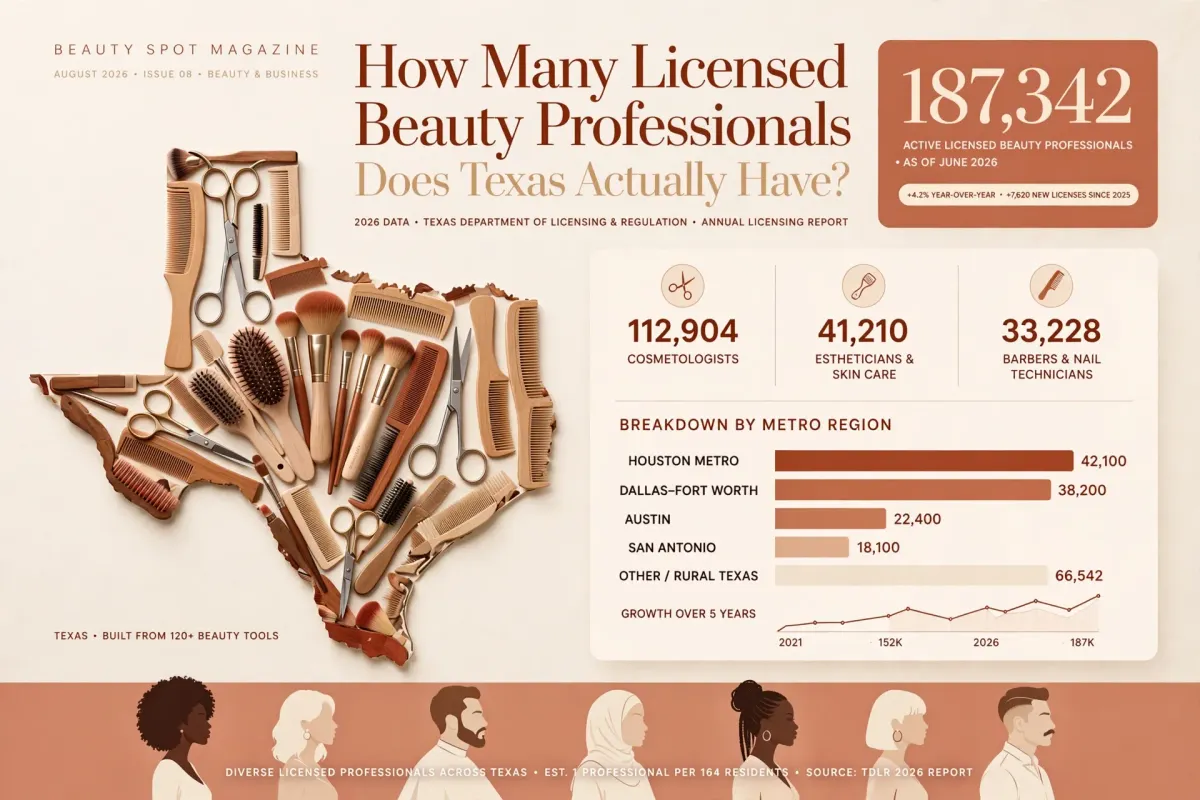
How many licensed beauty professionals does Texas actually have? Beauty Spot Magazine examines the statewide workforce by profession and geography, revealing why active-license counts, practitioner density, and regional concentration matter for beauty business growth.

Establishing the Texas statewide workforce baseline by profession and geography
Beauty Spot Magazine
Texas has one of the largest beauty economies in America, yet one of the most basic questions about that economy is surprisingly difficult to answer cleanly: How many licensed beauty professionals are actually working across the state? Not how many beauty businesses appear on Google. Not how many people identify as hairstylists, nail artists, estheticians or barbers on social media. Not how many licenses Texas has issued over decades. The number that matters for serious workforce intelligence is the number of identifiable, currently licensed individual practitioners, separated by profession and mapped by geography. That distinction sounds technical. In reality, it changes how beauty schools evaluate demand, how salon owners understand competition, how brands identify professional markets, how educators choose expansion locations and how beauty entrepreneurs decide whether a city represents saturation or opportunity.
And before Beauty Spot Magazine prints a dramatic statewide number, one point has to be established with unusual clarity: the source materials currently available to this analysis do not contain a verified, current statewide TDLR practitioner-level extract from which an accurate Texas total can be calculated. Under the data-governance framework guiding this project, inventing a number, combining unrelated estimates or treating an old license total as a present-day workforce count would violate the evidence standard. The International Data Backbone requires registry, schema, field-trust and geographic validation before a dataset becomes publication authority. That restraint is not a weakness in the analysis. It is precisely what makes a future Beauty Spot workforce baseline defensible.
First, Texas Beauty Is Not One Profession
The first mistake in counting Texas beauty professionals is treating “cosmetology” as if it represents the entire licensed workforce. Texas law recognizes multiple individual practitioner licenses. Chapter 1603 identifies Class A barber, cosmetology operator, manicurist, esthetician, manicurist/esthetician, hair weaving specialist, hair weaving specialist/esthetician and eyelash extension specialist as distinct individual practitioner categories. That immediately tells us that a serious workforce baseline cannot be reduced to one cosmetology total.
The difference matters commercially. A cosmetology operator may participate in a broad hair-and-beauty marketplace. A manicurist represents the nail economy. An esthetician sits inside the increasingly sophisticated skin, spa and corrective-aesthetics sector. Eyelash specialists belong to a highly specialized recurring-service category. Barbers participate in a grooming economy with its own schools, business models, cultural networks and client behavior. Combination licenses complicate the picture further because counting licenses is not always identical to counting unique people.
That last point may eventually become one of the most important methodological issues in the Texas Beauty Workforce Baseline. License records are not automatically people. If a professional holds more than one credential, a simple row count could overstate the human workforce. The statewide system therefore needs both a license count and, where the underlying data legally and technically permits it, a deduplicated practitioner count.
The Licensed Workforce Is Also Not the Entire Beauty Workforce
There is another boundary that matters. Texas law specifically excludes certain beauty activities from the barbering and cosmetology licensing framework. Threading is excluded. Makeup application performed as a standalone business activity is exempt. Natural hair braiding is also excluded under the statute.
That means a future headline reading “Texas has X beauty professionals” would still require qualification. A TDLR-derived number would more accurately describe the regulated barbering-and-cosmetology practitioner universe, not every person earning income from beauty.
This is especially significant in modern beauty culture. Makeup artists, braiders and other exempt professionals can build substantial businesses without appearing inside the same individual-license universe. Medical aesthetics introduces another boundary entirely: physicians, nurses and other medical license holders operate under different regulatory systems and should not be quietly folded into an esthetics total. Texas beauty is an ecosystem. The TDLR workforce is one governed section of that ecosystem.
Geography Is Where the Number Becomes Intelligence
A statewide total tells us scale. Geography tells us market structure.
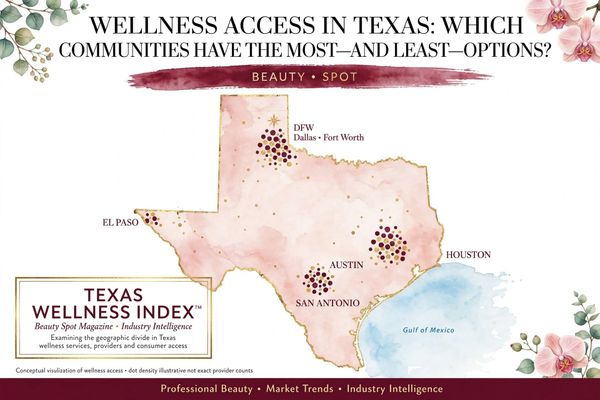
The real Beauty Spot baseline should therefore be built across several layers: Texas → metro → county → city → ZIP code, with the practitioner’s available licensing geography mapped through a canonical geographic spine rather than treated as free-form address text. The International Data Backbone specifically separates geographic identity from geographic intelligence and recognizes ZIP, city, county, metro and state as governed geographic layers.
Once that structure exists, the questions become far more powerful.
How many licensed estheticians are concentrated in Harris County compared with Bexar, Dallas, Tarrant or Travis? Which suburban ZIP codes have unusually high numbers of nail professionals relative to population? Where are barber licenses growing faster than cosmetology operator licenses? Which counties have significant populations but comparatively thin professional coverage? Where does a dense training pipeline sit beside an already crowded practitioner market—and where are schools producing professionals in places that still appear underserved?
Those are not simply editorial questions. They are expansion questions, recruitment questions, education questions and investment questions.
San Antonio already offers a glimpse of why this geographic approach matters. A separate Beauty Spot analysis of 56 beauty-school license records found training activity distributed across 18 ZIP codes, with especially visible clusters in 78221, 78238 and 78201. But school records are a pipeline indicator, not a workforce count. They tell us where professionals may be trained; they do not tell us how many licensed practitioners are currently available in those neighborhoods. That difference is exactly why the next analytical layer matters.
What the Texas Baseline Should Actually Report
The finished statewide workforce baseline should not publish one oversized number and call the job complete. It should establish separate counts for Class A barbers, cosmetology operators, manicurists, estheticians, combination manicurist/estheticians, hair-weaving specialists, combination hair-weaving/estheticians and eyelash-extension specialists, followed by a carefully deduplicated total of individual practitioners where the data permits.
Geographically, those professionals should then be organized by county, metro, city and ZIP code. Population-normalized measures—such as licensed professionals per 10,000 residents—would make the analysis substantially more useful. Houston will naturally contain more professionals than a small Texas city because Houston contains more people. Density allows us to distinguish sheer size from actual market concentration.
The same system should also separate active, expired, inactive, provisional and other relevant licensing states instead of quietly treating every historical record as part of today’s workforce. Texas law requires the appropriate individual practitioner license to perform regulated barbering or cosmetology services, and establishments may not employ or lease space to people performing those regulated services without the required practitioner license. The active-license universe is therefore the logical starting point for a workforce baseline.
The Bigger Story: Texas Beauty Is Economic Infrastructure
Once the baseline is established, beauty stops looking like a collection of salons and starts looking like a labor market.
Every licensed practitioner represents technical education, examination, recurring consumer demand and potential business activity. Many become independent contractors. Some rent suites. Some open salons, spas or barbershops. Others teach, develop products, create content, employ teams or move into more specialized areas of the professional beauty economy.
The statewide number matters because visibility creates leverage. Beauty professionals become easier to understand as a workforce when they can be measured by occupation and place. Schools can see where training capacity is needed. Brands can understand professional distribution. Economic-development organizations can recognize beauty entrepreneurship as part of local small-business infrastructure. Providers can evaluate competition with more intelligence than a social-media search.
And Beauty Spot can begin asking the more interesting question.
Not simply, “How many beauty professionals does Texas have?”
But:
Where are they? What are they licensed to do? Where is the workforce becoming denser? Where is the pipeline growing? And which Texas communities may be entering the next era of beauty-business opportunity?
For now, the responsible statewide baseline begins with a boundary: the current evidence library establishes the legal practitioner categories and the geographic methodology, but it does not yet contain the verified statewide practitioner dataset required to publish the final Texas headcount. That number should be calculated only after the current TDLR individual-license records are schema-verified, status-filtered, geographically normalized and evaluated for duplicate practitioners.
When that layer is complete, Texas will have something far more valuable than another impressive beauty statistic.
It will have a map of its professional beauty economy.