Are Beauty-School Graduates Ready for the Modern Salon?
Beauty-school graduates may be licensed, but are they prepared for today’s salon? This feature explores the growing gap between technical education and the business, communication, legal, digital, and client-experience skills modern beauty careers demand from the very first day.

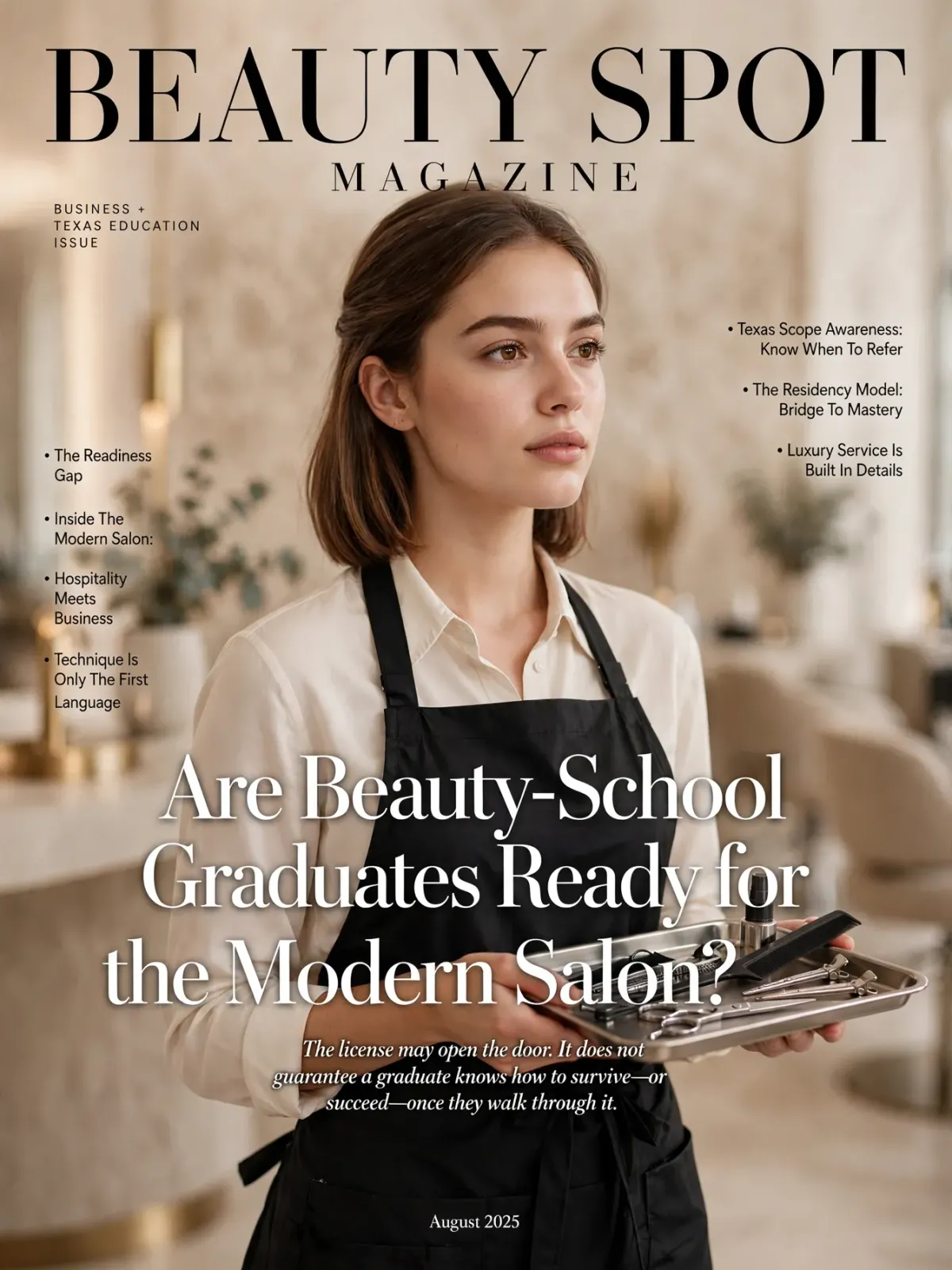
The license may open the door. It does not guarantee a graduate knows how to survive—or succeed—once they walk through it.
There is a particular kind of optimism that lives inside a beauty-school clinic. Mannequin heads line the stations. Stainless-steel implements sit in carefully arranged trays. Students rehearse consultations, sanitation procedures, sectioning patterns, facial movements, polish applications and service protocols while imagining the careers waiting just beyond graduation.
Then the first real salon day arrives.
The guest is late. The next appointment is early. The formula behaves differently than expected. A client presents a contraindication that was never quite this complicated in the classroom. The front desk wants a rebooking. The salon owner wants stronger retail numbers. A dissatisfied guest posts before the provider has had time to document the conversation. Somewhere between the consultation, the service ticket and the ring light, the new graduate realizes that beauty school and beauty business are connected—but they are not the same environment.
So, are beauty-school graduates ready for the modern salon?
Some are. Many are not. And the problem is more complex than blaming students, instructors or schools.
The modern beauty industry has evolved faster than the traditional definition of entry-level readiness. A graduate may leave school technically eligible for licensure while still being professionally unprepared for the pace, visibility, commercial pressure and emotional intelligence required inside today’s salons, spas and aesthetic businesses.
That distinction matters.
Licensure confirms that a professional has met a regulatory threshold. Readiness is the ability to perform responsibly, communicate confidently, protect the client experience and contribute to a functioning business.
The Modern Salon Is No Longer Just a Service Floor
The salon of today is part treatment space, part hospitality environment, part retail business, part content studio and part reputation-management system.
Clients arrive with screenshots, ingredient lists, influencer recommendations and highly specific expectations. They may know the name of a trend without understanding whether it is appropriate for their hair, skin, nails or lifestyle. They expect customization, visible results, polished communication and a sense that the professional in front of them understands not only technique, but context.
A new cosmetologist may be expected to interpret inspiration images, explain maintenance, photograph finished work, recommend home care, manage timing, retain the guest and protect the salon’s brand voice—all during the same appointment.
An esthetician may need to recognize when a client’s desired treatment does not align with the condition of the skin, the provider’s training or the legal limits of the license.
A nail professional may be technically talented but still unfamiliar with appointment pacing, service profitability, product costs, guest boundaries or the realities of building repeat clientele.
These are not minor additions to the job. They are now central to it.
Traditional education still provides an essential foundation: safety, sanitation, theory, service procedure and exam preparation. But the industry increasingly expects graduates to arrive with a second layer of competence—business awareness, consultation strategy, digital fluency, retail confidence, cultural sensitivity, problem-solving ability and professional judgment.
That second layer is where the readiness gap becomes visible.
Technique Is Only the First Language
Beauty students understandably focus on the skill they can see. The haircut must balance. The facial must flow. The polish must be clean. The color placement must be intentional.
But the strongest professionals know that the service itself is only one part of the client’s experience.
A technically correct service can still feel disappointing when the consultation is rushed, the provider appears uncertain, the environment feels disorganized or the aftercare is vague. Conversely, a thoughtful consultation can create trust before the first product is applied.
Modern salon readiness requires professionals to explain what they are doing, why they are doing it and what the client should realistically expect. It requires the confidence to adjust a plan without making the guest feel rejected. It requires the emotional discipline to receive feedback without becoming defensive.
This is particularly important in luxury environments, where clients are not purchasing technique alone. They are purchasing discernment.
They want to feel that the provider notices what they do not. They expect the professional to understand proportion, lifestyle, skin behavior, maintenance capacity, personal style and long-term goals. Luxury service is built through details: remembering preferences, preparing the room, managing transitions, protecting privacy and communicating with calm authority.
Those details are difficult to teach through theory alone. They develop through observation, repetition, mentorship and exposure to real-world standards.
The Business Knowledge Nobody Can Afford to Ignore
Beauty schools prepare students to perform services. Modern salons need professionals who also understand how services create sustainable businesses.
That does not mean every graduate must arrive as a fully developed entrepreneur. It does mean graduates should understand that time, product, labor, retention and rebooking are connected.
A booked schedule is not automatically a profitable schedule. A popular service is not necessarily a financially healthy service. A large social following does not guarantee client loyalty. Retail is not simply “selling products”; when handled ethically, it extends the service plan and helps clients protect their investment between appointments.
Industry education materials recognize that beauty careers can expand into management, education, brand representation, editorial work and artistic leadership. These paths require more than technical talent. Salon management, for example, can involve budgeting, inventory, marketing, staff development, client satisfaction and the ability to understand financial statements. Advanced educational and creative-director roles similarly depend on experience, communication, leadership and continued professional development.
The lesson is clear: technical education begins the career, but it does not complete the professional.
Graduates who understand basic business systems are better equipped to evaluate compensation structures, track personal performance, manage supplies, build clientele and recognize whether an opportunity supports long-term growth.
Without that knowledge, talented professionals can remain busy while financially unstable.
Social Media Has Raised the Stakes
The beauty industry has always been visual. Social media made it immediate.
A new graduate can now build an audience before building a clientele. That access creates extraordinary opportunity, but it also creates pressure to appear advanced before becoming experienced.
Online, the cleanest transformation wins. The most dramatic before-and-after travels fastest. Nuance rarely performs as well as spectacle.
This can tempt emerging professionals to chase services they have seen online without fully understanding the training, product chemistry, contraindications, licensing limitations or liability attached to them.
It can also distort expectations. Students may believe that graduation should lead quickly to a full book, premium pricing and brand partnerships. In reality, sustainable careers are usually built through less glamorous disciplines: consistency, punctuality, sanitation, consultation, documentation, continuing education, client retention and professional reputation.
Social media is a powerful career tool. It should not become a substitute for competence.
In Texas, Readiness Must Include Scope Awareness
For Texas graduates, professional readiness must also include a serious understanding of scope of practice.
The Beauty Spot Texas legal framework emphasizes that a license is not permission to perform every technique a person may have observed, purchased training for or seen marketed online. It is permission to perform services allowed within the relevant license and regulatory framework. The document specifically identifies concerns around aggressive exfoliation, procedures that move beyond superficial treatment, devices that resemble medical procedures and services promoted with medical positioning without appropriate oversight.
Texas law also defines regulated barbering and cosmetology services and establishes requirements around schools, student work and licensing examinations.
For a graduate entering a med-spa-influenced market, this distinction is critical. A luxurious treatment room, clinical branding or advanced device does not automatically place a service within an esthetician’s lawful scope. Nor does working near a medical professional automatically expand an individual provider’s license.
Readiness means knowing when to proceed, when to refer and when to decline.
That is not fear-based practice. It is professional maturity.
Texas graduates should leave school understanding that the treatment room is also a legal environment. Consent, documentation, sanitation, advertising language, equipment use and professional boundaries all matter. A provider who delivers beautiful results but misunderstands scope can expose the client, the business and their own license to unnecessary risk.
This article reflects the supplied Texas educational and legal framework and should not replace current guidance from the Texas Department of Licensing and Regulation or advice from qualified legal counsel.
The Missing Bridge: Structured Salon Residency
The industry may need to stop asking whether schools can produce fully finished professionals and begin building a stronger bridge between education and employment.
A promising model would look less like immediate independence and more like a structured residency.
Graduates could enter salons through defined developmental stages: observation, assisted services, supervised appointments, consultation evaluation, retail education, client-recovery training and performance review. Technical coaching could be paired with instruction in timing, documentation, communication, personal branding and business metrics.
This approach would not diminish the graduate’s license. It would respect the reality that professional refinement happens through guided practice.
Salon owners also have responsibilities. Too many businesses say they want new talent but lack the systems to develop it. They hire a graduate, provide a station and expect confidence to appear through pressure. When the new professional struggles, the industry labels them unmotivated rather than under-mentored.
A modern salon cannot demand readiness while refusing to invest in development.
Schools, employers and brands should function as parts of the same professional ecosystem. Schools establish foundations. Salons translate foundations into performance. Manufacturers deepen product knowledge. Continuing education expands specialization. Mentors help emerging professionals develop judgment.
No single layer can carry the entire career.
What Graduates Actually Need
The most salon-ready graduate is not necessarily the person who performs the flashiest service. It is the person who can think while performing.
They can conduct a focused consultation. They can identify when expectations are unrealistic. They understand sanitation as a nonnegotiable standard rather than an exam topic. They know the limits of their current ability. They can recommend maintenance without sounding transactional. They accept coaching. They document concerns. They protect the client relationship without sacrificing professional boundaries.
Most importantly, they remain teachable.
Beauty careers reward curiosity. Techniques change. Products change. platforms change. Client language changes. Laws and rules can change. The professional who believes graduation marks the end of education is already falling behind.
The Real Answer
Beauty-school graduates are ready to begin.
That is different from being ready for everything.
They should leave school with a safe technical foundation, respect for regulation and enough practical confidence to enter the industry. But salons should not confuse entry-level licensure with complete professional development. Nor should graduates feel ashamed that mastery has not arrived with the diploma.
The modern beauty industry does not need newly licensed professionals to pretend they know more than they do. It needs them to arrive prepared, observant, ethical and hungry to grow.
The future of the salon will not be protected by technique alone. It will belong to professionals who can combine artistry with judgment, hospitality with boundaries, visibility with integrity and ambition with continued education.
The license opens the door.
What happens next depends on how deliberately the industry teaches graduates to walk through it.