Why Preventative Healthcare Is Becoming Big Business
Preventative healthcare is becoming big business as consumers invest earlier in longevity, wellness, skin health, and personalized care. Discover what this shift means for beauty professionals, spas, and modern health brands.

Healthcare is quietly moving out of the hospital corridor and into the daily lives of consumers.
It is showing up in biometric screenings, concierge medical memberships, hormone consultations, recovery studios, skin-health programs, nutrition platforms, sleep technology, wearable data, longevity clinics, IV lounges, advanced wellness centers, and medical spas that position themselves as destinations for ongoing maintenance rather than occasional correction.
The language has changed, too. Consumers are no longer waiting to become visibly unwell before paying attention. They are tracking inflammation, sleep quality, glucose patterns, stress, hydration, muscle recovery, metabolic health, hormonal shifts, skin changes, and the subtler signs of aging long before those concerns become urgent.
Prevention has become aspirational.
And aspiration, when paired with recurring demand, premium positioning, and personalized service, has become very big business.
From Sick Care to Self-Optimization
Traditional healthcare has largely been organized around intervention. A symptom appears. A patient schedules an appointment. A diagnosis is made. Treatment follows.
The emerging preventive economy operates differently.
It asks consumers to monitor their health continuously, invest earlier, and view wellness as something that can be preserved, optimized, and upgraded over time. The goal is not simply to avoid illness. It is to feel sharper, age better, recover faster, maintain energy, protect appearance, and remain fully engaged in life for as long as possible.
That shift is commercially powerful because it transforms healthcare from an episodic need into an ongoing relationship.
A person may see a traditional provider once or twice a year. A preventive-health client may engage with an ecosystem every week: wearing a health tracker, receiving nutrition guidance, attending recovery treatments, purchasing supplements, maintaining a skincare plan, completing laboratory testing, or paying a monthly membership for coordinated services.
The business opportunity is not built around a single appointment.
It is built around continuity.
Longevity Is the New Luxury
For decades, luxury beauty was associated with visible indulgence: rare ingredients, beautiful treatment rooms, elaborate rituals, and prestige products displayed like jewelry.
Modern luxury is becoming more functional.
The affluent consumer still wants beauty, comfort, privacy, and exceptional service, but she increasingly expects those experiences to support a larger objective. She wants the facial to preserve skin quality, the body treatment to support recovery, the wellness consultation to clarify her next step, and the membership to make consistency easier.
Beauty Spot’s source material describes this evolution clearly: clients are moving away from viewing body care as an occasional indulgence and toward treating it as part of an ongoing wellness routine. The same material emphasizes skin longevity, barrier support, circulation, hydration, recovery, and emotional restoration as central elements of the modern treatment experience.
This is the new language of premium care.
Luxury is no longer only about how a space looks. It is about how intelligently the experience has been designed around the client’s future.
That future may include maintaining collagen, supporting healthy movement, reducing stress, improving sleep, preserving metabolic function, or simply feeling more resilient in a body under constant demand.
Preventive healthcare succeeds because it sells possibility before crisis.
The Consumer Has Become the Care Coordinator
Another reason the sector is expanding is that consumers have more information than ever before.
Wearables deliver sleep scores. Apps monitor heart rate, menstrual cycles, movement, food intake, hydration, and stress patterns. Direct-to-consumer platforms make testing and personalized recommendations feel more accessible. Social media has turned terms such as cortisol, inflammation, gut health, insulin resistance, hormone balance, lymphatic flow, nervous-system regulation, and biological age into mainstream conversation.
Not all of this information is equally reliable, and not every wellness trend is medically meaningful. But the cultural effect is undeniable: consumers are paying attention earlier.
They are also arriving at appointments with questions.
That creates an opportunity for businesses capable of translating complexity into credible, coordinated care. The strongest preventive-health brands do not simply sell services. They organize the client’s experience. They explain what belongs in the medical category, what belongs in lifestyle support, what requires referral, what can be monitored, and what should never be promised.
Education becomes part of the product.
Trust becomes part of the margin.
Why the Membership Model Fits Prevention So Well
Preventive care and recurring revenue are naturally aligned.
A one-time service can create a temporary result. Prevention, by definition, depends on consistency. It requires monitoring, maintenance, reassessment, habit formation, and adjustments over time.
That is why memberships have become one of the most attractive business structures in wellness, aesthetics, fitness, recovery, primary care, and beauty.
A thoughtfully designed membership can include scheduled consultations, routine treatments, preferred access, progress reviews, home-care planning, education, product support, or coordinated referrals. For the business, it can improve retention, stabilize revenue, deepen client data, and reduce dependence on constant new-customer acquisition. For the client, it reduces decision fatigue and turns intention into a system.
The commercial advantage is significant: prevention can be packaged as a relationship rather than a transaction.
The danger, however, is allowing the membership to become a collection of services without a clear clinical, wellness, or educational purpose. A premium preventive model should feel guided. Each touchpoint should answer a meaningful question: What are we supporting? What are we monitoring? Has anything changed? Is this service still appropriate? Does this concern require a different provider?
The most sophisticated programs do not overwhelm the client with more.
They curate what matters.
Beauty and Healthcare Are Moving Closer Together
Few industries illustrate this convergence more clearly than aesthetics.
Skin often reflects what is happening beneath the surface. Stress, hormonal shifts, medication changes, sleep disruption, inflammation, nutrition, environmental exposure, and aging can all influence the way the skin looks and behaves. As consumers become more health-conscious, they are less satisfied with beauty treatments that address appearance without context.
They want to understand the pattern.
Why is the barrier repeatedly compromised? Why has pigmentation changed? Why is the scalp shedding? Why is the skin suddenly reactive? Why does inflammation continue returning? Why are recovery times changing?
This does not mean an esthetician should diagnose systemic disease or operate as a medical provider. It means the beauty professional occupies an increasingly important observational and educational position.
A highly trained esthetician may notice changes, document treatment responses, educate the client about skin function, reinforce healthy maintenance, and recommend medical evaluation when a concern moves beyond cosmetic care. This is where professional maturity becomes a business advantage.
The provider who knows when to treat, when to pause, and when to refer often earns more trust than the provider who attempts to do everything.
The Texas Opportunity—and the Texas Responsibility
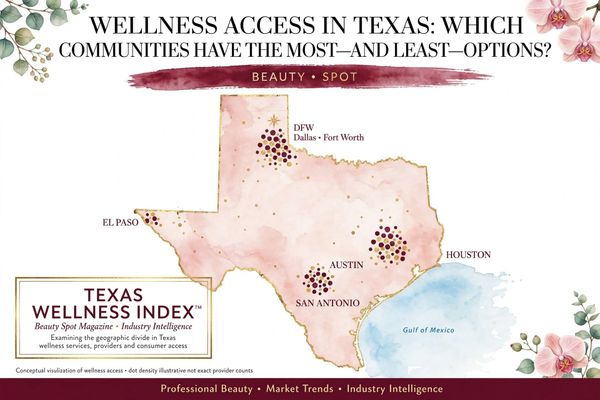
Texas is uniquely positioned for preventive-health expansion. Its major cities support strong medical, wellness, fitness, hospitality, and beauty economies. Markets such as Austin, Dallas, Houston, San Antonio, and surrounding luxury communities have created fertile ground for concierge medicine, performance wellness, advanced aesthetics, recovery concepts, and membership-based care.
But commercial opportunity does not erase regulatory boundaries.
In Texas, beauty professionals must distinguish between esthetic services and the practice of medicine. Beauty Spot’s Texas legal framework emphasizes that a license does not authorize a provider to perform every technique encountered in training. Services that penetrate too deeply, alter tissue beyond permitted cosmetic practice, or cross into medical treatment may fall outside an esthetician’s lawful scope.
Texas law also distinguishes licensed medical professionals operating within the scope of their medical, nursing, dental, chiropractic, or other healthcare licenses from barbering and cosmetology practice.
This distinction matters because the preventive-health market often uses language that blurs categories. Terms such as therapeutic, regenerative, medical-grade, hormone-balancing, detoxifying, lymphatic, corrective, and clinical may sound commercially compelling, but they can also imply medical authority.
Branding must never outrun licensure.
A Texas spa may support relaxation, appearance, skin maintenance, and client education within its lawful scope. A medical practice may evaluate, diagnose, prescribe, order testing, or perform medical procedures when properly licensed and governed. A collaborative business may bring these disciplines together, but the structure, supervision, advertising, documentation, and provider roles must remain clear.
Compliance is not the opposite of luxury.
In a premium market, compliance is part of luxury.
The Data-Driven Wellness Client
The next stage of preventive healthcare will be increasingly personalized.
Clients will expect businesses to remember their history, monitor change, communicate across visits, and make recommendations based on more than a generic intake form. This does not require every spa to become a diagnostics laboratory. It does require better systems.
Consultations should become more meaningful. Treatment notes should show patterns. Contraindications should be updated. Referrals should be documented. Progress should be discussed realistically. Home care should reflect the client’s changing needs rather than a fixed retail script.
The broader intelligence framework behind Beauty Spot emphasizes the importance of separating fact, interpretation, implication, and recommended action. That discipline is especially valuable in preventive wellness, where confident marketing can easily become an unsupported health claim.
A responsible business should be able to explain what a service is designed to support, what evidence or professional reasoning informs the recommendation, what limitations exist, and what the client should not expect.
Clarity builds credibility.
Credibility builds retention.
Prevention Is Becoming a Status Symbol
There is also a cultural dimension to this market.
Preventive care signals control.
A standing wellness appointment, a personalized health plan, a recovery ritual, or a longevity membership communicates that a person is not merely responding to life. She is managing it intentionally.
This is one reason preventive healthcare has become deeply compatible with the aesthetics and luxury sectors. Both industries trade in identity as much as outcome. They help people feel that they are protecting the version of themselves they value most.
The appeal is emotional, but it is not superficial.
A client investing in prevention may be seeking more time, more confidence, more energy, fewer disruptions, and a stronger sense of agency in a system that often feels reactive and fragmented.
The winning businesses will understand that they are not selling fear of decline.
They are selling stewardship.
The preventive-health boom will continue to attract physicians, nurses, wellness entrepreneurs, estheticians, fitness professionals, technology companies, product brands, educators, and investors.
Not every concept will endure. Some will be built around trend language rather than meaningful care. Others will overpromise, cross professional boundaries, or confuse consumer enthusiasm with clinical legitimacy.
The businesses most likely to last will be the ones that combine personalization with restraint, innovation with ethics, and luxury with legitimate professional standards.
They will create elegant client experiences without making careless claims. They will use memberships to support continuity rather than simply increase billing. They will build referral relationships instead of pretending one discipline can solve every concern. They will recognize that beauty, wellness, and healthcare can collaborate without becoming indistinguishable.
Preventive healthcare is becoming big business because consumers are no longer willing to wait for a crisis before investing in themselves.
They want to preserve what is working.
They want to understand what is changing.
And they want trusted professionals who can help them move forward with greater intelligence, intention, and care.
The future of health may still include the examination room.
But increasingly, it will be shaped by everything that happens before the patient ever needs to enter it.