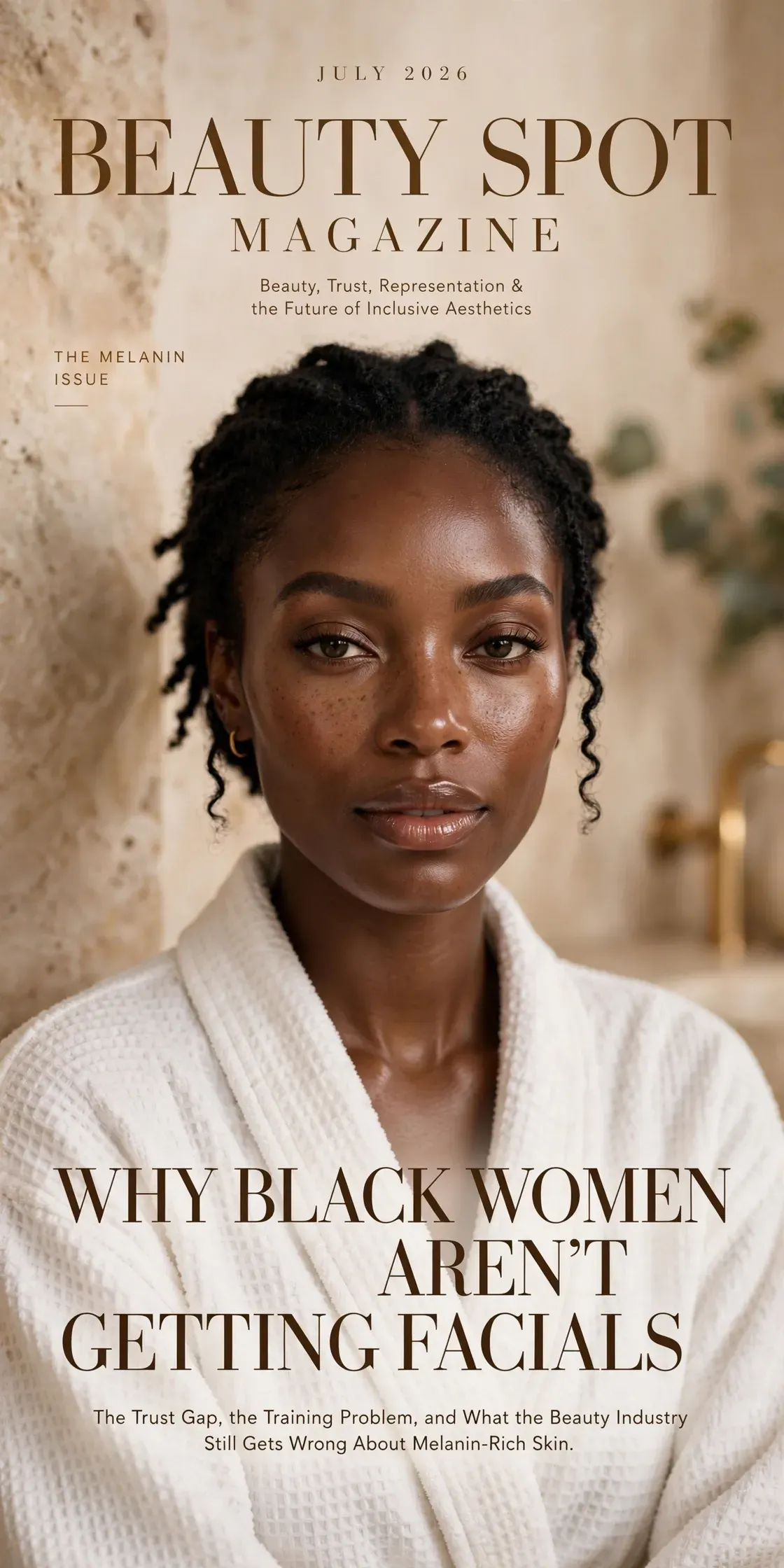
Why Black Women Aren’t Getting Facials
Why are Black women still underserved in facial rooms? Beauty Spot Magazine examines the trust gap, training failures, melanin-rich skin education, and the future of inclusive aesthetics.

—And What the Industry Still Gets Wrong
The facial industry has spent years attempting to attract Black women through polished campaigns, inclusive shade ranges, and carefully staged images of diversity. Yet representation in advertising cannot repair what many clients experience once they enter the treatment room: uncertainty, poor consultation, product assumptions, and providers who have never been adequately trained to understand their skin.
The beauty industry often frames the facial as a universal ritual. Cleanse. Exfoliate. Extract. Mask. Moisturize. Glow.
But beauty has never been universal, and neither is skin.
For many Black women, the decision not to book a facial is not evidence of disinterest in skincare, wellness, or luxury. It is frequently a rational response to an industry that has not consistently earned their trust.
Black women have always participated deeply in beauty culture. They have built rituals around cleansing, oils, butters, masks, complexion care, hair care, fragrance, makeup, and personal presentation—often while mainstream beauty institutions excluded them, misunderstood them, or treated their needs as an afterthought. The modern spa industry did not introduce Black women to self-care. In many cases, it simply failed to recognize the sophisticated beauty knowledge already present in their homes, salons, communities, and cultural traditions.
The real question, then, is not, “Why don’t Black women get facials?”
It is this:
Why has the facial industry made so many Black women feel that professional skincare was not designed with them in mind?
The Trust Gap Begins Before the Treatment
A Black client often starts evaluating a spa long before she schedules an appointment.
She scans the website. She looks at the treatment images. She studies the provider’s before-and-after photographs. She searches for deeper complexions, not as decorative evidence of diversity, but as proof of experience. She reads the descriptions of chemical peels, acne treatments, brightening services, and corrective facials with a quiet but essential question:
Does this provider actually understand skin like mine?
When every visible result features fair or lightly pigmented skin, the message is not neutral. It suggests that deeper complexions are either not being treated, not being documented, or not being considered central to the business.
This becomes especially significant when a client has previously experienced irritation, prolonged discoloration, aggressive extractions, ashiness, product residue, or post-treatment inflammation. One poorly managed facial can leave a deeper skin tone with visible consequences that persist long after the temporary redness on lighter skin would have disappeared.
The consultation, therefore, cannot be treated as a pre-service formality. It is the first clinical and cultural trust-building moment.
A provider should be asking about the client’s current routine, prescription products, previous reactions, acne patterns, sensitivity, hormonal changes, sun exposure, shaving or hair-removal practices, history of dark marks, and the way her skin responds after inflammation. Professional facial education itself emphasizes skin analysis, contraindications, client consultation, treatment records, product selection, and procedural safety as foundational components of competent care.
Yet many clients still encounter consultations that are rushed, generic, or built around visual assumptions.
“Oily” becomes the default classification.
“Resilient” becomes shorthand for “can tolerate more.”
“Dark spots” are treated as a surface-level brightening problem rather than a history of inflammation.
And “strong skin” becomes permission to exfoliate aggressively.
These assumptions are not simply outdated. They can be damaging.
Melanin Is Not a Skin Type
One of the industry’s most persistent mistakes is confusing skin color with skin type.
Black women can have dry skin, oily skin, combination skin, sensitized skin, acne-prone skin, mature skin, dehydrated skin, impaired barriers, or multiple conditions at once. Two clients with similar complexions may respond entirely differently to the same cleanser, peel, enzyme, extraction technique, or home-care recommendation.
Melanin-rich skin is not inherently difficult to treat. It requires providers to understand how inflammation, trauma, and pigmentation can interact.
The objective should never be to fear deeper skin tones or to avoid effective treatment. The objective is to make intelligent treatment decisions: controlling inflammation, respecting the barrier, selecting appropriate exfoliation, avoiding unnecessary trauma, and building progressive plans rather than chasing dramatic one-appointment transformations.
This is particularly important when addressing post-inflammatory hyperpigmentation. A dark mark is often not the original condition. It is the visible memory of what happened before it: a breakout, an extraction, an ingrown hair, a burn, friction, over-exfoliation, or another inflammatory event.
Treating only the pigment while repeatedly triggering new inflammation creates a cycle in which the facial appears corrective but continuously produces the condition it claims to resolve.
The more sophisticated approach is slower, more observant, and often more effective. It considers barrier integrity, hydration, inflammation, product compatibility, daily sun protection, client behavior, and realistic treatment intervals. Modern professional skincare is increasingly moving toward skin longevity and cumulative improvement rather than aggressive correction at any cost. Consistent treatments, home care, education, and barrier-conscious planning support healthier outcomes over time.
The Industry Still Confuses Pain With Performance
There remains a deeply embedded belief in some treatment rooms that a facial must feel intense to be effective.
The client should peel.
The extractions should hurt.
The skin should look “worked on.”
The product should tingle.
The treatment should produce visible proof that something happened.
This results-driven theater can be especially risky for clients who are prone to lingering discoloration. Excessive pressure, repeated passes, over-manipulation, aggressive scrubbing, inappropriate acids, and indiscriminate device use may create an immediate impression of activity while compromising long-term skin health.
A luxury facial should not be passive, but it should be precise.
The most advanced provider in the room is not necessarily the one using the strongest peel, the newest device, or the most intimidating protocol. It is the provider who understands when to proceed, when to modify, when to stop, and when to refer.
That distinction matters in Texas, where estheticians must remain aware of the boundary between esthetic services and medical procedures. Skin treatments, superficial exfoliation, product application, and certain properly used devices may fall within an esthetic framework, while treatments that penetrate too deeply, alter living tissue, or cross into medical practice require different authority and oversight.
Cultural competence does not replace legal competence. Both are essential.
A Black client should not be exposed to an overly aggressive procedure because a provider is attempting to prove expertise. Nor should she be denied thoughtful treatment because the provider is afraid of melanin. The answer is not under-treatment or over-treatment. It is better education.
Product Knowledge Must Move Beyond “Brightening”
The language used to market skincare to Black women often reveals how narrowly the industry understands them.
Brightening.
Dark-spot correction.
Uneven tone.
Clarifying.
These concerns are valid, but they are not the totality of Black skin.
Black women are also seeking hydration, acne management, smoother texture, barrier repair, graceful aging, stress relief, skin longevity, pre-event radiance, pregnancy-conscious routines, seasonal care, and luxurious maintenance. They want complexion services that do not reduce their skin to a pigmentation problem.
Even the word brightening requires care. A client may hear luminosity, clarity, and even tone. She may also hear a coded promise to make her complexion lighter. Providers should explain what the service is designed to do: reduce dullness, support more even-looking tone, improve hydration, or address the appearance of post-inflammatory marks—without implying that naturally deep skin requires correction.
Product selection also demands more sophistication than choosing a line with a model of color on the packaging. Professionals must understand formulation, concentration, pH, delivery systems, exfoliating activity, fragrance load, sensitizing potential, and the cumulative impact of the client’s entire routine.
A technically elegant serum can still be wrong for the person sitting in front of you.
Black Women Notice Who Holds Authority
Representation is not merely about who appears in the campaign. It is also about who is positioned as the expert.
Who teaches the advanced class?
Who develops the protocols?
Who appears in the treatment manual?
Whose skin is used in demonstrations?
Who owns the spa?
Who is promoted into leadership?
Who is trusted to speak about corrective skincare?
Black estheticians have often developed strong expertise in treating melanin-rich skin because their communities demanded it and because traditional education left significant gaps. Their knowledge should not be treated as a niche contribution to an otherwise complete industry. It is part of the industry’s missing foundation.
Beauty education has historically reflected the standards and priorities of the institutions that produced it. Mainstream beauty culture repeatedly elevated narrow ideals of complexion, hair texture, and femininity, while Black innovators, professionals, and consumers built parallel systems of expertise and entrepreneurship. Even broad cosmetology histories document African American innovation in product development and hair care, including Garrett Augustus Morgan’s early chemical and grooming inventions.
The modern aesthetics industry must move beyond inviting Black educators to speak only during diversity panels or Black History Month. Their knowledge belongs in core curriculum, product development, treatment testing, executive decision-making, and advanced education.
The Texas Opportunity Is Larger Than the Industry Realizes
Texas is not a culturally uniform beauty market.
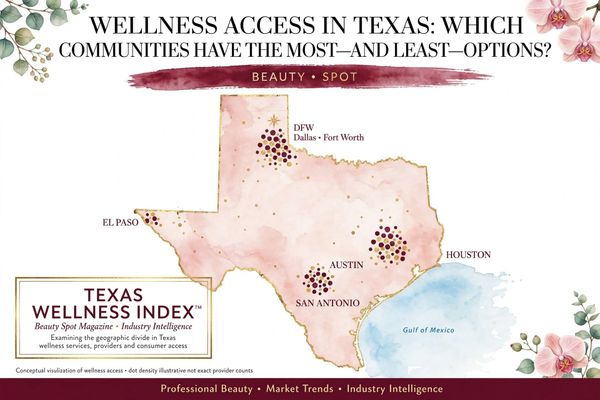
Houston, Dallas–Fort Worth, San Antonio, Austin, and the communities between them contain distinct Black populations, professional networks, beauty traditions, income profiles, wellness preferences, and consumer expectations. A treatment menu that works in one neighborhood may feel disconnected in another. A generic “multicultural” campaign may appear inclusive while failing to speak meaningfully to any local community.
For Texas spa owners, this is not simply a social consideration. It is a business intelligence issue.
When Black women do not see themselves reflected in a spa’s clientele, staff, reviews, service descriptions, or results, the spa loses more than a single facial appointment. It may lose recurring memberships, retail relationships, referrals, bridal groups, teen acne clients, professional women seeking maintenance, mothers bringing daughters, and multigenerational household loyalty.
The facial is rarely the complete economic relationship. It is the entry point.
A client who feels safe may return monthly. She may purchase home care, book seasonal treatments, refer friends, and expand into additional services. A client who feels misunderstood may leave quietly—and tell the people she trusts.
Texas beauty businesses should also recognize that compliance strengthens this relationship. Clients increasingly want visible evidence of sanitation, informed consent, provider education, scope awareness, and responsible treatment planning. Texas professionals are expected to understand that a license authorizes only the services permitted under law, regardless of what a provider may have been shown in an informal class or online demonstration.
Safety is not separate from luxury.
Safety is part of luxury.
What an Inclusive Facial Practice Actually Looks Like
An inclusive practice does not begin with a stock image. It begins with operational decisions.
The provider studies melanin-rich skin throughout the year, not only when a Black client appears on the schedule. The intake process asks meaningful questions. The consultation allows time for conversation. The treatment room lighting supports accurate skin observation. Product protocols are flexible. The provider documents reactions and progress. Before-and-after photography includes a range of complexions and is captured consistently. Recommendations are explained rather than imposed.
The client is not made to feel like a test case.
The provider does not say, “I’ve never worked on skin this dark before,” and proceed anyway.
The provider does not overpromise the removal of longstanding pigmentation.
The provider does not interpret natural facial features, oil distribution, or texture through a deficit-based lens.
The provider knows when a condition requires referral to a dermatologist or another qualified healthcare professional. Beauty professionals should be able to recognize healthy skin, identify contraindications, and refer conditions outside their scope rather than attempting to diagnose or treat disease.
Most importantly, the client is treated as a participant in the process. She is told what is being used, why it was selected, what sensations are expected, what changes may occur afterward, and how to care for her skin at home.
Education builds trust because it removes mystery. Professional transparency around treatment goals, limitations, maintenance, and realistic timelines supports stronger client relationships and more ethical care.
The Facial Must Become More Than a Service
For the industry to close this gap, it must stop viewing the absence of Black women from facial rooms as a marketing problem.
It is a trust problem.
An education problem.
A leadership problem.
A treatment-design problem.
And in some markets, a cultural fluency problem.
Black women do not need to be convinced that they deserve softness, ritual, radiance, rest, or expert care. They already know.
The industry must prove that it can offer those experiences without misunderstanding their skin, minimizing their concerns, treating them as an exception, or exposing them to unnecessary risk.
The future of inclusive aesthetics will not be built through louder claims. It will be built through quieter forms of credibility: a thoughtful consultation, a barrier-respecting protocol, a provider who explains rather than performs, a treatment menu that sees beyond pigmentation, and a room in which Black women do not have to remain alert while they are supposed to be receiving care.
Because the real luxury is not simply glowing skin.
It is being able to close your eyes on the treatment table—and trust the hands above you.