The Next Generation of Beauty Professionals
The next generation of beauty professionals is redefining the industry through specialization, business intelligence, digital fluency, advanced education, and stronger professional standards—turning technical skill into trusted expertise, lasting careers, and modern beauty leadership.

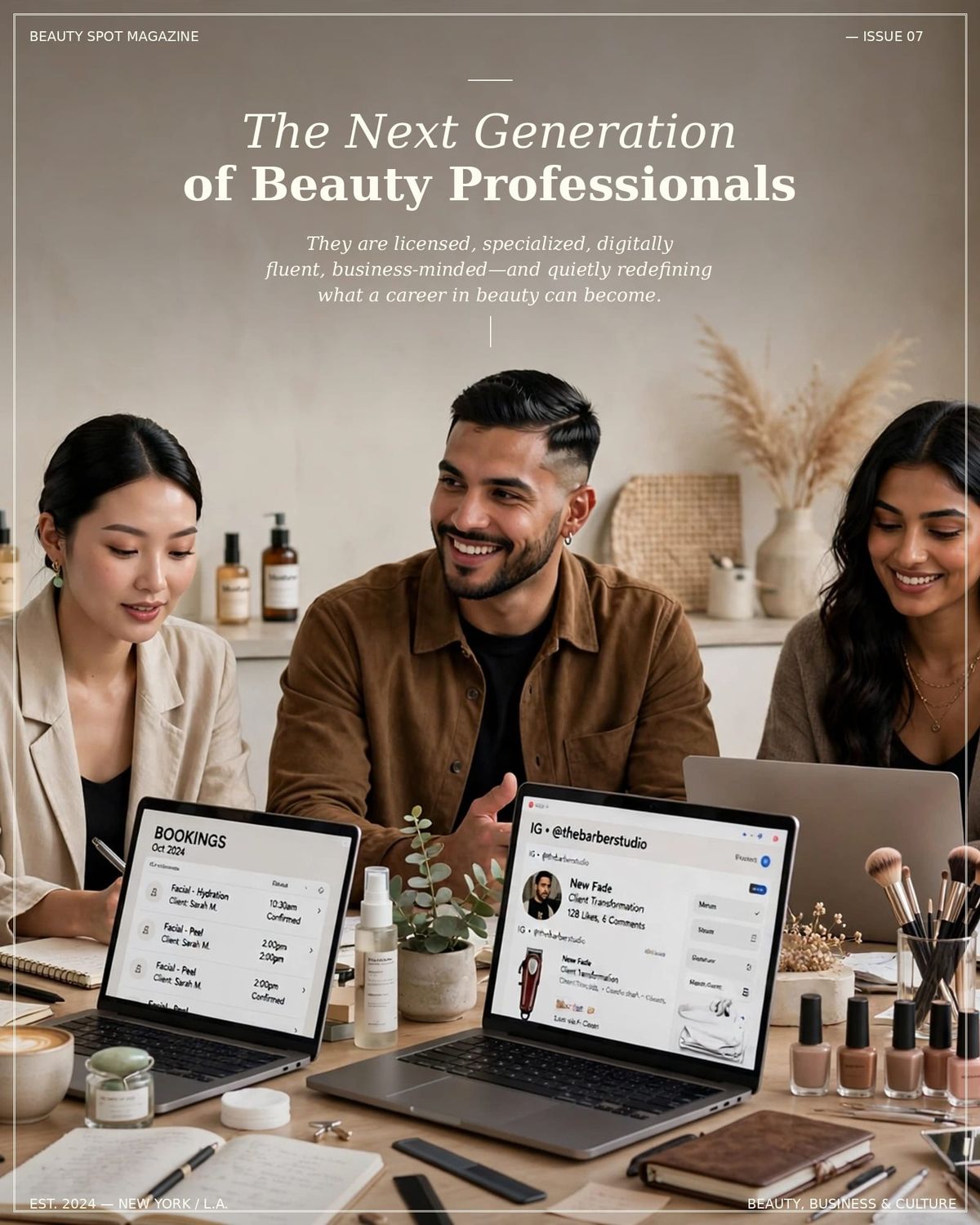
They are licensed, specialized, digitally fluent, business-minded—and quietly redefining what a career in beauty can become.
By Beauty Spot Magazine
There is a particular moment happening inside the beauty industry right now, and it is bigger than a new facial technique, a viral hair trend or another treatment promising the next version of glow. It is happening in classrooms filled with mannequin heads and treatment beds, inside barber academies where clippers hum through afternoon practice sessions, in aesthetics programs where students are learning to read skin with greater sophistication, and across social platforms where young professionals are building an audience before they have even built a full clientele. The next generation of beauty professionals is entering an industry that looks dramatically different from the one many of their instructors entered years ago. They are becoming licensed in a marketplace where technique matters, but technique alone is no longer enough. They are expected to understand client psychology, ingredient literacy, personal branding, technology, retail, digital content, business operations, professional boundaries and the increasingly complicated distinction between what is trending online and what they are actually qualified—and legally permitted—to perform. The beauty professional of the future is not simply learning a service. They are learning how to build an entire professional identity.
That shift is particularly visible in Texas, where beauty education is beginning to reveal a much broader workforce story. A Beauty Spot Magazine analysis of 56 San Antonio beauty-school license records found an increasingly diverse training ecosystem across Bexar County, including cosmetology schools, barber colleges, aesthetics programs, specialized academies, public-school career programs and community-college education. The significance is not simply the number of institutions. It is the range of pathways emerging around them. The records show a training landscape that can lead not only to traditional salon employment, but to independent practice, suite ownership, education, management, product development, specialized services and entrepreneurship. Public high schools and district career programs also appear throughout the records, suggesting that beauty education can function as a serious workforce-development pathway for students who may want a skilled, licensed and entrepreneurial career outside the conventional four-year college track.
Beauty Is Becoming More Specialized
For decades, the public image of beauty education was relatively simple: enroll in cosmetology school, learn a broad collection of salon skills, pass the licensing process and go to work behind the chair. That pathway still exists—and remains important—but it now sits inside a far more fragmented and specialized beauty economy. San Antonio's education landscape, for example, includes institutions centered around nails, lashes, makeup, aesthetics and barbering alongside comprehensive cosmetology programs. The local records include names such as Boss Nail Academy, Lash Habit Academy, Boss Beauty Makeup Academy, American Laser & Aesthetics Institute, Institute of Modern Aesthetics, Luxury Aesthetics and Esti Project. That specialization reflects something larger happening nationally: consumers increasingly seek professionals for a particular expertise rather than simply a broad category of service.
The result is an emerging generation of professionals who may identify themselves less by a traditional occupational label and more by a niche: corrective-skin specialist, blonding expert, textured-hair artist, scalp-care practitioner, nail artist, brow specialist, editorial makeup artist, grooming expert, bridal artist, acne-focused esthetician or luxury facialist. Specialization can create powerful authority because a professional no longer has to be everything to everyone. But it also raises the stakes for education. The more specialized the marketplace becomes, the more important it is for professionals to understand the difference between advanced education and expanded legal authority. Learning something in a class does not automatically place that procedure within a license holder's scope of practice.
That distinction is especially important in advanced aesthetics, where social media can make sophisticated procedures look deceptively accessible. A treatment appears in a thirty-second video. A device is available online. A certificate can sometimes be obtained over a weekend. Suddenly the professional is confronted with one of the defining questions of modern beauty practice: Just because I know how something is performed, am I legally permitted to perform it?
In Texas, that question cannot be treated as an afterthought. Beauty Spot's Texas compliance framework emphasizes that professional education and legal scope are not interchangeable. Estheticians must understand the boundaries of their license, particularly when treatments involve aggressive exfoliation, tissue penetration, medical-style devices or services promoted with medical terminology. Sanitation, disinfection, equipment safety, documentation and establishment requirements are not administrative details sitting outside the treatment experience; they are part of professional practice itself.
The next generation will not be defined by how many treatments they can perform. It will be defined by how intelligently they know which treatments they should perform.
The Rise of the Beauty Entrepreneur
Perhaps the most profound change, however, is happening beyond technique altogether. Today's emerging professional is entering beauty at a time when the distance between practitioner and entrepreneur has almost disappeared.
A newly licensed professional may begin by working for someone else, but from the first day of their career they are also likely thinking about a booking platform, Instagram presence, content strategy, retail recommendations, referral system, suite rent, cancellation policy, pricing architecture and eventually a brand of their own. The chair, treatment room or manicure table is no longer necessarily the final destination. It can be the beginning of a business ecosystem.
Professional cosmetology education has long identified career opportunities beyond direct client service, including specialization, salon training, manufacturer education, artistic direction, instruction, editorial work, creative direction and salon management. Modern connectivity has expanded those possibilities further because professionals can now build reputation, clientele and educational visibility far beyond the physical location where they work.
That creates extraordinary opportunity—but also a new kind of pressure.
Previous generations could often learn business slowly after mastering their craft. Today's professionals are frequently expected to master both at once. A beautiful result may earn a client's compliment, but a sustainable career requires much more: rebooking, client retention, inventory discipline, expense awareness, tax planning, pricing confidence, consultation skills, reputation management and the emotional maturity to establish professional boundaries.
This is where the glamour of entrepreneurship meets its less-photographed reality. A booked-out calendar means very little if the professional does not understand profit. Ten thousand followers mean little if the business cannot retain clients. A stunning treatment room means little if operating costs overwhelm revenue. And being known for the newest service means very little if the provider has not built the compliance, consultation and client-safety systems necessary to support it.
The professionals who last will be the ones who understand that artistry creates attention, but systems create longevity.
From Service Provider to Trusted Authority
Luxury beauty is also changing what clients expect from the person standing across the treatment bed.
The modern client arrives with more information—and more misinformation—than perhaps any client generation before them. They have watched dermatologists explain ingredients on TikTok, saved treatment videos from med spas in Los Angeles, researched Korean skin-care routines, read Reddit discussions about acne, compared before-and-after photographs and memorized the names of devices they may not fully understand. They are sophisticated consumers, but sophistication does not necessarily mean accuracy.
That creates an opportunity for a new kind of beauty professional: the interpreter.
The strongest professionals will not simply sell whatever treatment is currently popular. They will understand how to explain why a service may or may not be appropriate, how to create realistic expectations, how to recognize when a client should be referred elsewhere and how to translate technical information into language a client can actually use. Product knowledge becomes more than memorizing brand talking points. Skin analysis becomes more than assigning someone a skin type. Consultation becomes more than asking, “What are we doing today?”
This is where trust becomes luxury.
Quiet luxury in beauty is not only marble countertops, warm towels and beautifully arranged product shelves. It is the feeling that the person providing the service knows exactly what they are doing—and also knows where their expertise ends. It is a practitioner who does not overpromise. An esthetician who understands barrier health rather than chasing constant exfoliation. A stylist who protects hair integrity even when a client arrives carrying an unrealistic inspiration photograph. A nail professional who recognizes sanitation as part of the brand experience. A barber who understands that technical consistency is what turns a first appointment into years of recurring business.
The new luxury professional is calm because they are prepared.
Education Is Becoming the Beginning, Not the Finish Line
Licensure has always represented a threshold into professional beauty. Increasingly, however, it should be understood as the beginning of a career rather than proof that professional development is complete.
Specialty mastery often requires continued education and experience, and advanced career roles—from brand education and management to creative leadership—typically require deeper communication, technical, leadership and business skills beyond entry-level training.
That matters because the speed of the beauty market can create a dangerous illusion: that being first is more valuable than being prepared.
It isn't.
The professionals building lasting reputations are usually not chasing every new technique the moment it enters the algorithm. They are studying. Testing. Asking better questions. Looking at ingredient systems instead of isolated hero ingredients. Understanding contraindications. Refining consultation. Learning photography. Improving treatment documentation. Studying client retention. Developing financial literacy. Watching regulatory changes. Building referral relationships. Becoming fluent enough in their specialty to know when marketing language has outrun evidence.
Continuing education, at its best, is not certificate collecting. It is professional evolution.
San Antonio Shows What the Pipeline Can Become
San Antonio offers an especially interesting view of this transition because beauty education is not concentrated within one institutional model or one part of the city. Beauty Spot's analysis found programs across central San Antonio, the South Side, West Side, Northeast Side and portions of the North Side, although distribution is uneven. The records also show particularly strong barber education: 18 of the 56 records included “barber” or “barbers” in the institution name.
That matters because modern barbering illustrates exactly how dramatically a traditional trade can expand. Today's barber may be a technician, shop owner, suite entrepreneur, educator, content creator, retailer and community figure simultaneously. Similar reinvention is occurring across aesthetics, nails, hair and makeup.
The presence of beauty and barber programs inside San Antonio public high schools adds another dimension. Career programs associated with schools and districts including Lanier, Lee, Harlandale, Sam Houston, South San Antonio, John Jay, Edgewood and Holmes appear in the licensing records, along with Palo Alto College. These pathways can introduce students to licensed trades earlier and potentially connect technical education with entrepreneurship before adulthood.
Yet access cannot be measured merely by placing dots on a map. Transportation, tuition, work schedules, childcare, class times and program quality can determine whether an educational opportunity is truly reachable. The source analysis also cautions that licensing records alone cannot tell us enrollment, completion rates, tuition burdens, state examination performance or graduate employment outcomes. Those are crucial next layers for understanding whether a training ecosystem is simply large—or genuinely effective.
That distinction deserves more attention across the beauty industry.
We should not measure the health of beauty education solely by how many people enroll. We should measure whether students understand what they are buying, whether programs prepare them for licensure and professional reality, whether graduates can translate technical skill into sustainable income and whether career pathways remain accessible across neighborhoods and income levels.
A school is not simply producing graduates.
At its best, it is helping launch professionals.
The New Professional Standard
So what will separate the next generation?
It will not simply be followers. It will not be the most expensive device in the treatment room. It will not be a wall covered in certificates or the ability to reproduce whatever service happens to dominate social media that month.
It will be synthesis.
The ability to combine technical mastery with judgment.
Creativity with structure.
Ambition with ethics.
Luxury with safety.
Education with curiosity.
Personal branding with genuine expertise.
Technology with human connection.
Business intelligence with client care.
The strongest beauty professionals of the coming decade will understand that their value is not contained in a single pair of hands. It lives in the complete experience they create around those hands: the consultation before the service, the knowledge behind the recommendation, the sanitation protocol the client may never see, the treatment notes saved for the next visit, the financial systems behind the studio, the continuing education behind the confidence and the professional restraint to say no when a requested service exceeds the appropriate boundary.
That is what transforms a beauty worker into a beauty authority.
And culturally, that transformation matters.
Beauty professionals often occupy extraordinarily intimate spaces in people's lives. They prepare clients for weddings, interviews, graduations, memorial services and new beginnings. They see people before photographs that will remain in families for generations. They listen to stories told across shampoo bowls and treatment beds. They help people navigate changing hair, changing skin, changing bodies and changing identities. Their work touches confidence, ritual, culture, entrepreneurship and community in ways that traditional economic descriptions of “personal services” rarely capture.
The industry has always been more sophisticated than outsiders understood.
The next generation may finally make that sophistication impossible to ignore.
The Future Is Not Just More Advanced. It Is More Professional.
There will always be another treatment trend. Another ingredient. Another tool. Another platform promising instant visibility. Another version of beauty marketed as the future.
But the most important evolution may be happening somewhere quieter.
It is the student who realizes that sanitation is part of luxury.
The esthetician who studies formulation rather than repeating marketing claims.
The barber who builds systems before opening a second location.
The nail professional who understands retention, margins and client experience as deeply as artistry.
The stylist who becomes an educator.
The makeup artist who becomes a creative director.
The treatment professional who knows when to refer a client rather than exceed their scope.
The graduate who enters beauty school expecting to learn a skill and leaves realizing they have entered an industry.
That is the next generation.
Not simply more visible.
More informed.
More specialized.
More entrepreneurial.
More accountable.
And, perhaps most importantly, more capable of seeing beauty for what it has become: not merely a service category, but a sophisticated professional economy where education, artistry, wellness, commerce and culture increasingly meet.
For Texas—and for cities like San Antonio where new professionals are already moving through classrooms, career programs and specialty academies—the opportunity is larger than producing the next stylist, esthetician, barber, makeup artist or nail professional. The real opportunity is to build a generation that understands how much influence comes with becoming one.
Because the future of beauty will not belong to the professionals who know the most trends.
It will belong to the professionals who know how to turn skill into expertise, expertise into trust, and trust into a career that can evolve for decades.