Texas Eliminated the Cosmetology Instructor License. What Happened Next?
Texas eliminated the cosmetology instructor license, changing who can teach inside beauty schools. The shift raises new questions about educator qualifications, school accountability, training standards, and who is responsible for preparing the next generation of beauty professionals.


Texas did not eliminate beauty-school regulation. It changed who could stand at the front of the classroom—and quietly moved more responsibility onto the institutions deciding who was qualified to teach.
For decades, the idea of a cosmetology instructor carried a particular kind of authority. Teaching the next generation of beauty professionals was not simply an extension of working behind the chair or inside the treatment room. It represented another professional threshold: practitioner first, educator second. The instructor was expected to know the service, understand the rules, manage a classroom, translate technique into theory and somehow turn hundreds of required training hours into actual professional readiness.
Then Texas changed the architecture.
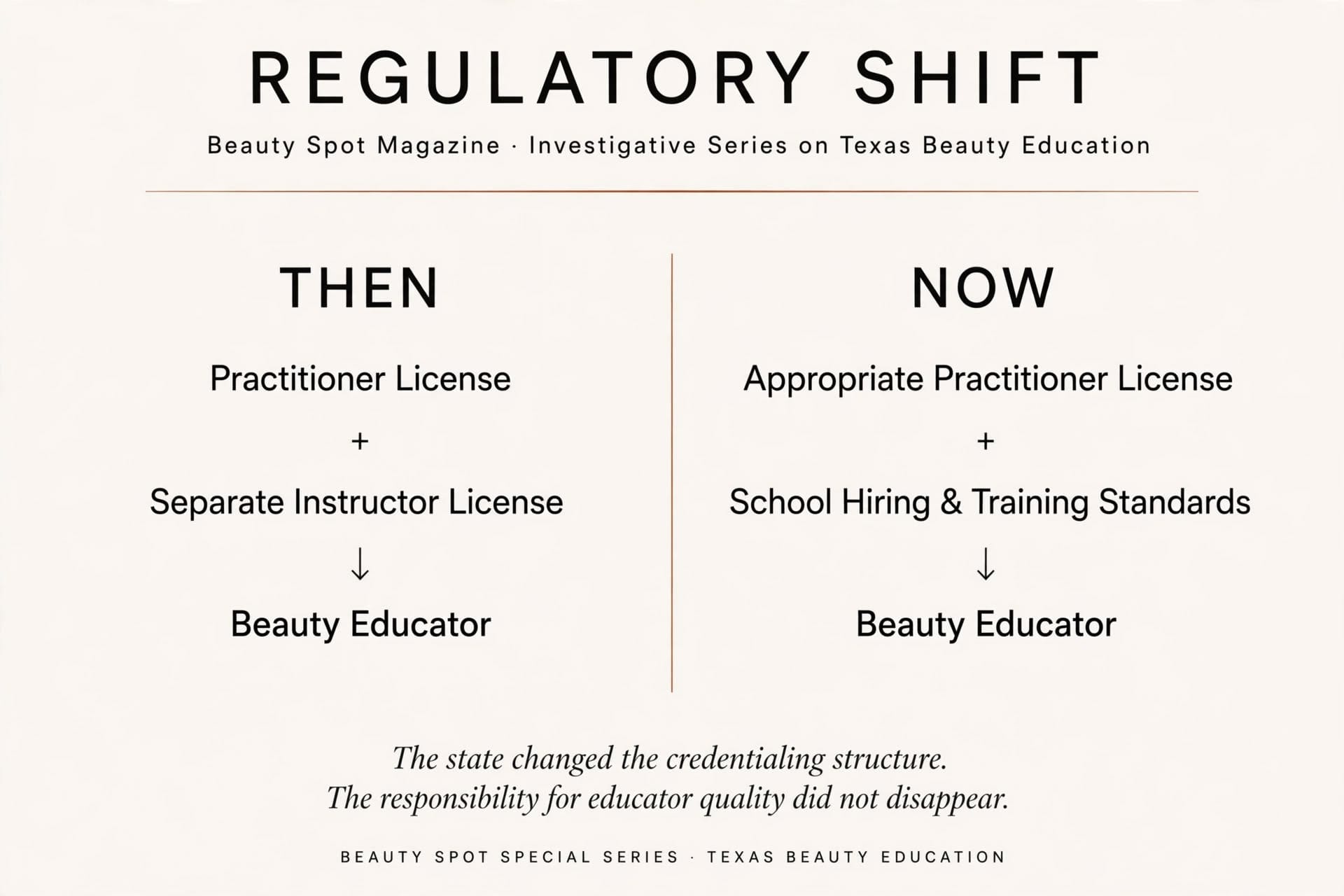
In 2021, House Bill 1560 reorganized the state’s barbering and cosmetology statutes, with major provisions taking effect September 1, 2021. Under the current framework, a separately licensed cosmetology instructor is no longer the gatekeeper to the classroom. Instead, a licensed barbering or cosmetology school may employ a person to teach a service when that person holds the appropriate practitioner license authorizing the acts being taught. In other words, Texas still requires the instructor to be licensed in the discipline being taught—but the state no longer requires a distinct instructor license layered on top of that practitioner credential.
That distinction matters.
Because the headline version—“Texas eliminated the cosmetology instructor license”—can sound as though the state simply stopped regulating who teaches beauty professionals.
That is not what the law says.
What Texas actually did was shift the regulatory model.
And what came next was a much larger question for beauty education:
If the state no longer separately licenses the skill of teaching, who is responsible for determining whether a practitioner is actually prepared to educate?
The answer, increasingly, is the school.
The Credential Disappeared. The Classroom Did Not.
Texas still regulates beauty schools.
A person cannot simply open a cosmetology or barbering school and begin enrolling students. A school must hold the appropriate state license, satisfy applicable financial-responsibility requirements, meet health and safety standards and comply with the larger regulatory structure governing barbering and cosmetology education.
The state also retained significant control over what those schools are expected to deliver.
Texas law requires schools to design course length and curriculum content so students can reasonably develop the job skills and knowledge necessary for employment. Course length and curriculum content must be submitted to the Texas Department of Licensing and Regulation for approval, and a school cannot simply implement a course outside that approval framework. Schools must teach both theory and practice in subjects necessary and beneficial to professional barbering and cosmetology.
There is also still an instructor-to-student requirement: a licensed school must have at least one instructor for every 25 students on the school premises.
So Texas did not erase the classroom.
It changed the qualification structure of the person leading it.
That difference is where the industry conversation becomes much more sophisticated.
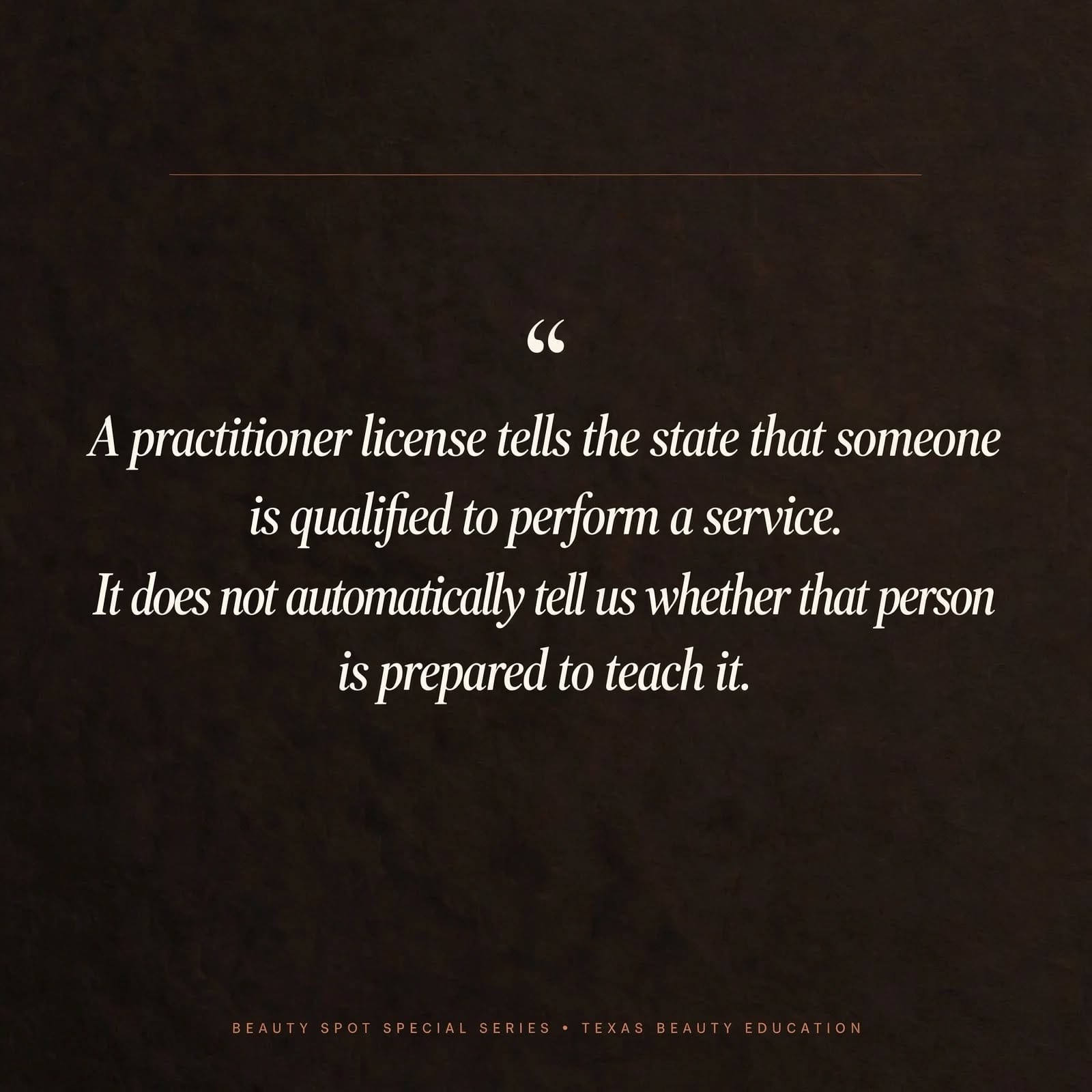
A practitioner license tells the state that someone has met the requirements to perform a regulated beauty service.
It does not, by itself, answer whether that person knows how to teach one.
Those are related competencies.
They are not identical.
Knowing how to perform a service and knowing how to build a professional who can perform it safely, consistently and intelligently are two different forms of expertise.
The Quiet Transfer of Responsibility
The elimination of a separate instructor credential effectively made institutional judgment more important.
Under the current statute, a school may employ an individual to teach barbering or cosmetology services when that individual holds the practitioner license necessary to perform the acts being taught. TDLR may take disciplinary or enforcement action when a school violates that requirement.
What the statute does not do in that provision is create a second state credential certifying that the practitioner has mastered pedagogy, curriculum delivery, student assessment or classroom management.
That means the school becomes the critical quality-control layer.
A sophisticated institution can respond by creating its own internal educator standards: minimum field experience, teaching demonstrations, mentorship periods, curriculum training, evaluation systems, continuing professional development and documented competencies before someone is trusted with a class.
A less sophisticated institution can potentially interpret “legally eligible to teach” as “fully prepared to teach.”
Those are not the same standard.
And that may be the most consequential change of all.
The state created a legal floor.
The market must decide how high the professional ceiling should be.
When Deregulation Meets a More Complicated Beauty Industry
The timing deserves attention.
Beauty education is not becoming simpler.
It is becoming more complex.
Modern students enter an industry shaped by ingredient literacy, advanced skin analysis, chemical exfoliation, professional devices, corrective skincare, scalp science, luxury service design, client psychology, social media marketing, independent contracting, suite ownership, infection control and an increasingly blurred cultural boundary between traditional esthetics and medical aesthetics.
That means an educator may be responsible for much more than demonstrating hand movements.
Students need to understand why a treatment is selected.
They need to know contraindications.
They need to distinguish marketing terminology from legal scope.
They need to recognize when a trend circulating online exceeds what their Texas license actually permits.
They need enough chemistry knowledge to understand what they are applying to skin, hair or nails.
And perhaps most importantly, they need to leave school understanding that education and legal authorization are not interchangeable.
Beauty Spot’s Texas legal framework makes that distinction central: being taught a procedure does not automatically mean a license authorizes a professional to perform it. Scope of practice remains the controlling issue.
That becomes especially important when advanced treatments are involved.
An educator who demonstrates a technique without teaching its regulatory boundaries can produce a student who is technically enthusiastic but professionally exposed.
That is not education.
That is information without context.
The New Question Is Not “Can You Teach?” It Is “Should You?”
This is the conversation beauty schools should be having internally.
The law may establish whether someone is eligible to provide instruction.
A school still has to decide whether that person is ready.
A newly licensed professional and a veteran practitioner may hold the same category of license. Their teaching readiness may be dramatically different.
Likewise, years in the field do not automatically create a strong educator. Some exceptional practitioners struggle to explain foundational concepts because so much of their own work has become instinctive. Others can reproduce a technique beautifully but cannot diagnose why a student continues to make the same error. Some know the service but not the current rules. Some know the rules but have not worked meaningfully in the modern market.
Teaching requires translation.
It requires being able to take tacit professional knowledge—the tiny decisions an experienced beauty professional makes almost automatically—and make those decisions visible to a beginner.
Why are you changing your pressure?
Why are you stopping here?
Why are you choosing this product?
Why is this client contraindicated?
Why does this service belong within scope while another crosses into a different professional territory?
Why did this treatment produce a different result on this skin condition?
Why is sanitation performed in this exact sequence?
A student cannot learn what an instructor cannot articulate.
And that is precisely why schools that view educator development as an operating expense rather than a strategic asset may eventually find themselves competing against schools that treat teaching quality as part of the brand.
Texas Still Regulates the Outcome Environment
There is another misconception worth correcting.
Eliminating a separate instructor license did not remove the surrounding obligations placed on schools.
Prospective students must receive specified information, including course outlines, tuition and fees, refund policies, grading policies, operational rules, TDLR complaint information and current job-placement and employment rates for students completing the course.
Schools must maintain daily attendance records, and those records may be inspected by the department.
Texas law also includes consumer protections for students when a private postsecondary barbering or cosmetology school closes, including mechanisms involving placement at another school or qualifying tuition reimbursement through the barbering and cosmetology school tuition protection account.
The state therefore still regulates the educational enterprise.
What changed is the credentialing architecture inside it.
And that makes the distinction between regulatory compliance and educational excellence more important than ever.
A school can ask, “Does this instructor satisfy the legal minimum?”
A serious education brand asks a second question:
“Would we trust this person to shape the professional judgment of the people carrying our name into the industry?”
Those are very different conversations.
What Happened Next? The Evidence Requires Precision.
There is a temptation in beauty-industry commentary to tell an easy story.
Instructor licenses disappeared.
Education declined.
Students became less prepared.
Experienced educators left.
Standards collapsed.
It makes a dramatic headline.
But the source material reviewed for this article does not establish those statewide causal conclusions.
The law clearly documents the structural change. It clearly establishes what schools, practitioners and instructors must now satisfy. It does not, by itself, prove that removing the separate instructor credential caused a measurable statewide decline—or improvement—in graduate competency, examination performance, employment outcomes, school complaints or student safety.
That distinction matters editorially.
A serious industry publication should not convert a regulatory change into a crisis narrative merely because the storyline feels plausible.
What can be said with confidence is more useful:
Texas moved from a state-issued instructor-credential model toward a system in which practitioner licensure and school-level responsibility play a larger role in determining who teaches.
The consequences of that structure depend heavily on what schools do with that responsibility.
That is the story beauty education should be watching.
The Schools That Win Will Build Their Own Standard
This is where deregulation can become either a weakness or an opportunity.
High-performing schools do not have to wait for the state to create a higher educator standard.
They can create one themselves.
Imagine an internal faculty pathway in which a prospective instructor must demonstrate current licensure, professional experience, technical competency, scope-of-practice knowledge, sanitation mastery, curriculum fluency, classroom communication and the ability to evaluate students objectively before leading a program independently.
Imagine new instructors shadowing senior educators before receiving their own classroom.
Imagine faculty meetings that function like clinical case conferences—not simply administrative check-ins—where instructors review recurring student weaknesses, industry changes, regulatory updates, ingredient developments and emerging service trends.
Imagine annual teaching evaluations that assess not only whether instructors completed the syllabus, but whether students can explain the reasoning behind the services they perform.
That is what mature beauty education can look like in a post-instructor-license environment.
Not less professionalization.
More intentional professionalization.
For School Owners, Education Quality Is Now Brand Equity
Luxury beauty has already learned this lesson on the client side.
Clients increasingly distinguish between someone who can perform a facial and someone who can interpret skin.
Between someone who owns an expensive device and someone who understands when not to use it.
Between a polished treatment room and a truly sophisticated provider.
Beauty education is moving through the same distinction.
Students are consumers making a significant investment of money, time and future earning potential.
A beautiful campus matters.
Social media matters.
Modern equipment matters.
But the intellectual quality of the faculty matters more.
When separate instructor licensure is no longer the primary external marker of teaching qualification, schools have an opportunity to make their internal faculty standards visible.
Who teaches here?
What professional experience do they bring?
How are instructors trained?
How often do they receive continuing education?
How does the school evaluate teaching quality?
How does the curriculum distinguish state licensing requirements from advanced education?
How does the institution prepare graduates for the business reality waiting outside the school door?
Those questions are not simply academic.
They are positioning.
The Risk of the “I Can Do It, So I Can Teach It” Era
Beauty has always had a strong apprenticeship culture.
That is one of its strengths.
Some of the best education in this industry happens when an experienced professional stands beside a developing one and says, “Look closer. Feel the tissue. Watch what happens here.”
But modern professional education also requires systems.
Without them, teaching can become personality-driven.
One educator teaches what she was taught 15 years ago.
Another teaches what is currently trending on social media.
Another teaches what she performs in her own business.
Another avoids a topic completely because she does not feel confident explaining it.
The student experiences all of those differences as “the curriculum.”
That inconsistency becomes more consequential when the industry is moving rapidly.
A school therefore needs more than talented practitioners.
It needs educational governance.
Curriculum maps.
Teaching standards.
Assessment rubrics.
Faculty onboarding.
Documented scope-of-practice education.
Regular legal review.
Clear distinctions between state-required education, optional advanced theory and procedures that may belong to another regulated profession.
The elimination of the instructor license did not remove the need for these systems.
It arguably made them more important.
For Educators, the Title Has to Mean Something Again
There is also an opportunity here for individual educators.
The disappearance of a state-issued instructor license does not mean the identity of “educator” has to become casual.
Quite the opposite.
In an environment where the government is no longer issuing a separate credential to distinguish instructor preparation, serious educators can differentiate themselves through demonstrable professional development.
Curriculum design.
Adult-learning principles.
Assessment.
Technical specialization.
Regulatory literacy.
Advanced ingredient knowledge.
Communication.
Mentorship.
Industry experience.
Continuing education.
Published work.
Leadership inside professional education.
The future authority of the beauty educator may be less about possessing one additional state credential and more about building a visible body of expertise.
That is not automatically better or worse than the previous system.
It is different.
And it places considerably more pressure on educators to establish credibility through substance rather than title alone.
The Texas Beauty Industry Should Be Asking Better Questions
Five years after the 2021 statutory restructuring took effect, the most important conversation is not nostalgia for a discontinued credential.
It is accountability.
What should instructor preparation look like now?
Should schools publish their faculty standards?
How much real-world professional experience should an educator have before leading students?
Should educator-development programs become a voluntary industry standard?
Are graduate outcomes meaningfully different between schools with formal internal teacher-development systems and those without them?
What do licensing examination results show?
What do student complaints show?
What do employment and placement data show?
What do employers say about graduate readiness?
Those questions can be measured.
And that is where the next phase of this story should go.
Because regulation tells us the minimum a system requires.
Data tells us what the system produces.
The Bigger Lesson
Texas did not eliminate the need for qualified beauty educators.
It eliminated one regulatory mechanism that had been used to identify them.
The current structure still requires licensed schools. It still requires instructors to hold the practitioner license appropriate to what they teach. It still regulates curricula, student information, attendance, school operations and instructor-to-student ratios.
But the professional question has moved beyond the license.
Who decides what makes an educator excellent?
Increasingly, the institution does.
The school owner does.
The education brand does.
And eventually, the student does.
For Texas beauty schools, that creates an unusually important moment. The absence of a separate instructor credential can become permission to operate at the minimum—or an invitation to build something considerably stronger.
The smartest schools will understand the difference.
Because in beauty education, the product is not the classroom.
It is not the kit.
It is not the mannequin, the treatment bed or the certificate handed across the stage.
The product is the professional who walks out the door.
And no regulatory restructuring changes the responsibility attached to that.