The Three Beauty Economies of San Antonio
“San Antonio doesn’t lack beauty professionals—it lacks the storefronts to support them.” Former Mayoral candidate, Christopher C. Herring

Where salons thrive, where they compete—and where they have yet to arrive
In a city as expansive and fast-growing as San Antonio, the beauty industry does not grow evenly. It clusters, it competes, and in some places, it lags behind the very workforce that sustains it.
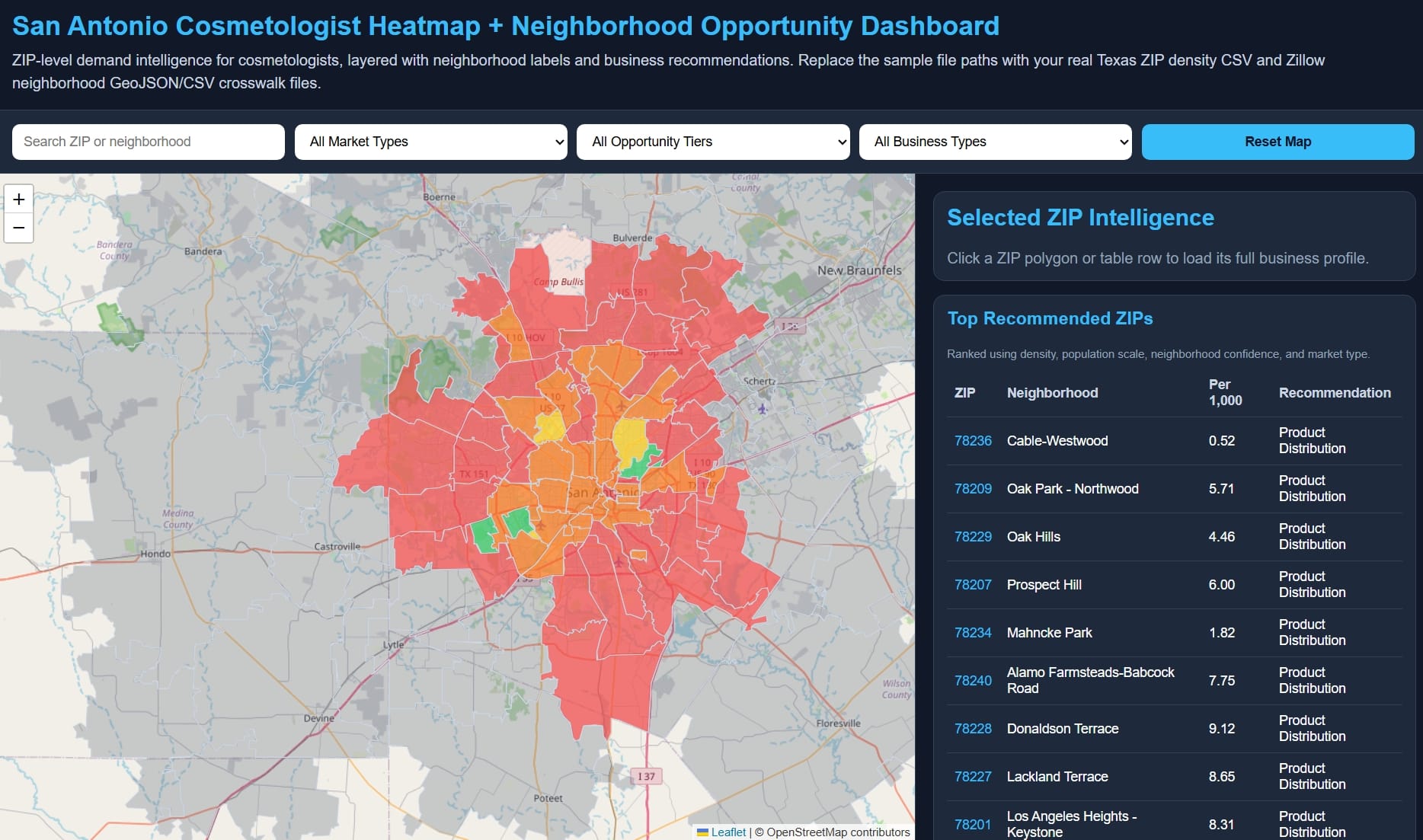
A new analysis of licensed cosmetologists and salon locations across the city by Consumer.info reveals a striking pattern: San Antonio is not one beauty market—it is three.
🔥 The Expansion Zones
Where the workforce exists—but the storefronts don’t
In pockets across the Northeast, West, and far North Side, entire communities are quietly operating with a surplus of licensed professionals and a shortage of physical salon spaces.
These ZIP codes include:
- 78260 — Timberwood Park and the far North corridor
- 78261 — Encino Park and the Bulverde Road expansion
- 78244 — Converse and the East Side growth corridor
- 78239 — Woodlake and Camelot II
- 78207 — Prospect Hill and the Near West Side
- 78242 — Valley Hi and the far West Side
- 78252 — the Southwest expansion corridor
In these neighborhoods, dozens—sometimes hundreds—of cosmetologists are concentrated in areas with relatively few salons. The imbalance suggests a workforce that is present, trained, and ready—but not fully supported by local infrastructure.
In places like Prospect Hill (78207), long known for its cultural identity and dense residential base, the data hints at a different kind of density: one of untapped economic potential.
Further north, in Timberwood Park (78260) and Encino Park (78261), population growth has outpaced the development of everyday services. Residents commute outward for work—and often for beauty services as well.
These are not empty markets. They are early-stage commercial opportunities, where the first well-positioned salon can establish deep roots.
🏆 The Prestige Corridors
Where beauty is already a business—and a brand
Elsewhere in the city, the beauty industry is not emerging—it is entrenched.
ZIP codes such as:
- 78232 — North Central San Antonio
- 78249 — the University and medical corridor
- 78253 — Alamo Ranch and the Far West Side
- 78250 — Braun Station and surrounding neighborhoods
- 78247 — Northeast suburban clusters
- 78251 — Westover Hills area
- 78228 — Woodlawn Lake vicinity
represent what can only be described as fully realized beauty ecosystems.
Here, salons are plentiful, competition is visible, and branding becomes essential. These are the corridors where:
- clients have options
- services are differentiated
- reputation carries weight
In areas like Alamo Ranch (78253), the numbers reflect both population growth and business response—new rooftops followed by new storefronts.
These are not underserved markets. They are high-functioning, high-competition environments, where success depends less on presence and more on positioning.
⚠️ The Quiet Markets
Where both workforce and storefronts remain limited
Then there are the quieter corners of the city—places where the beauty economy has yet to take hold in any meaningful way.
ZIP codes such as:
- 78202 — East Side historic neighborhoods
- 78204 — Southtown and surrounding areas
- 78215 — downtown-adjacent districts
- 78255 — the Hill Country edge near Helotes
- 78222 — Southeast San Antonio
show relatively low numbers of both cosmetologists and salons.
In some cases, like in Southtown (78204), the explanation may be transitional—an area shifting from industrial or historic roots toward redevelopment.
In others, like the Hill Country (78255), the issue may be geographic: larger properties, dispersed populations, and longer distances between commercial centers.
These are not necessarily failing markets. They are slow-forming or specialized markets, where timing and concept matter more than scale.

🧠 A City of Imbalance—and Opportunity
What emerges from the data is not a simple story of supply and demand, but of misalignment.
In several parts of San Antonio:
- the workforce exists
- the population is growing
- but the salon infrastructure lags behind
This is most visible in the expansion zones—places where cosmetologists may be:
- commuting to other ZIP codes
- working from home or mobile
- or competing for limited booth space
The implication is clear:
San Antonio’s beauty industry is not overbuilt—it is unevenly built.
💡 The Next Wave of Growth
If the past decade of development has been about expansion, the next may be about distribution.
The ZIP codes identified as expansion zones—Timberwood Park and the far North corridor (78260), Encino Park and the Bulverde Road expansion (78261), Valley Hi and the far West Side (78242), and the Southwest expansion corridor (78252), and others—represent the front line of that shift.
They are where:
- new salons can enter with less competition
- existing professionals can find local opportunities
- and communities can gain services that match their growth
✨ The Takeaway
San Antonio does not lack beauty professionals. It does not lack customers.
What it lacks—in specific, measurable places—is the connection between the two.
And in that gap lies the opportunity.
✍️ Author Bio
Christopher C. Herring is the Publisher of The Beauty Spot Magazine and President of Global Chamber San Antonio, Austin, and Houston. A data strategist, entrepreneur, and U.S. Air Force veteran, Herring specializes in transforming public data into actionable market intelligence.
With a background in business development, economic analysis, and community leadership, he has developed proprietary models that analyze local industries at the ZIP code level—identifying growth patterns, underserved markets, and investment opportunities.
Through The Beauty Spot Magazine, Herring is pioneering a new approach to the beauty industry—one that blends storytelling with data-driven insights to help professionals, entrepreneurs, and brands make smarter decisions about where to grow.
📊 Research & Data Credit
Research and Analysis by Christopher C. Herring
Publisher, The Beauty Spot Magazine
This report is based on an original analysis of:
- Licensed cosmetology professional data from the Texas Department of Licensing and Regulation
- Salon license records and ZIP code–level business data
- Population estimates from the U.S. Census Bureau (ACS 5-Year Estimates)
- Proprietary data modeling, including the Beauty Market Pressure Index (BMPI) developed by Christopher C. Herring
All findings, segmentation models, and rankings are part of an independent research initiative designed to map the beauty economy across San Antonio and Texas.
📊 Research Note
This analysis is based on licensed cosmetology and salon data from the Texas Department of Licensing and Regulation and population estimates from the U.S. Census Bureau, combined with proprietary modeling by The Beauty Spot Magazine.